Equity, Diversity and Inclusion Blueprint
Please use the buttons below to skip to that section.
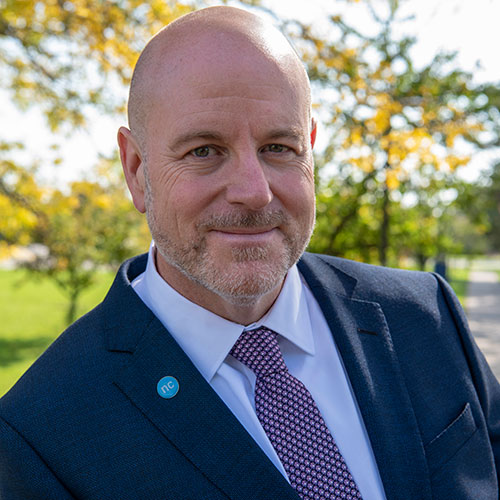
Welcome from NC President Sean Kennedy
Sean Kennedy
Niagara College President
Our College is strengthened by a diversity of experiences, backgrounds, and perspectives. Our NC community is one where all are welcomed and where respect for each other is of the utmost importance.
As we write the next chapter in our College’s history, NC’s Equity, Diversity and Inclusion (EDI) Blueprint is a tremendously important guide for our continuous efforts in support of a learning environment and workplace that is respectful, inclusive, and welcoming for all.
The EDI Blueprint is the product of a unique partnership between NC and the Niagara College Student Administrative Council (NCSAC) and is informed by the work of the Diversity and Inclusion Taskforce and broad consultations with our students, employees, and community. It reflects the voices of our community and is a framework of principles, goals and actions to guide and support our shared work towards being a more equitable, diverse, and inclusive College.
Like our Strategic Plan, the EDI Blueprint recognizes that as our students and employees evolve in their needs and goals, we evolve with them. It is a living document that will ensure our programs, services, physical spaces and policies are accessible and equitable and recognizes that NC is always engaged in a process of learning, unlearning, and continuous improvement.
The EDI Blueprint recognizes where we are, identifies what work is ongoing, and guides the improvements we continue to make as a College to recognize and address systemic barriers that limit opportunities for some individuals and groups.
I am pleased to acknowledge the many great strides taken by staff, faculty and students to date and I look forward to what we can accomplish together as we bolster the strong culture of inclusion and belonging that is so central to our NC identity.
Sean Kennedy
Sean Kennedy
Niagara College President
Message from the NC Student Administrative Council President
Sam Jemison
President, Niagara College Student Administrative Council
The Niagara College Student Administrative Council exists to enhance the student experience at Niagara College, and to amplify the voice of the students, bringing their perspectives, needs, and dreams into the conversations and decisions that impact them.
A major directive of NCSAC has been working hand-in-hand with Niagara College to develop and launch the NC Equity, Diversity, and Inclusion (EDI) Blueprint. Throughout the evolution of this EDI Blueprint, the student voice was always front and centre thanks to the tremendous efforts by the Diversity and Inclusion Taskforce. Through the D&I Taskforce, students representing diverse areas of the College took on key roles to guide the process and influence positive change at NC.
This blueprint is more than a simple document. It is a testament to continuous improvement and a commitment to ensure that all students are welcomed, included, and accepted – during every step of their NC journey. With this blueprint, we have a clear path and guide to help us challenge our ways of knowing and being so that we consider everyone from the NC community in all that we do, to ensure no one is left behind.
The result of tremendous collaboration between NC, our community, students, and NCSAC, the EDI Blueprint marks a key milestone in our quest to make sure everyone belongs at NC.
Sam Jemison

Sam Jemison
President, Niagara College Student Administrative Council
Background
In 2020, Niagara College and the Niagara College Student Administrative Council (NCSAC) created a Diversity and Inclusion Taskforce, with equal representation from employees and students. The taskforce worked collaboratively to create an Equity, Diversity, and Inclusion strategy, plan and conduct consultations across Niagara College, and provide feedback to shape the EDI blueprint.
Taskforce members set a shared vision and areas of focus. They also developed a clear plan for feedback from the college community.
We collected feedback through in-person consultations, virtual consultations, and a fully online survey.
We heard from 619 employees and students who shared their insights, experiences, and feedback to shape this blueprint.
The collective wisdom of our NC community is at the heart of this plan to ensure that Niagara College is a welcoming, respectful, and inclusive place to learn and to work.
This blueprint aligns with our mission and strategic plan (see: Niagara College 2022– 2027 Strategic Plan). It is a living document that guides us and that we will continue to revise through conversation and ongoing learning to guide us on our EDI journey.
Learn more about the creation of the EDI Blueprint
EDI Blueprint LaunchOur Blueprint Vision
A student-focused, trailblazing, passionate, and welcoming college committed to accessibility, equity, and inclusion, where all members of our diverse community are engaged, valued, and supported.
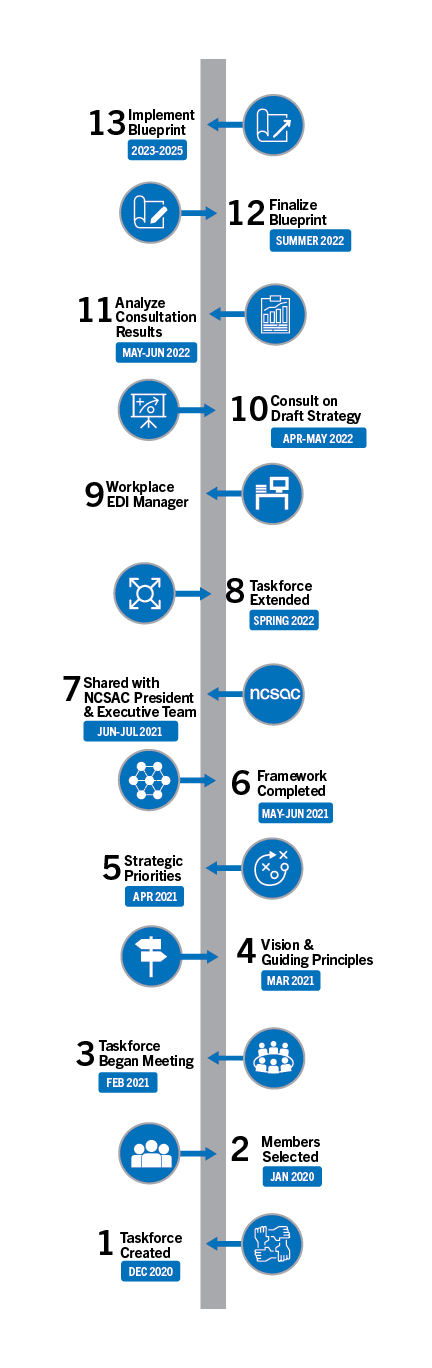
What We’ve Accomplished
- December 2020: Taskforce Created
- January 2020: Members Selected
- February 2021: Taskforce Began Meeting
- March 2021: Vision and Guiding Principles
- April 2021: Strategic Priorities
- May-June 2021: Framework Completed
- June-July 2021: Shared with NCSAC President and Executive Team
- Spring 2022: Taskforce Extended
- Workplace EDI Manager
- April-May 2022: Consult on Draft Strategy
- May-June 2022: Analyze Consultation Results
- Summer 2022: Finalize Blueprint
- 2023-2025: Implement Blueprint
Guiding Principles
Our collective success is strengthened when we advance opportunities for equity-deserving communities.
We focus on organizational change that leads to an equitable culture.
Our comprehensive approach to EDI includes the individual, departmental and organizational levels of Niagara College.
Our collaborative, sustainable and accessible EDI work creates trust and belonging.
We hold ourselves accountable by setting baseline metrics, targets and feedback loops.

Initiatives that directly support Indigenous students, employees, and/or communities will continue to be led by the Indigenous Education department in consultation with the IEMC and local Indigenous communities.
Areas of Focus
Based on feedback collected through the consultation process, four reciprocal and interconnected areas of focus emerged to shape the EDI Blueprint.
Indigenous Ways of Knowing, Being and Doing
Indigenous Ways of Knowing, Being, and Doing refers to shared elements of various Indigenous nations’ worldviews that focus on engaging the world in wholistic ways that account for physical, emotional, spiritual, and intellectual dimensions of experience.
Explore: Indigenous Ways of Knowing, Being and DoingStudent Experience

Student success is supported by a welcoming and inclusive college community where students have a sense of belonging and a safe space to learn.
Explore: Student Experience
Student Experience
Student success is supported by a welcoming and inclusive college community where students have a sense of belonging and a safe space to learn.
Explore: Student Experience
Employee Experience
Employees’ experiences are central to our success as an organization. The Niagara region, where most employees come from, and the college’s student body are becoming increasingly diverse.
Explore: Employee ExperienceOrganizational Culture and Structure
Our organizational culture is informed by and expressed in a variety of ways, including the conversations we prioritize, our professional relationships, physical environment, digital tools, policies, practices, and procedures.
Explore: Organizational Culture and Structure
Organizational Culture and Structure
Our organizational culture is informed by and expressed in a variety of ways, including the conversations we prioritize, our professional relationships, physical environment, digital tools, policies, practices, and procedures.
Explore: Organizational Culture and Structure
It recognizes interconnectedness among and between all living beings and the land. In postsecondary environments, this is supported through what Kirkness and Barnhardt call the four Rs: respect for the cultural integrity of Indigenous peoples, relevance of Indigenous perspectives and experience in education, reciprocal relationships between and among students and teachers, and responsibility for education through increased participation.
At Niagara College, the four Rs are encouraged through the work of Indigenous Education (IE) and the Indigenous Education Management Circle (IEMC). IEMC is a group with connections to Indigenous communities in the Niagara region, who act as a vehicle for community connection and a liaison point with Indigenous communities. The IEMC also provides advice to the Indigenous Education department, which supports Indigenous students through culturally appropriate teachings, academic guidance, leadership opportunities, community referrals, and assistance in navigating the college system.
A central part of IE and the IEMC’s mandate is to ensure that Indigenous students and employees are supported. Yet, everyone at NC shares a collective responsibility to work toward truth and reconciliation with Indigenous peoples and to support IE in meeting its mandate without taking over that work. IE and IEMC’s understanding of Indigenous ways of knowing, being, and doing must be centered in all Indigenous initiatives at NC, even as we acknowledge that every person and department at NC has a role to play in supporting truth and reconciliation.
Goals and Actions
Create conditions where Indigenous ways of knowing, being, and doing are woven into the College’s curricular and co-curricular learning environment.
Status: To be started by 2025
- We will hire an Indigenous curriculum consultant and develop college-wide Indigenous learning outcomes to guide academic departments to incorporate Indigenous ways of knowing, being, and doing into the curriculum.
- We will identify and implement opportunities for IE to contribute to learning initiatives, including in-class, at the Indigenous gardens, and through adoption of learning modules about Indigenous ways of knowing, being and doing.
VP Champions:
- Vice President, Students
- Vice President, Academic
Implement the Colleges and Institutes Canada (CICan) Indigenous Education Protocol, TRC Calls to Action, and the Indigenous Peoples Education Circle Action Plan (IPECAP).
Status: To be started by 2025
- We will create a report card for Niagara College to identify strengths and areas for growth related to the TRC Calls to Action, CICan Protocols and IPEC AP.
- We will be guided by the IPEC action plan to develop a localized Niagara College action plan.
VP Champion:
- Vice President, Students
Review the Truth and Reconciliation Commission’s 94 Calls to Action to identify items that the college can act on within the next three years.
Status: In Progress
- We will increase awareness of, and opportunities to learn about, Indigenous histories, presents, and futures through college-wide events that celebrate Indigenous cultures; planned activities that increase representation of Indigenous peoples across the college environment; and communications about Indigenous initiatives at the college and within the community.
- We will increase cultural competence of non-Indigenous employees and students through training and resources about cultural respect and safety, as well as ways to contribute to a culture where Indigenous students and colleagues can thrive.
VP Champion:
- Vice President, Students
Examples of Implementation:
Continue to build relationships with and maintain accountability to Indigenous communities within Niagara College and partner organizations through dialogue and consultation using the principles of the Guswenta Two Row Wampum.
Status: In Progress
- We will develop best practices to inform working with IE, IEMC, and Indigenous communities on initiatives and events.
- We will establish resources to support Indigenous students and employees to thrive at Niagara College through recruitment, hiring, programming, growth, and promotion practices.
VP Champion:
- Vice President, Students
EDI Catalysts:
- Tallulah Williams
- Baljit Bhamber
- Maija Saari
- Tina Annett
- Carol Phillips
- Bellan Dye
Embedding equity, diversity, and inclusion into all policies, practices, procedures, and programming at Niagara College will lead to meaningful organizational change, supporting a culture where all members of our community experience a sense of belonging. Strategies to increase awareness and understanding of equity, diversity, and inclusion will also reinforce our shared responsibility in maintaining and enhancing our welcoming and inclusive culture.
Goals and Actions
Create a welcoming and inclusive space to learn and work, where everyone feels a sense of belonging.
Status: In Progress
- We will reinforce our commitment to EDI through increased representation across physical and digital spaces, including through artwork by Indigenous and racialized artists, updated pride crosswalks, and use of gender-neutral and accessible language on all signs and forms.
- We will ensure regular and ongoing recognition of days of significance through a shared calendar, communications, and college-wide events.
VP Champions:
- Senior Vice President, College Operations
- Vice President, Advancement
EDI Catalysts:
- Tharshiha Nagasivakumaran
- Brooke Pasco
Examples of Implementation:
Build and strengthen connections both within Niagara College and with partner organizations.
Status: In Progress
- We will consolidate and coordinate feedback from external members of equity-deserving communities to develop inclusive resources and events at the College.
- We will identify and implement opportunities to learn from partner organizations through intentional partnerships.
VP Champions:
- Vice President, Research, Innovation & Strategic Enterprises
- Vice President, Advancement
EDI Catalysts:
- Emily O’Connor
- Mabel Watt
Examples of Implementation:
Develop regular, accessible, and ongoing EDI communications and feedback mechanisms.
Status: In Progress
- We will maintain consistent communication structures about resources, training, events, future initiatives, and progress.
- We will create multiple avenues for students and employees to share feedback and concerns, including online forms, transparent complaints processes, and regular pulse surveys.
VP Champions:
- Vice President, Students
- Vice President, Advancement
EDI Catalysts:
- Brooke Pasco
- Shelby VanderEnde
- Jacob Bernatz
Examples of Implementation:
Review college policies, practices, procedures, and programming to improve equity, diversity, and inclusion.
Status: In Progress
- We will audit college services, physical spaces, and digital tools with input from members of equity-deserving communities, including feedback on aspects of culture, including food options, washroom spaces, ramps, hallways, celebrations, Learning Management System, online forms, MS Office Suite.
- We will develop an EDI assessment approach to examine college policies, procedures, and academic programs.
VP Champions:
- Senior Vice President, College Operations
- Vice President, Academic
EDI Catalysts:
- Lucia Nigro
- Nazanin Nadri
- Katie McQuestion
- Taryn Wilkinson
Examples of Implementation:
As Niagara College’s student body becomes increasingly diverse, we recognize the need for our services to be enhanced by focusing on supporting the whole student and acknowledging their diverse experiences and needs. In this context, it will be important to enhance students’ experience at Niagara College by increasing accessible and ongoing opportunities to engage in dialogue and provide feedback on initiatives.
Goals and Actions
Increase awareness about the mandates of and access to specific student services among students and anyone in a student-facing role.
Status: To be started by 2025
- We will develop and distribute accessible resources to clarify services provided by all departments in Student Affairs and International.
- We will ensure consistent application of practices, processes, and responsibilities related to letters of accommodation.
VP Champions:
- Vice President, International
- Vice President, Academic
EDI Catalysts:
- Jessica Berecz
Develop additional initiatives and activities to support students’ sense of belonging.
Status: In Progress
- We will expand communication about co-curricular opportunities and informal events and activities for students.
- We will increase EDI learning opportunities (e.g., safe space, cultural humility, bystander intervention, student rights and responsibilities, and allyship training) and include these as part of student orientation and co-curricular experiences.
VP Champions:
- Vice President, Students
EDI Catalysts:
- Ali Ryder
Examples of Implementation:
Bridge the gap between domestic and international student services, communications, and experiences to increase interaction and cultural sharing among domestic and international students.
Status: In Progress
- We will share communications, initiatives, and events related to days of significance with both domestic and international students.
- We will review and compare domestic and international student policies, practices, and procedures to develop and communicate the rationale and purpose for tailored services.
VP Champions:
- Vice President, International
- Vice President, Students
EDI Catalysts:
- Alyssa Milana
- Leigh Cunningham
- Shawna Luey
Examples of Implementation:
Develop and enhance consistent structures to support students from equity-deserving communities.
Status: In Progress
- We will continue to review accessibility of academic programming to provide flexibility for students with varying life circumstances.
- We will increase awareness of and offer EDI resources to partner organizations and employers hosting NC students for placements, internships and co-op employment opportunities, particularly as it relates to students from equity-deserving communities.
VP Champions:
- Vice President, Students
- Vice President, Academic
EDI Catalysts:
- Yiching Chua
- Elaine Burgess
Examples of Implementation:
The Niagara region, where most employees come from, and the college’s student body are becoming increasingly diverse. In this context, it is important to ensure that our employee body represents this increasing diversity. We also need to assess recruitment, hiring, and other workplace policies and practices to support the success of employees from equity-deserving communities. Doing so requires that we provide all employees across the college with learning and development opportunities that support inclusion and belonging.
Goals and Actions
Develop and implement learning opportunities for employees in principles of EDI and allyship.
Status: In Progress
- We will make self-directed and self-paced resources available for employees at all levels of the organization to identify and understand current terminology, days of significance, and best practices related to EDI.
- We will deliver training related to key workplace EDI topics, such as anti-bias, microaggressions, allyship, bystander intervention, and inclusive leadership.
VP Champions:
- Senior Vice President, College Operations
EDI Catalysts:
- Centre for Organizational Excellence (COE)
- Centre for Academic Excellence (CAE)
- Jill Cook
Examples of Implementation:
Increase participation from, support for, and advancement of members of equity-deserving communities.
Status: In Progress
- We will review and clarify employee demographics, recruitment and hiring, workplace policies and procedures, and recognition practices using EDI principles to invite participation from and create safety for members of equity-deserving communities.
- We will support employees from equity-deserving communities through access to mentoring and communities of practice.
VP Champions:
- Senior Vice President, College Operations
EDI Catalysts:
- Human Resources (HR)
- Centre for Organizational Excellence (COE)
- Debbie-Ann Fender
Offer ongoing EDI-focused support in curriculum development and program review.
Status: In Progress
- We will expand resources and learning opportunities for employees within academic departments that highlight how learning outcomes, assessments, and rubrics contribute to EDI in the classroom.
- We will leverage existing resources, such as the NC Accessibility Hub and expand opportunities for employees within academic departments to apply universal design principles and implement student Letters of Accommodations.
VP Champions:
- Vice President, Academic
EDI Catalysts:
- Matt Sajn
Enhance support for EDI across Niagara College.
Status: In Progress
- We will provide a range of resources and structures that allow individuals as well as teams to try practices that contribute to EDI across the college, including access to an EDI fund, dedicated time for learning, EDI-specific recognition events.
- We will support employee engagement in EDI-focused events by addressing barriers to participation, offering ongoing opportunities to share experiences, and ensuring enough notice to participate in events.
VP Champions:
- Senior Vice President, College Operations
EDI Catalysts:
- Jessica Strite
Terms and Phrases
Language and terminology related to equity, diversity, and inclusion sometimes changes as new ways of thinking about and doing things emerge. To support readers of this blueprint, we have included a list of current terms and concepts that are useful to understand our Niagara College community continues to embark on this journey toward inclusion and belonging. Please visit the EDI Glossary page for a list of Terms and Definitions.
Further Reading
In addition to the below resources, please visit niagaracollege.ca/edi/learn/ for more information about EDI.
- Colleges and Institutes Canada. 2014. Indigenous Education Protocol for Colleges and Institutes. Accessed August 25, 2022 at https://www.collegesinstitutes.ca/policyfocus/indigenous-learners/protocol/
- Crenshaw, K. 1991. Mapping the Margins: Intersectionality, Identity Politics, and Violence against Women of Color. Stanford Law Review, 43(6), 1241-1299.
- Gibbard, R., Desormeaux, M., Persaud, M., and Wright, R. 2018 (Feb 23). The Business Case to Build Physically Accessible Environments. The Conference Board of Canada.
- Government of Canada. 2019. Dimensions: equity, diversity and inclusion. Accessed August 25, 2022, http://www.nserc-crsng.gc.ca/NSERC-CRSNG/EDI-EDI/Dimensions-Charter_Dimensions-Charte_eng.asp
- Henry, F, Enakshi D, James, C.E, Kobayashi, A, Li, P, Ramos H, and Smith, MS. 2017. The Equity Myth: Racialization and Indigeneity at Canadian Universities. UBC Press: Vancouver, BC.
- Kirkness, V. J. and R. Barnhardt. 2001. First Nations and Higher Education: The Four R’s – Respect, Relevance, Reciprocity, Responsibility. Knowledge Across Cultures: A Contribution to Dialogue Among Civilizations. R. Hayoe and J. Pan. Hong Kong, Comparative Education Research Centre, The University of Hong Kong.
- Miller, F.A. and Katz, J.H. 2002. The Inclusion Breakthrough. Barrett-Koelher Publishers: California.
- Policy on Accessible Education for Students with Disabilities, Ontario Human Rights Commission, March 2018.
- Truth and Reconciliation Commission of Canada. 2015. Honouring the truth, reconciling for the future: summary of the final report of the Truth and Reconciliation Commission of Canada. Accessed August 25, 2022, https://nctr.ca/records/reports/#trc-reports
- Truth and Reconciliation Commission of Canada. 2015. Calls to Action. Accessed August 25, 2022, https://nctr.ca/records/reports/#trc-reports
- Tuck, E. and Yang, KY. 2012. Decolonization if not a metaphor. Decolonization: Indigeneity, Education, Society 1(1): 1-40.
- Williams, D.A., Berger, J.B., & McClendon, S.A., 2005. Toward a model of inclusive excellence and change in postsecondary institutions. Washington, D.C.: Association of American Colleges and Universities.
Friendly NC staff are here to answer your questions. Chat with us, or contact us via email or phone.
Contact Us