
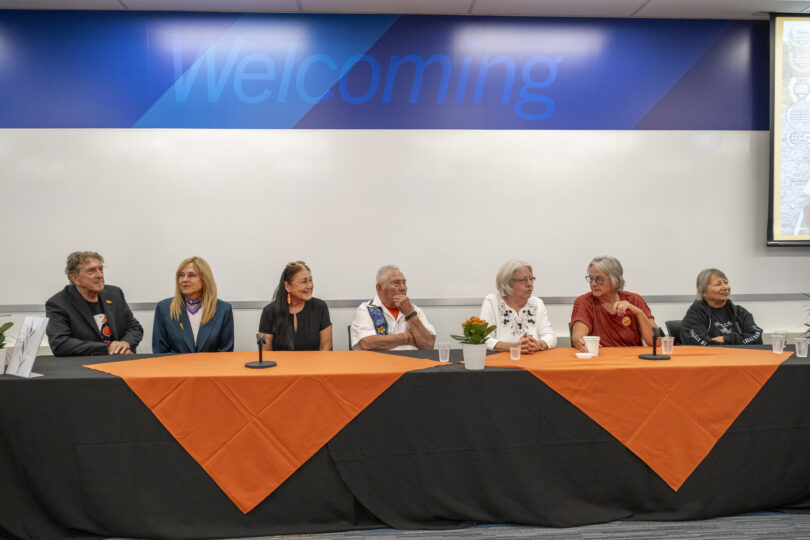
Every year on Sept. 30, the National Day for Truth and Reconciliation is recognized as a day when Indigenous and non-Indigenous peoples across the country recognize and commemorate the harmful legacy of residential schools, and honour victims, survivors, their families and affected communities. This year, Niagara College honoured this important day by connecting with survivors of the Residential school system and by sharing their stories.

NC President Sean Kennedy delivered a land acknowledgement before the film screening and panel discussion.
On Sept. 26, Niagara College welcomed five survivors of the Mohawk Institute, Canada’s first and longest running residential school, for a special screening of the documentary “The Nature of Healing,” – an honest retelling of the injustices suffered by seven victims of the Mohawk Institute and how they are working to heal the generational trauma experienced by their families and communities.
Following the screening of the film, survivors Dawn Hill, Roberta Hill, John Elliott, Diane Hill and Sherlene Bomberry along with the film’s Director, Faith Howe, and Executive Producer, Michael Howe joined NC’s Director, Equity, Diversity, Inclusion and Accessibility, Samah Sabra for a panel discussion about their experiences at the Mohawk Institute.
“I’m very happy and proud to be here and to be a survivor of genocide and ethnic cleansing,” said survivor Dianne Hill. “I want to honour you and thank you for taking the time to be here tonight, for taking the time to listen, taking the time to watch the documentary and for taking the time to learn.”
Organized by NC’s Indigenous Education team, in partnership with the Equity, Diversity and Inclusion team, and Community Relations and Events, the event highlighted the importance of preserving this history and the responsibility of all Canadians to educate themselves about residential schools and our nations commitment to Truth and Reconciliation.
“You can only help somebody when you’ve done the work yourself” said survivor Sherlene Bomberry. “Do your own research and listen to the truth, learn from survivors and debrief afterwards. Talk about it and share the history.”
The Nature of Healing Curriculum
As the first postsecondary institution to secure a licensing agreement for The Nature of Healing, Niagara College has developed a wrap-around curriculum intended to accompany the film.
“This type of curriculum has been a long time coming and now we have the opportunity to share how this history affects all nations across Canada,” shared survivor Dawn Hill. “Even though the film focuses on us, you can assume that most places (residential schools) caused the same kind of trauma, and this curriculum will allow you to walk others through this history.”
Led by NC’s Indigenous Education Cultural Advisor, Karl Dockstader and School of Academic and Liberal Studies Professor, Jamie Oresar, and created in partnership with Mac Orlando and Joyce Jonathan-Crone – who’s writing was sponsored by the Hadiya’dagénhahs First Nations, Métis, and Inuit Student Centre and the Office of Indigenous Education at Brock University – this new curriculum will guide faculty through the teaching process to ensure students feel supported as they tackle the important issues in the film.
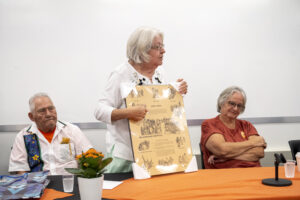
Grandmother Dawn Hill presents NC with a plaque depicting traditional Indigenous dances.
“This curriculum was designed in a holistic way,” shared Sabra. “This process has been guided by the insights and truths shared by survivors as well as consultations with faculty. The team was cognizant of our responsibility to preserve the truth and honesty of the film while ensuring that it is taught in a thoughtful and impactful way.”
Mohawk Village Memorial Park
The event also highlighted the Mohawk Village Memorial Park initiative. The creation of the park is a survivor-led initiative in honour of the students who attended the former Mohawk Institute Residential School.
During the month of October, when you donate to the Mohawk Village Memorial Park initiative, you will gain access to view The Nature of Healing on vimeo. To make a donation, visit the Park donation page.
In addition to the film screening and panel discussion, NC hosted a number of on-campus events and initiatives in support of Truth and Reconciliation. For a full list of events that took place, please read the InsideNC article.
To further underscore the College’s strategic commitments to student success and equity and inclusion, and commitments to the Calls to Action of the Truth and Reconciliation Commission, NC also announced the Strong Students, Stronger Futures Scholarship, a first-of-its-kind scholarship for eligible First Nations students that covers tuition and ancillary fees.
Supports
As we discuss truth and reconciliation, this can be a particularly difficult time for Indigenous students and employees. Know that your college community supports you and that there are resources in place to assist.
A list of residential school survivor supports is available on the Indigenous Education website, including the National Indian Residential School Crisis Line at 1-866-925-4419.
Student supports are also available through Health, Wellness & Accessibility Services, including NC’s Indigenous Counsellor, who is available to support students’ mental wellness needs.
Staff and faculty are encouraged to access the Employee and Family Assistance Program.
