Area of Focus: Climate Action and Leadership
This area of focus outlines several core priorities, with goals and targets associated with each priority. These can be found in the Goals and Targets section below. The Actions table lists the actions that we plan to take to achieve our goals and targets. Every action in the actions table has additional information associated with it that connects that action to sustainability efforts. Scroll down to begin exploring this Area of Focus, or use the menu below to jump to a specific section.
Jump to:
Goals and Targets
Core Priority: Carbon Emissions
- Goal 12.1 Work towards achieving net zero carbon emissions by 2050 in line with the Paris Agreement and the International Panel on Climate Change.
Core Priority: Procurement
- Goal 13.1 Increase sustainability in procurement processes to align with the Ontario College’s Purchasing Managers Association (OCPMA) Sustainable Procurement Program.
- Target 13.1a Increase the overall score of OCPMA Sustainable Procurement Program Assessment by 20%.
Core Priority: Governance
- Goal 14.1 Support opportunities for Niagara College as an institution to commit or pledge to sustainability and climate action and maintain current commitments.
- Target 14.1a Prioritize sustainability and climate change in institutional policies, plans, and decisions.
As a country, we are heading in the net-zero direction. As a sector, colleges and institutes are standing out. They are ensuring that industries, skills, learners, and the economy are better equipped to face the challenges of the future, and there is no future without net-zero.
Did You Know?
Sacred Earth Solar, Indigenous Climate Action, and Power to the People collaboratively created the Just Transition Guide, which takes you on a journey into the lived experiences of Indigenous communities across Turtle Island who have faced centuries of colonial oppression, yet continue to act as leaders in the protection of Mother Earth.
— Produced by Real World Media, and the David Suzuki Foundation
SDGs in Action: SDG4, SDG17
In September 2021, Niagara Regional Council declared a climate change emergency.
— Niagara Region Climate Change
SDGs in Action: SDG13
The 2022 International Panel on Climate Change (IPCC) clearly states with a very high confidence that the cumulative scientific evidence is unequivocal, climate change is a threat to human well–being and planetary health. Any further delay in concerted anticipatory global action on adaptation and mitigation will miss a brief and rapidly closing window of opportunity to secure a liveable and sustainable future for all.
— IPCC 6th Assessment Report 2022
SDGs in Action: SDG11, SDG13, SDG17
Actions
Tap and drag on table (mobile) or use horizontal scrollbar below the table (laptop) to view the full width of the table below.
| Action | Connected Priorities | Timeline | Lead | STARS in Action | SDGs in Action | Greening TVET in Action |
|---|---|---|---|---|---|---|
| Complete a comprehensive Scope 3 carbon emissions inventory, including on-site carbon sequestration | Carbon Emissions | Short-Term | Sustainability, Facilities | Operations (OP 1, OP2, OP 5) | 13 | Campus |
| Complete an institution-wide climate change adaptation risk assessment | Carbon Emissions | Long-Term | Sustainability, Facilities | Operations (OP 6) | 11, 13 | Campus |
| Conduct Product Lifecycle Assessments on NC produced products, including honey, wine, beer, spirits, and plants. | Carbon Emissions | Medium-Term | Sustainability, Facilities | Operations (OP 2) | 12, 13 | Campus, Curriculum |
| Develop a sustainability assessment approach to examine all college policies, and procedures | Governance | Long-Term | Sustainability, Centre for Organizational Excellence | Planning & Administration (PA 1) | 11 | Campus, Culture |
| Develop and distribute sustainable event guidelines | Procurement | Short-Term | Sustainability | Operations (OP 11) | 12 | Campus, Culture |
| Develop sustainable procurement guidelines for different purchasing categories including promotional materials, furniture, capital construction and renovations, and more. | Procurement | Medium-Term | Sustainability, Financial Services | Operations (OP 11) | 9, 12, 13 | Campus, Culture |
| Establish a standard for high quality carbon offsets that can be used to support the decarbonization plan. | Carbon Emissions, Procurement | Medium-Term | Sustainability, Procurement | Operations (OP 2) | 11, 13 | Campus |
| Establish a sustainable procurement roadmap to increase sustainability in procurement, incorporating environmental impact assessments and lifecycle costing analysis to support the circular economy | Procurement | Short-Term | Sustainability, Financial Services | Operations (OP 11) | 9, 12, 13 | Campus |
| Evaluate fuel efficiency when purchasing new fleet vehicles, or other travel (car rental, train, bus, flights) on College business | Carbon Emissions, Procurement | Medium-Term | Sustainability, Facilities | Operations (OP 15) | 7, 13 | Campus |
| Conduct a living wage assessment | Governance | Medium-Term | Human Resources | Planning & Administration (PA 12) | 8, 10 | Campus, Culture |
| Publish a comprehensive decarbonization plan, to support Niagara College’s transition to a low carbon economy3 | Carbon Emissions | Short-Term | Planning, Sustainability, Capital Projects | Operations (OP 1) | 7, 9, 13 | Campus |
| Establish a governance process to evaluate and approve sustainable building standards for all new buildings and deep retrofits. | Governance, Carbon Emissions | Short-Term | Planning, Sustainability, Capital Projects | Operations (OP 1) | 3, 6, 7, 9, 11, 12 | Campus |
Message of Support
It is with great pride that we launch the 2024-2029 Sustainability Plan to deepen our commitment and longstanding focus on sustainability.
At Niagara College, we help learners achieve their dreams and in so doing, we are also preparing our learners to be global citizens and stewards of our world. We have a responsibility to model a commitment to sustainability to our students to show how they too can make a difference.
As we engage in the work of our Master Plan to envision the future of our campuses, sustainability, accessibility, and inclusion are top of mind. We continue to ask: How we can operate in more equitable and environmentally sustainable ways?
From our buildings and facilities to how we procure products, learning materials, supplies and equipment, to forging new and strengthening existing community partnerships, we are focused on being leaders in climate action.
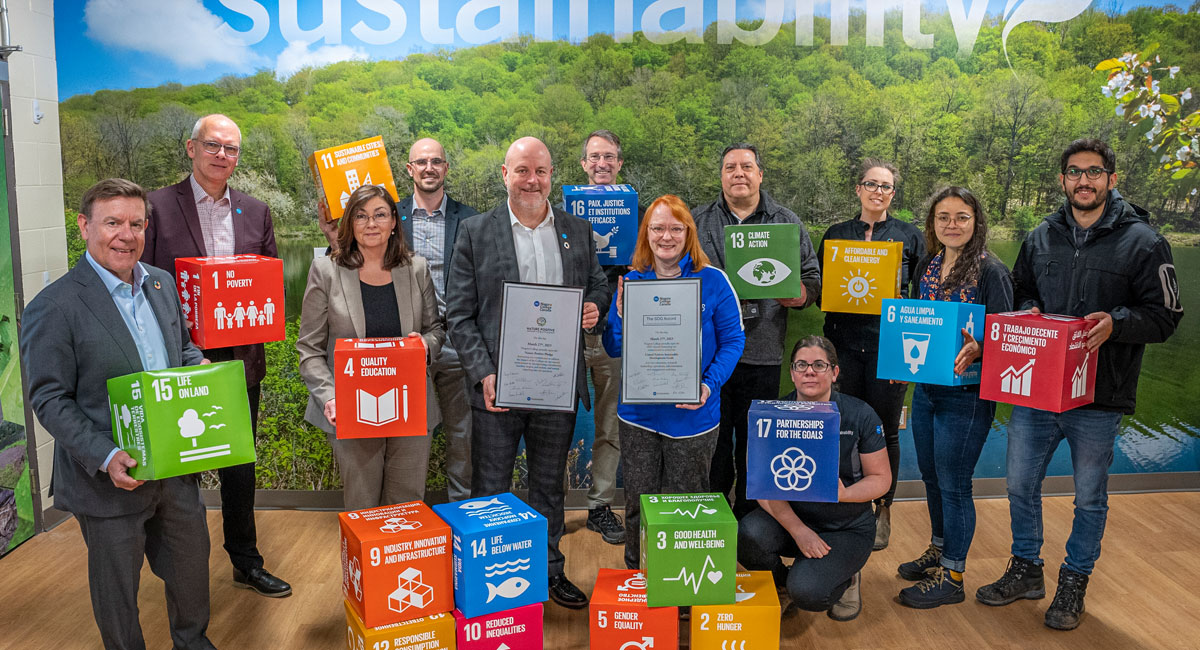
In 2023, the College signed the SDG Accord, elevating our determination to implement the United Nations Sustainable Development Goals at an institutional level. This work is a college-wide endeavor supported by our Sustainability Office, and as the Sustainable Development Goals are already being woven into academic programs, social activities, global activities and more, we are seeing tangible benefits.
Our Plan will advance our capacity for this important work, ensuring our community of students and employees can learn about how we can make a difference, individually and collectively.
Stories
Transitioning landscaping equipment to electric
The School of Environment & Horticulture Studies has started to transition key pieces of landscaping equipment, such as mowers, chainsaws, hedge trimmers, line trimmers and Gators, from gas powered to electric, which contributes to reducing carbon emissions and noise pollution on campus.
SDGs in Action: SDG7, SDG13
Sharing through the SAGE Program
Niagara College is sharing sustainability expertise with Caribbean partners through the Skills to Access the Green Economy (SAGE) program to expand its global reach and support climate-related sectors to meet regional economic and environmental demands.
SDGs in Action: SDG4, SDG12, SDG16, SDG17
Niagara College installs new electric vehicle charging stations
In 2022, six new electric vehicle charging stations were installed at the Welland Campus, in addition to the 14 EV stations at the Daniel J. Patterson campus. The new chargers were made possible through investment by the College, grant funding from Green Economy Canada, and support from NCSAC in partnership with the STEC fund. Charging is free for students, making the charging process more accessible and supporting their decision to reduce their carbon footprint.
SDGs in Action: SDG7, SDG12
References
1 Scope 3 activities included are business travel, and electricity transportation and distribution loss. Additional scope 3 activities will be identified in Target 12.1a. Reduce absolute carbon emissions by 50% in tCO2e for Scope 1 & Scope 2 and limited Scope 3 activities from baseline 2011, including waste management, student and employee commuting, embodied energy and carbon emissions in buildings and vehicles, and embodied energy and carbon emissions in purchased materials and services. Scope 3 – Scope 3 are indirect emissions that are not covered by Scope 1 and Scope 2. Currently, Niagara College, in alignment with other higher education institutions is assessing the indirect emissions that result within the boundaries determined to be under the responsibility of Niagara College in accordance with best practices, including the GHG Protocol – Corporate Value Chain (Scope 3) Accounting and Reporting Standard (2011).
2 Identified as one of the sustainability metrics for the Niagara College Board of Governors annual reporting.
3 A costed plan that outlines how a building will leverage natural intervention points and adapt over time to remove combustion from building operations. Having a transition plan and models to scenario plan and provide a clear but flexible plan of action, and helps ensure that future building improvements, planned or otherwise, work towards the goal of zero carbon emissions. CICan ImpAct Climate Report
Goals and Targets
- Each Area of Focus outlined above identifies several Core Priorities.
- Goals and Targets are associated with each Core Priority.
Actions
- Actions will help us achieve our Goals and Targets and are provided in an Actions table.
- Multiple Actions are associated with each Core Priority.
Actions Tables
Every Action has columns of additional information that connects that Action to sustainability efforts. These columns of information are explained below.
Connected Priorities
Connected Priorities identify the Core Priorities this action impacts to help illustrate the interconnection of single actions.
Timeline
Timeline outlines the approximate time frame it will take to implement this action. The timelines are defined as:
- Short-term: 1-2 years
- Medium-term: 3-5 years
- Long-term: 5+ years
Lead
Lead identifies the Niagara College Departments and Schools that will provide leadership to support the implementation of this action, with the support from respective Directors, and Executive Team members. The success of these actions is a combined effort between all members of the Niagara College community. We need to collectively work together to support the Leads directly and indirectly.
STARS in Action
STARS in Action identifies the Sustainability Tracking, Assessment & Rating System (STARS) credits from the Association for the Advancement of Sustainability in Higher Education (AASHE) that Action aligns with.
SDGs in Action
SDGs in Action identify the United Nations Sustainable Development Goals that this Action positively impacts. Learn more about how NC is impacting the SDGs.
GTVET in Action
GTVET in Action identifies the Greening Technical Vocational Education and Training (GTVET) Dimensions of Greening that each Action aligns with.
The United Nations Sustainable Development Goals (SDGs) are the layout to achieve a better and more sustainable future for all by 2030. Learn more about SDGs and access a learning module on the Sustainability website.
The 17 Sustainable Development Goals (SDGs) are:
- No Poverty
- Zero Hunger
- Good Health and Well-Being
- Quality Education
- Gender Equality
- Clean Water and Sanitation
- Affordable and Clean Energy
- Decent Work and Economic Growth
- Industry, Innovation and Infrastructure
- Reduced Inequalities
- Sustainable Cities and Communities
- Responsible Consumption and Production
- Climate Action
- Life Below Water
- Life on Land
- Peace, Justice and Strong Institutions
- Partnerships for the Goals