Area of Focus: Learning
This area of focus outlines several core priorities, with goals and targets associated with each priority. These can be found in the Goals and Targets section below. The Actions table lists the actions that we plan to take to achieve our goals and targets. Every action in the actions table has additional information associated with it that connects that action to sustainability efforts. Scroll down to begin exploring this Area of Focus, or use the menu below to jump to a specific section.
Jump to:
Message of Support
We know our learners are seeking out educational institutions that are leaders in sustainability and are no longer arriving at NC with the notion that resources are limitless and there for all to exploit—moving away from material wealth to holistic well-being. This sustainability plan is highly ambitious and aspirational and achieving even the majority of this Plan will position NC as a true leader in sustainability. Simply put, it is a plan that is required of our planet and one that is expected from our current students and will become even more important for future students in this rapidly changing world.
Goals and Targets
Core Priority: Academic
- Goal 1.1 Advance staff and student awareness and literacy of sustainability in various industries and careers.
- Target 1.1a Track the increase in the percentage of students identifying gaining sustainability skills on the student survey.
Core Priority: Co-Curricular
- Goal 2.1 Provide volunteer experiential learning opportunities for students, employees, and community members to learn about all areas of sustainability and climate change.
- Target 2.1a Increase the total number of sustainability-focused volunteer hours through experiential learning opportunities by 10%.
- Target 2.1b Increase the total number of events and experiential learning opportunities to explicitly incorporate sustainability by 10%.
Core Priority: Research
- Goal 3.1 Integrate sustainability into research projects to increase awareness and grow a culture of creativity, innovation, and entrepreneurship.
- Target 3.1a Establish a baseline of applied research projects that connect with the Sustainable Development Goals.
Canada’s colleges, institutes, cégeps, and polytechnics make up the largest post-secondary network in the country. At more than 680 locations, their collective engagement to support Canada’s transition to a low-carbon economy goes a long way. They provide students with job-ready skills, develop innovative solutions for small and medium enterprises through applied research, and serve as examples of campus infrastructure that can reduce greenhouse gas (GHG) emissions and contribute to Canada’s net-zero ambitions.
Did You Know?
67% of respondents say a college’s commitment to the environment would contribute to their decision to apply to or attend the school.
— 2023 College Hopes & Worries Survey
SDGs in Action: SDG16
Every job is a climate job. Employees are a critical catalyst for climate action with a range of skills and knowledge that can scale climate solutions in the workplace and beyond.
SDGs in Action: SDG8
The new NC Greenhouse facility scheduled to open in 2024 will be a hub for the college’s Horticultural & Environmental Sciences Innovation Centre (HESIC), which aims to meet growing demands for applied research services from industry.
— InsideNC
SDGs in Action: SDG4 & SDG9
Actions
Tap and drag on table (mobile) or use horizontal scrollbar below the table (laptop) to view the full width of the table below.
| Action | Connected Priorities | Timeline | Lead | STARS in Action | SDGs in Action | Greening TVET in Action |
|---|---|---|---|---|---|---|
| Academic and Liberal Studies to develop and deliver general education elective on sustainability | Academic | Short-Term | Academic and Liberal Studies, Sustainability | Academic (AC 1, AC 2) | 4 | Curriculum, Culture |
| Complete an inventory of academic courses and programs that align with the Sustainable Development Goals (SDGs) | Academic | Medium-Term | Sustainability | Academic (AC 1) | 4.17 | Curriculum |
| Establish a process for identifying opportunities to increase positive sustainability impacts in new research projects | Research | Medium-Term | Research & Innovation | Academic (AC 9) | 4, 9, 11 | Curriculum, Research |
| Create land-based learning opportunities to share knowledge systems such as traditional ecological knowledge | Academic, Co-Curricular, Land | Short-Term | Sustainability, Indigenous Education | Academic (AC 8) | 4, 10, 15 | Community, Culture |
| Create pathways for more sustainability-related opportunities and activities to show case BIPOC voices and stories through internal and external partnerships and collaboration | Academic, Co-Curricular | Short-Term | Sustainability, Indigenous Education, Centre for Organizational Excellence | Academic (AC 8), Planning and Administration (PA 5) | 10, 17 | Community, Culture |
| Identify new course-based project opportunities to integrate direct and in-direct sustainability-related content into academic courses | Academic | Short-Term | Sustainability | Academic (AC 1) | 4, 17 | Curriculum |
| Increase accessibility to sustainability training material and support services | Academic | Long-Term | Sustainability | Academic (AC 7) | 4 | Curriculum |
| Increase support for student, departmental or community-based projects, initiatives, and activities to incorporate sustainability and provide students opportunities to volunteer | Co-Curricular | Short-Term | NC-Wide | Academic (AC 8) | 4, 13, 7 | Curriculum, Culture, Community |
Stories
An Introduction to UNSDG Goals Module
In 2022, the Centre for Academic Excellence and NC Sustainability collaborated to create “An Introduction to the UN Sustainable Development Goals at Niagara College” module. This accessible module was created so that students, faculty, and staff can learn about the SDGs and the Niagara College initiatives that are already contributing to their success. The module provides tips and resources to help you personally start taking action, whether that be in your studies, your work, or your day-to-day life.
SDGs in Action: SDG4, SDG13, SDG17

Sustainability X Sport Summits
NC Sustainability, Athletics and Student Engagement, and the School of Media, teamed up with 2022 Niagara Canada Summer Games to host two Sustainability x Sport Summits leading up to the games, to educate and engage people from all over the world on the impacts of sustainability and sport.
SDGs in Action: SDG4, SDG13, SDG17
NC Research and Innovation and Terra Optima Partnership
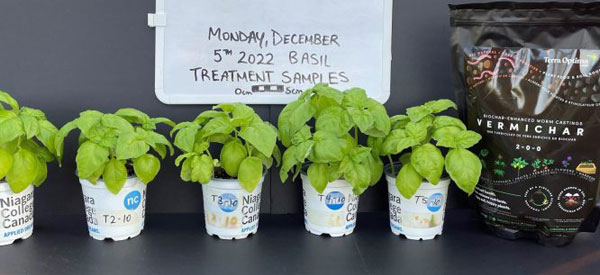
More than half of all food produced in Canada is wasted (58%), and up to 90% of soils may be degraded by 2050 globally. Terra Optima believes it has a solution—store carbon in soils, not the atmosphere. Niagara College’s R&I Horticultural & Environmental Sciences Innovation Centre (HESIC) team worked with the Terra Optima team to provide expertise in conducting comprehensive plant growth trials and validate the product’s efficacy on plant growth.
SDGs in Action: SDG2, SDG3, SDG13, SDG15, SDG17
Goals and Targets
- Each Area of Focus outlined above identifies several Core Priorities.
- Goals and Targets are associated with each Core Priority.
Actions
- Actions will help us achieve our Goals and Targets and are provided in an Actions table.
- Multiple Actions are associated with each Core Priority.
Actions Tables
Every Action has columns of additional information that connects that Action to sustainability efforts. These columns of information are explained below.
Connected Priorities
Connected Priorities identify the Core Priorities this action impacts to help illustrate the interconnection of single actions.
Timeline
Timeline outlines the approximate time frame it will take to implement this action. The timelines are defined as:
- Short-term: 1-2 years
- Medium-term: 3-5 years
- Long-term: 5+ years
Lead
Lead identifies the Niagara College Departments and Schools that will provide leadership to support the implementation of this action, with the support from respective Directors, and Executive Team members. The success of these actions is a combined effort between all members of the Niagara College community. We need to collectively work together to support the Leads directly and indirectly.
STARS in Action
STARS in Action identifies the Sustainability Tracking, Assessment & Rating System (STARS) credits from the Association for the Advancement of Sustainability in Higher Education (AASHE) that Action aligns with.
SDGs in Action
SDGs in Action identify the United Nations Sustainable Development Goals that this Action positively impacts. Learn more about how NC is impacting the SDGs.
GTVET in Action
GTVET in Action identifies the Greening Technical Vocational Education and Training (GTVET) Dimensions of Greening that each Action aligns with.
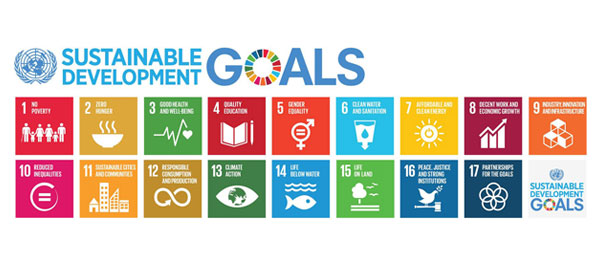
The United Nations Sustainable Development Goals (SDGs) are the layout to achieve a better and more sustainable future for all by 2030. Learn more about SDGs and access a learning module on the Sustainability website.
The 17 Sustainable Development Goals (SDGs) are:
- No Poverty
- Zero Hunger
- Good Health and Well-Being
- Quality Education
- Gender Equality
- Clean Water and Sanitation
- Affordable and Clean Energy
- Decent Work and Economic Growth
- Industry, Innovation and Infrastructure
- Reduced Inequalities
- Sustainable Cities and Communities
- Responsible Consumption and Production
- Climate Action
- Life Below Water
- Life on Land
- Peace, Justice and Strong Institutions
- Partnerships for the Goals