
As NC celebrates Inclusion Week from April 13-16, members of the College’s Equity, Diversity and Inclusion (EDI) Catalyst program are being recognized for advancing initiatives that foster a more inclusive and equitable campus community.
Launched as part of the College’s EDI Blueprint, the EDI Catalyst program brings together employees from across departments to lead projects that promote equity, diversity and inclusion in meaningful and practical ways, supporting one of the four areas and actions identified in the Blueprint.
For EDI Catalyst Tina Annett, Associate Dean of the School of Health Sciences, the opportunity to connect beyond her department and expand her perspective was what first sparked her interest in the role.
“My interest in becoming an EDI Catalyst started with me wanting to connect with colleagues outside of my department and broaden my sense of community at the college,” she said. “Having spent all of my career in healthcare, I was looking for opportunities to engage with people outside of my department.”
Annett was particularly drawn to the Blueprint’s emphasis on Indigenous Ways of Knowing, Doing and Being, an area shaped by both her professional and lived experiences.
“I was drawn to the focus on Indigenous Ways of Knowing, Doing and Being, as both my professional and lived experiences have exposed me to the disparities faced by Indigenous populations,” she said. “This motivated me to apply for the role, as I saw it as an opportunity to learn strategies to create a more inclusive and equitable environment.”
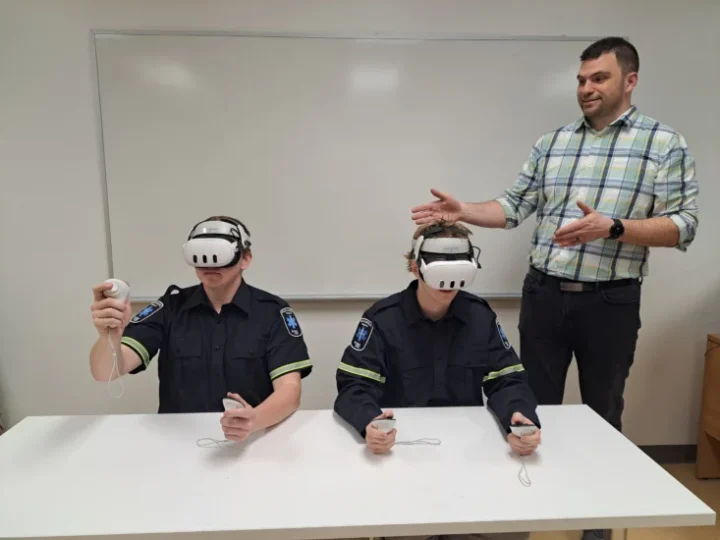
Annett’s project brought these intentions to life through an immersive learning experience for students in the Paramedic program.

Using a Canadian-made virtual reality (VR) experience titled This Is Not a Ceremony, Annett introduced a 20-minute cinematic piece that challenges participants to confront bias and reflect on Indigenous experiences in healthcare. Unlike traditional teaching methods, the VR experience uses storytelling to prompt emotional engagement and self-reflection.
“It presents a message through an immersive, story-driven format,” she said. “It delivers a narrative centered on Indigenous experiences, challenging participants to recognize that stereotyping and bias persist today while encouraging self-reflection on personal assumptions.”
The project has since been fully implemented into the program’s curriculum. All first-year paramedic students now participate in the VR experience, followed by in-person reflection sessions designed to deepen learning and discussion.
“The outcomes have been very positive,” said Annett. “Feedback from the final survey has been overwhelmingly encouraging, and it has been especially meaningful to hear students share their perspectives and reflect on their learning. This is exactly what I was hoping for.”
For Annett, the work is personal and driven by a responsibility to help shape future healthcare professionals.
“Having had the opportunity to work in remote communities early in my career, I recognize that that work had a huge impact on me and it’s something I have always felt the need to share,” she said. “With NC graduating so many new healthcare practitioners, I believe I have a responsibility to try and help build culturally responsible healthcare practitioners.”
Beyond the project, she says the relationships built through the EDI Catalyst program were one of the most rewarding aspects of the experience.
“The individuals in my group truly brought the ‘I’ in EDI to life,” she said. “Building relationships with colleagues from across the college was fantastic. Through these connections, I learned a great deal from others’ perspectives, experiences, and expertise, and was continually inspired by the work being done across departments.”
Looking ahead, she hopes the project will continue to grow and reach more areas of the College community.
“My hope is that more areas across the college will adopt this project to help raise awareness of healthcare disparities experienced by Indigenous peoples,” she said. “While the VR experience itself is impactful, the most meaningful learning emerges through the conversations and reflections that follow.”
As Inclusion Week highlights the importance of belonging at NC, projects like this show how experiential learning and connection can inspire reflection, conversation and meaningful change.
