
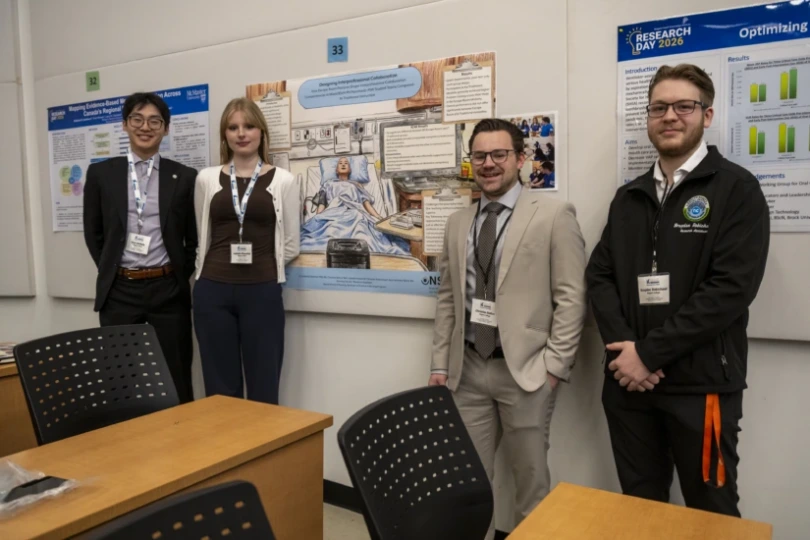
The onset of vital nursing research is underway as award-winning NC Professor Dr. Holldrid Odreman launches a new initiative that injects innovation into academic advancement.
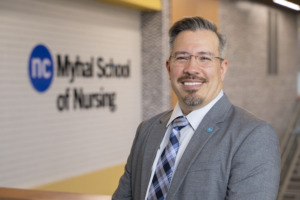
Dr. Holldrid Odreman, Nursing Professor and Program Coordinator of NC’s BScN program, unveils ONSET.
Professor and Program Coordinator of NC’s Honours Bachelor of Science in Nursing program, Odreman has officially unveiled Odreman’s Nursing Scholarship and Education Team (ONSET), a dedicated stream for his various forms of scholarly works and teaching and learning opportunities with a focus on academic output.
“ONSET provides students at Niagara College, students from other institutions, and independent researchers, an opportunity to collaborate with me on studies and other scholarly activities,” said Odreman, PhD, MScN-Ed, RN, CCNE, CCSNE, who was recently awarded the prestigious Silver Leadership Excellence Award for Faculty from Colleges and Institutes Canada.
All ONSET projects focus on using simulation and experiential learning to optimize how nursing students develop clinical competence – from technical skills to confidence and teamwork.
“Ultimately, the goal across all projects is to identify evidence-based educational strategies that better prepare students for real-world clinical practice,” said Odreman.
Critical skills
Three NC nursing students in their second year of the BScN program are currently involved in ONSET, helping Odreman move forward ONSET’s research goals: Christian Baltus (co-investigator), Isabelle Klapatiuk (communications director) and Brayden Robichaud (volunteer coordinator). Master of Nursing student Ryan McNally, who is currently completing his graduate studies at the University of Toronto, is also involved as a research co-investigator helping ONSET with research activities related to external healthcare and professional organizations. Within their ONSET roles, the students have the opportunity to not only get involved with Odreman’s research studies but mentor other students who become involved with ONSET’s research activities.
Odreman noted that all NC nursing students have an opportunity to get involved in ONSET research activities or projects. They may apply to become paid research assistants for funded studies or volunteer as research assistants for pilot studies.
For Christian Baltus, who has been a part of ONSET since its first research study, it has been rewarding to watch it evolve into the ONSET team and is proud of what they are accomplishing together.
“Being part of research has been incredibly rewarding to me as a nursing student because it has allowed me to grow beyond the classroom and develop skills that directly translate into healthcare practice. Through these experiences, I have strengthened my communication, collaboration, leadership, and critical thinking abilities while working alongside students and professionals from different disciplines,” said Baltus.
He noted that his career goal is to become a nurse who provides high-quality patient care and contributes to improving healthcare systems and patient outcomes through innovation, education, and research.
“Being involved in research has shown me how evidence-based practice can shape the future of healthcare and improve interprofessional collaboration,” he said.
Road to ONSET
Odreman knows the value of research first-hand. It has increasingly played a central role in his career. As an ICU clinical educator and as a post-secondary professor, he has led 10 studies – both scholarly and research – from his clinical work.
Early on, his work was grounded primarily in clinical practice and teaching, where his priority was supporting student learning and delivering high-quality education.
Through these experiences, he noticed recurring questions about how students learn best, how performance in clinical settings could be improved, and how educational strategies translate into practice.
“These questions naturally led me toward research as a way to explore and address the challenges I was seeing in both clinical and academic environments,” said Odreman. “Over time, research evolved from being a complementary activity to becoming a core pillar of my professional identity. It has allowed me to move beyond observation and intuition to systematically investigate, evaluate, and improve nursing education practices.”
It was this shift that led him to develop of a more intentional and structured program of research, ultimately resulting in the creation of ONSET.
“While research was not always the central focus of my career, it has become an essential part of how I contribute to the profession, by generating evidence, informing practice, and supporting the development of future nurses,” he said.
Odreman noted that he wanted to launch ONSET to bring intentional structure, coherence, and visibility to what had already become a growing and interconnected body of scholarly and research work.
“After years of engaging in clinical practice, teaching, and leading various research initiatives, it became clear that my work was no longer a collection of individual projects, but rather part of a larger, integrated program of research. Establishing ONSET was a way to formally recognize and organize that evolution,” he said.
“What I hope to accomplish through ONSET is the creation of a sustainable, impactful program of nursing education research–one that not only advances knowledge, but also directly informs teaching practice, strengthens leadership capacity, and contributes to improved educational and clinical outcomes. It is also an important way of providing opportunities for nursing students to learn and integrate themselves in the work of research.”
Leading studies
ONSET includes a mix of both short-term and long-term projects – which Odreman noted, supports ongoing productivity while building toward sustained, larger-scale research outcomes.
Presently, ONSET has two research projects underway.
The first, “Evaluating the Effectiveness of Escape Room Simulation on Registered Nursing Student Leadership Development in Interprofessional Teams: A Randomized Controlled Trial“ sets out to evaluate the effectiveness of an escape room-based simulation in developing leadership skills among RN students.
The primary outcome of this study will be the development of RN leadership competencies including delegation, communication, prioritization and team coordination. The study will generate high-quality evidence on the effectiveness of simulation-based strategies for strengthening RN leadership while collaborating closely with practical nursing, PSW, paramedic and other students in health programs.
Odreman and his team recently completed a pilot study that examined how escape room design elements such as puzzle complexity, role-based tasks, time limits, team composition and discipline mix influenced collaboration competencies in inter-professional student groups compared with traditional classroom teaching. Preliminary data suggested that groups that went through escape room competencies exhibited richer task-related communications, faster convergence on shared plans, and more explicit role negotiation, which reflected team functioning and communication.
Conversely, groups that went through traditional case-based experience showed a decrease in learner opportunities to self-organize, negotiate roles and coordinate actions.
BScN student Isabelle Klapatiuk, Communications Director for ONSET, who was involved with this study, values the experience.
“ONSET has provided me with learning opportunities that extend beyond the classroom. I’ve been able to develop new skills as a researcher, and I’ve grown in ways I didn’t anticipate when I first joined,” she said. “As a nursing student and future nurse, evidence-based practice is foundational to everything we do and being actively involved in research, rather than simply applying it, has deepened my understanding of why research matters. Part of my career goal is to continue allowing evidence to inform my practice at every stage, and ONSET has given me a strong foundation to do that.”
BScN student Brayden Robichaud noted how participating in the study and being a part of the ONSET research team has been beneficial, allowing him to further develop different sets of skills that are critical for the future.
“My future career goals are to be a strong nurse that works alongside evidence-based practices and innovative approaches. As healthcare is always changing and improving, being a part of this change and doing my part as a future nurse is essential to this growth within the healthcare system and interprofessional competencies,” said Robichaud.
“This is also a very rewarding group to be a part of as it has showed me what I am capable of within myself, that I may have doubted before.”
ONSET is also conducting a research study, in collaboration with a hospital in Toronto, involving the training of nurses using Simulation-Based Teaching and Learning Techniques.
Both are currently in the design phase.
Recent studies
A few projects have already been completed.
“Self-Confidence and Modulation of Performance Anxiety Through Simulation-Based Learning”
This study looked to evaluate the effects of simulation-based training using virtual reality and haptic gloves on nursing students’ self-confidence and performance anxiety during clinical skills assessments using Attentional Control Theory as a theoretical framework. Preliminary data suggest that when using virtual simulation to train a complex nursing skill, students experience increased self-confidence while decreasing anxiety, which affects their performance.
“Hand Dexterity and Proficiency: Simulation-Based Training of Nursing Students”
This study evaluated nursing students’ learning curve and knowledge retention when withdrawing liquid medication, measuring time taken during the initial and retention phases to assess the effectiveness of training. The data showed a steady decline in time taken per attempt, highlighting the effectiveness of this simulation-based training. Targeted training, as implemented in this pilot study, confirms that skill retention and medication administration efficacy can significantly enhance nursing students’ hand-eye coordination and dexterity.
“Virtual Reality Simulation Prebrief: Promoting Psychological Safety and Clinical Reasoning”
This research study aimed to determine the extent of differences in the experience of psychological safety and in the performance of clinical judgement across three pre-briefing techniques. This study found that as collaboration and interaction between the learner and educator during a pre-briefing activity increase, the learner’s support for learning and confidence-building also increases. This study was published in the peer-reviewed journal Clinical Simulation in Learning.
Vital impact
Odreman noted that the research conducted through ONSET is important for the healthcare sector.
“It directly addresses how we prepare future nurses to deliver safe, high-quality care in increasingly complex clinical environments,” he said. “By focusing on evidence-based, simulation-driven, and experiential learning approaches, ONSET examines how students develop clinical competence; not only in technical skills, but also in critical areas such as decision-making, communication, and performance under pressure. This ensures that graduates are not simply task-oriented, but are confident, adaptable, and capable of functioning effectively in real-world healthcare settings.”
The impact of ONSET’s work extends beyond education into the broader healthcare system. Odreman pointed out that by improving how nurses are trained, ONSET research contributes to enhanced patient safety, stronger workforce readiness, and more resilient healthcare teams.
“It helps bridge the gap between academic preparation and clinical practice, allowing new nurses to transition more smoothly and contribute meaningfully from the outset,” he said.
“Ultimately, ONSET plays a role in strengthening the overall quality and effectiveness of healthcare delivery by ensuring that educational practices are both innovative and grounded in evidence, leading to better outcomes for patients and the system as a whole.”
Related
National excellence: Nursing prof Dr. Holldrid Odreman receives CICan award for teaching leadership
Simulation-based study from BScN program presented on UK stage
Research study led by BScN faculty and students to be featured at conference in UK
