
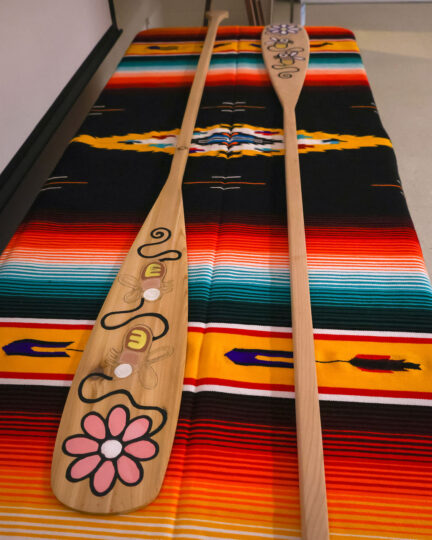
This January, Niagara College will launch a new professional learning series for employees aimed at reshaping colonial education systems and creating safer, more inclusive classrooms.
Developed in partnership between the College’s Centre for Academic Excellence (CAE) and Indigenous Education (IE), the program , Reshaping our Learning Spaces: Centering Indigenous-Led Approaches in Teaching and Learning, is designed to support educators in enhancing their knowledge, allyship and relational practices that centre on Indigenous ways of knowing.
The series was inspired by the desire to extend learning beyond September 30, the National Day for Truth and Reconciliation, and to create opportunities for faculty and staff to turn awareness into action.
“Reconciliation is not just one day a year, it’s an ongoing process,” said Whit Ross, Associate Director, Educational Development, Centre for Academic Excellence. “This program is one way we can show our commitment to Truth and Reconciliation while recognizing there is still more work to do.”
The idea for the program grew after Ross and Leah Hogan, Director of Indigenous Education, travelled to the unceded Coast Salish Territory in North Vancouver as part of a land-based learning experience for NC employees.
“Working with and learning from the Coast Salish community was incredibly impactful,” said Hogan. “When we returned, we started discussing how we could share what we learned with the larger NC community while also creating meaningful and practical approaches to reconciliation.”
This new learning series responds to a growing call from NC faculty for support in decolonizing curriculum and building inclusive classrooms, while also meeting the needs of Indigenous students who want to see their identities reflected in education. It also aligns with the College’s upcoming Indigenization Strategy, where one of the focus areas, which are represented through the metaphor of canoes, emphasizes transforming the teaching and learning ecosystem.
For Indigenous Cultural Consultant Karl Dockstader, addressing these gaps is urgent.
“There are still gaps in knowledge, and those gaps can make classrooms feel unsafe for Indigenous students,” he said. “It is rarely intentional, but the harm is real. The NC community is aware of these gaps, and we all want to do better. This program is about bridging that divide.”
Reshaping Our Learning Spaces builds on earlier projects including the O:riwake curriculum that was developed by Dockstader and Professor Jamie Oresar in partnership with Survivors of the Mohawk Institute Residential School. The project honours Survivor stories while ensuring education becomes a tool of empowerment rather than harm.
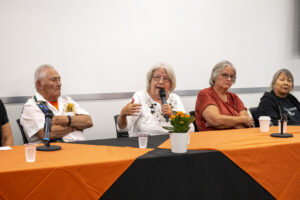
On Sept. 30, 2024, Survivors of the Mohawk Institute – who worked with NC staff to create the O:riwake curriculum – visited NC to share their stories.
The series itself is framed as a shared journey, using the canoe as a guiding metaphor. Participants will gather tools and intentions, learn to enter the canoe with care, paddle together, navigate challenges, and reflect on teachings. The goal is to return ready to share what has been learned and to support others in their own paths toward decolonization.
Though this winter marks the first offering, the team sees the series as just the beginning. Future phases will be shaped by participants and their experiences, leaving room for the program to evolve.
“Our goal is to reshape our learning spaces so they are safer, more inclusive, and more reflective of the diverse students we serve. This program is an important step in that journey,” said Ross.
Program Details
Reshaping Our Learning Spaces is a four-part series requiring full commitment to all sessions and is best suited to those who have already engaged in some foundational learning through readings, workshops, or formal education, and are now ready to deepen their practice.
The Winter 2026 sessions will be offered as follows:
Welland Campus:
- Tuesdays 1:30 – 3:30 p.m.
- January 27, February 10, February 24, and March 10
- Visit the CAE website for more information.
Daniel J. Patterson Campus:
- Thursdays 9:30 – 11:30 a.m.
- January 29, February 12, February 26 and March 12
- Visit the CAE website for more information.
To apply for Reshaping our Learning Spaces: Centering Indigenous-Led Approaches in Teaching and Learning, click here.
For more information, contact Kate Wiley at [email protected].
