

In Canada, Truth and Reconciliation is an ongoing process that acknowledges the history and legacy of residential schools and promotes relationship building between Indigenous and non-Indigenous people. Niagara College acknowledges this important process and is committed to supporting the advancement of the Truth and Reconciliation Commission’s Calls to Action, including to expand access and inclusion to post-secondary education for First Nation, Inuit and Métis peoples at NC.
The College has made a strong and multi-faceted commitment to the understanding and advancement of reconciliation and to weaving Indigenous Ways of Knowing, Being and Doing into the fabric of the College, and in its relations with the communities upon whose territory it operates.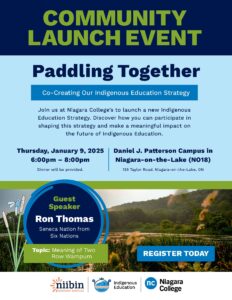
To help guide this important work, NC’s newly formed Indigenous Education Strategy Advisory Group is developing an Indigenization Strategy that will clearly articulate a vision for what Indigenization and decolonization means to Niagara College and positions the College to better support the Truth and Reconciliation process.
Co-chaired by Leah Hogan, Director, Indigenous Education, and Carol Phillips, Dean, Community Services, Justice and Fitness Studies, the Advisory Group has a mandate to provide strategic advice, guidance and counsel in the development and delivery of the Indigenization Strategy.
“Over the last several years, Niagara College has done important work in identifying the need to support our Indigenous community,” said Hogan. “Having an Indigenization Strategy will help NC understand where the gaps are in that support while identifying ways in which we can work towards meeting the needs and potential of Indigenous students and our Indigenous community.”
NC has partnered with Niibin Advisory Services – an Indigenous owned consulting firm that will help facilitate engagement sessions for community partners, employees and students.
The Advisory Group is excited to host a community launch event on January 9 for both Indigenous and non-Indigenous community organizations and partners who work and collaborate with NC. Guest speaker Ron Thomas from Six Nations of the Grand River will kick off the event to talk about the Two Row Wampum – a wampum belt that symbolizes a treaty agreement between the Haudenosaunee and European peoples that was made in 1613 – before community guests will hear from the NC team about the upcoming strategy work.
The Advisory Group hopes that these engagement sessions will help facilitate meaningful conversations about reconciliation and help gather feedback on how the College can support existing relationships and develop new partnerships with its Indigenous community which encompasses, students, employees and the wider Niagara community.
“The Advisory Group is really looking forward to hearing from our community members, employees and students at the upcoming engagement sessions,” said Phillips. “Until we hear the stories and experiences of the community, we aren’t able to fully understand what the gaps are.”
“At Niagara College we have a wonderful community that wants to learn and lean into reconciliation, whether it be through curriculum development or through supports and services offered to students,” shared Hogan. “Niagara College represents a community that is dedicated to putting in the work and the engagement sessions are a safe space for us to come together to have open and honest conversations about the work that needs to be done.”
In total, six engagement sessions are planned in the coming months, as well as three surveys that will be shared with students, employees and NC alumni.
NC’s Indigenization Strategy is scheduled for completion in the Spring of 2025 and will provide a framework for how the College negotiates, navigates and nurtures all relationships that must be reconciled to move forward with Indigenous Peoples in a good way.
“What I hope to get out of the Indigenization Strategy is a list of commitments that ensures barriers are reduced for Indigenous learners,” said Hogan. “I am so proud of the work we are doing here at Niagara College and together we can build community, advance awareness and educate our people as we move towards the future.”
Employees and students who are interested in attending the upcoming engagement sessions are encouraged to register in advance.
Employee sessions will take place on at the Welland Campus on Jan. 14 from 10 a.m. to noon in room AH 255 and at the Daniel J. Patterson Campus in Niagara-on-the-Lake on Jan. 16 from 10 a.m. to noon in room N018.
Student sessions will take place in February and registration will open soon.
Earlier this year, NC announced the creation of the Strong Students, Stronger Futures Scholarship, a first-of-its-kind scholarship that will cover the costs of tuition and ancillary fees for eligible First Nations and Former Youth in Care students. The College also received a transformative grant of $500,000 from the Embark Student Foundation to support the educational experience for Indigenous Students at the College.
