
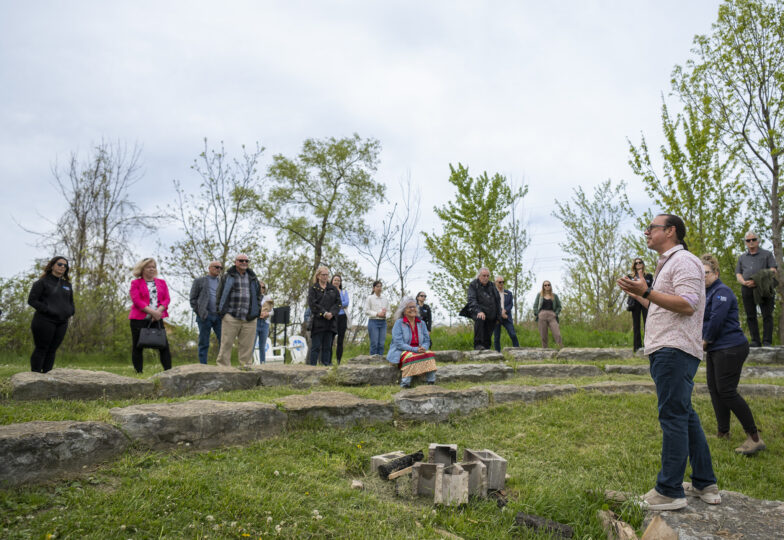
On May 9, Niagara College welcomed representatives and reviewers from the Canadian Commission of United Nations Educational, Scientific and Cultural Organization (CCUNESCO) for a periodic review coordinated by the Niagara Escarpment Biosphere Network (NEBN). The visitors toured the living biosphere laboratory at the Daniel J. Patterson Campus, located at the base of the Niagara Escarpment – a UNESCO-designated World Biosphere Reserve. The event marked one of several stops in a three-and-a-half-day site visit throughout the region.
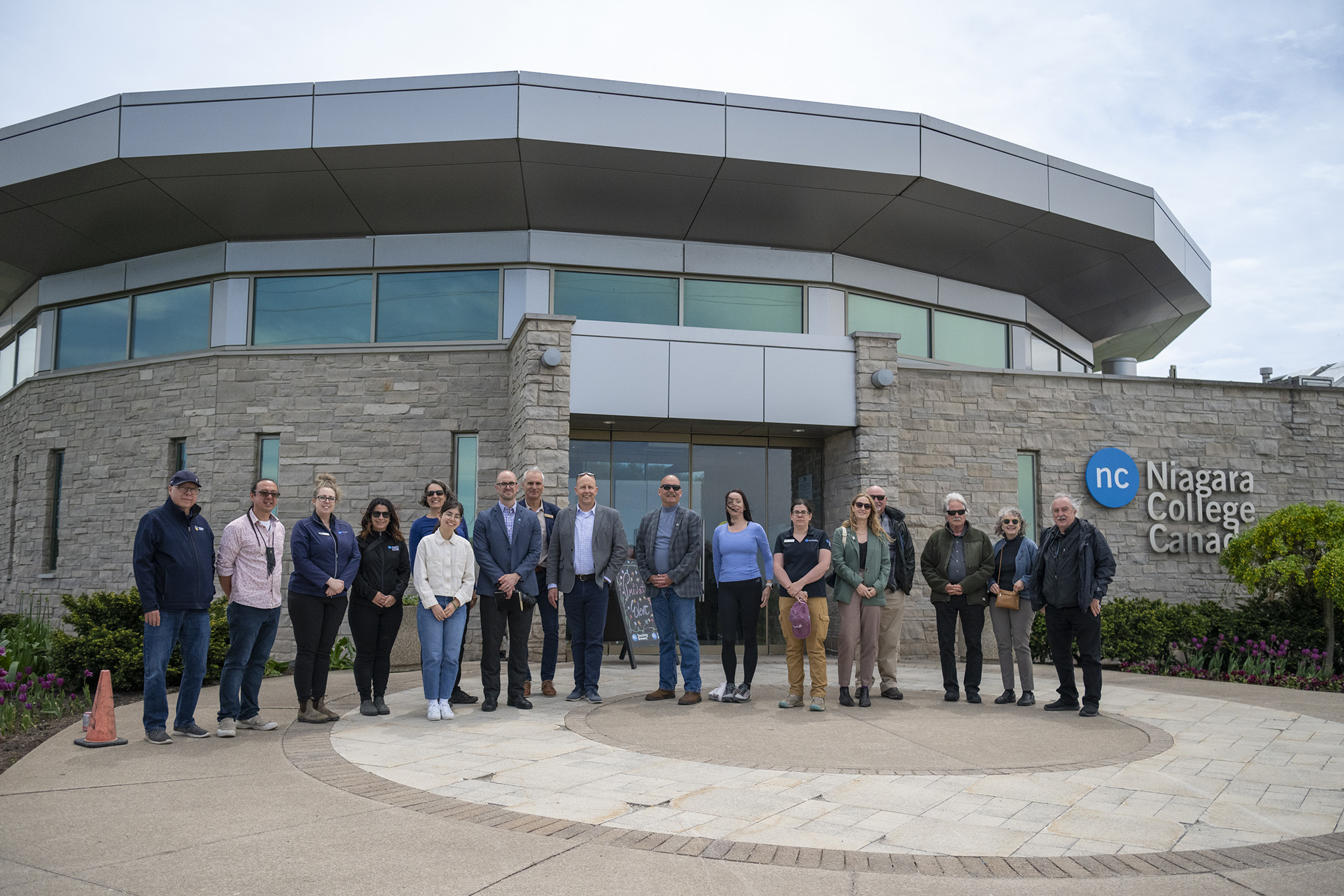
NC staff and faculty with representatives and reviewers from the Canadian Commission of United Nations Educational, Scientific and Cultural Organization (CCUNESCO) outside the Wine Visitor and Education Centre.
The designation of the Niagara Escarpment as a World Biosphere Region is reviewed every 10 years through the Canadian Commission of UNESCO. This process is important for maintaining the designation and continue the work of protecting this magnificent feature that is the Niagara Escarpment. It is the largest continuous stretch of forested area remaining within Ontario, reaching 725 km from Lake Ontario to the tip of the Bruce Peninsula. It encompasses two major biomes (Boreal Forest and Temperate Broadleaf Forest), contains 30+ regions/municipalities, and many other diverse natural and urban environments.
The event began at the Wine Visitor + Education Centre, where CCUNESCO representatives and members of the college community gathered for presentations and lunch. Patrick Robson, Professor at the School of Environment and Horticulture, welcomed guests and introduced the day’s program, emphasizing the shared commitment in the room to maintaining and enhancing the Biosphere.
Fiona Allan, Vice President, Academic, outlined the day’s discussions and tours, emphasizing several NC programs that align with UNESCO’s educational goals. She also highlighted the Daniel J. Patterson Campus’s role as a living laboratory, where students learn directly from the surrounding nature as well as the College’s commitment to embracing Indigenous perspectives and Traditional Knowledge through the Campus biosphere.
Gavin Robertson, Professor at the School of Food & Wine Sciences, delivered a presentation on Escarpment Conservation and the Teaching Winery, highlighting its unique economic and agricultural elements. He notes that Teaching Winery is the only one of its kind in Canada where students engage hands-on with the living laboratory by working directly in the grape vines.

Taryn Wilkinson, Manager of Sustainability, presented on the iNaturalist app, which allows NC students to explore and track biodiversity on both NC campuses, immersing them further in the biosphere.
The day continued with a tour of the campus wetlands, led by Evan DiValentino, Interim Dean of the School of Environment & Horticulture, Indigenous Cultural Consultant Karl Dockstader, and Wilkinson. The tour included the Indigenous Garden, a space dedicated to growing native plants and sacred medicines used for teaching and healing. Dockstader explained how the Indigenous Garden supports Indigenous learners and fosters cultural understanding within the College community.
“We sing in this space, we use our language in this space, and I believe we share this space with our relatives, not just the four-legged ones but the ones that grow out of the earth,” he said. “We are to treat this space as if it is sacred.”
The tour also covered the 15-acre wetland area, previously used as a sewage lagoon. Wilkinson described how over the years, NC students and community members helped restore the wetland, which now hosts over 900 species.
Dockstader introduced the Wetland Circle, an outdoor classroom used for Indigenous practices and teachings, embodying the values of the Dish With One Spoon Wampum principles: to take only what you need, leave enough for others, and keep the dish clean.
The tour highlighted various activities and teachings held at the Wetland Circle, including the May 17 Moose Hide Campaign event, an Indigenous-led movement to help end violence towards women and children. He also mentioned past events such as the corn soup demonstration, where he shared knowledge about this traditional dish with the college community in the outdoor learning space.
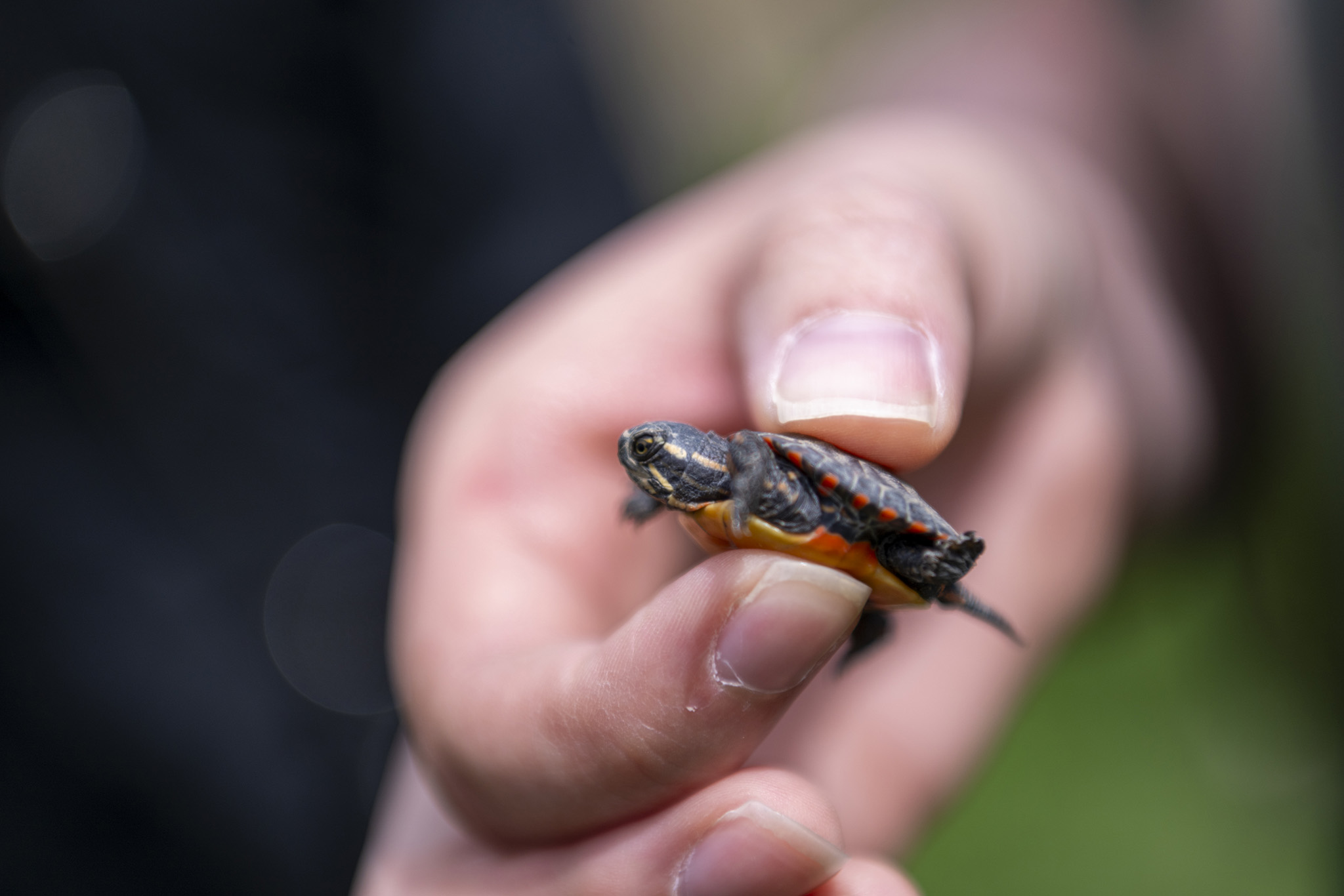
The tour concluded with an overview of the Turtle Monitoring & Nest Protection program, where participants had the opportunity to observe turtles in their natural habitat. These ecologically significant species are regularly monitored and protected on campus, with students from the Office of Sustainability actively participating in these conservation efforts, especially during laying and hatching seasons. Additionally, the tour highlighted the recent efforts of Ecosystem Restoration students who have recently begun a three-year project to remove Phragmites, an invasive plant species that is harming ecological systems and infrastructure across the province and on NC campuses. Phragmites patches have been obstructing access to the lagoon for various species of turtles and wetland birds, making this removal project critical for restoring the natural habitat.
