
A message from the Student Rights and Responsibilities Office:
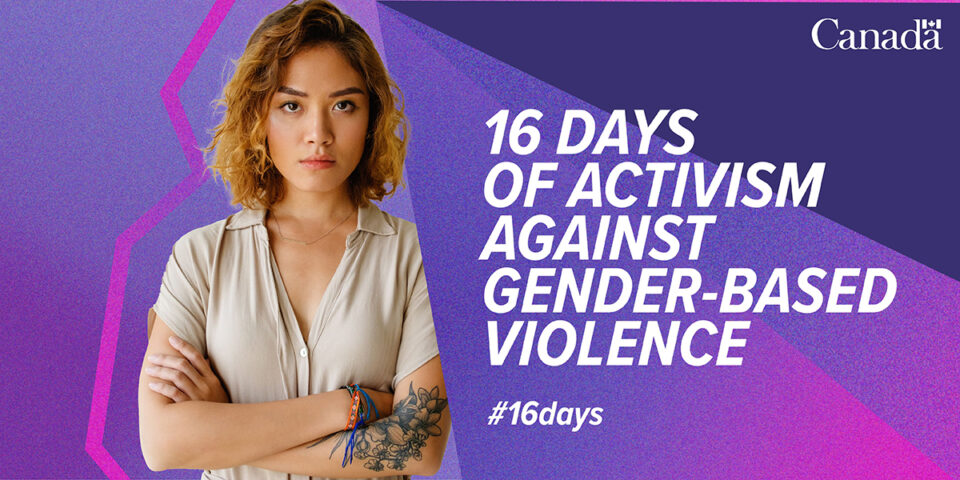
Please join The Student Rights and Responsibilities Office (SRRO) in learning more about 16 Days of Activism Against Gender-Based Violence, an annual international campaign starting on November 25, the International Day for the Elimination of Violence against women, until December 10, International Human Rights Day.
Everyone has the right to live free from violence. However, many Canadians across the country continue to face violence every day because of their gender, gender expression, gender identity or perceived gender. This is referred to as gender-based violence and is a violation of human rights.
While violence affects people of all genders, ages, religions, cultures, ethnicities, geographic locations, and socio-economic backgrounds, populations more at risk of gender-based violence include women, young women and girls, Indigenous Peoples, LGBTQ2 and gender diverse people, women living in Northern, rural, and remote communities, and women living with disabilities.
Facts
- Every 6 days a woman in Canada is killed by her intimate partner
- More than 4 in 10 women in Canada have experienced some form of intimate partner violence in their lifetime
- 64% of people in Canada know a woman who has experienced physical, sexual, or emotional abuse
- Indigenous women and girls are 12 times more likely to be murdered or missing than any other women in Canada
(source: canadianwomen.org/the-facts/gender-based-violence/)
Now is the time to learn more about gender-based violence and the role we all have in challenging social norms and ending this violence.
Initiatives on campus
November 28: Pot Painting & Planting
Students are invited to join Indigenous Education & the SRRO for an afternoon of painting pots, planting, and chatting about gender-based violence & ways you can challenge negative social norms.
Location: Wellness Room, DJP Campus in Niagara-on-the-Lake
Free, registration required.
November 29: Movie Screening of A Better Man
Students are invited to join NCSAC and the SRRO to watch the documentary A Better Man, the story of a woman who confronted her abuser after escaping from him 22 years earlier. Students will have the opportunity to discuss the movie with Elysia, the Sexual Violence Prevention & Response Coordinator.
Location: AH 141, Welland Campus
Free, pizza included. Registration required.
December 5: Gender-Based Violence Workshop with Draw the Line and Gillian’s Place
Students are invited to attend a workshop with Draw the Line and Gillian’s Place, to enhance their understanding of the root causes of gender-based violence, challenge common myths about sexual violence, and develop the necessary skills and capacity to engage in prevention efforts.
Students who attend will be entered into a draw to win a $100 visa gift card.
Location: W215, DJP campus in Niagara-on-the-Lake
Free, registration required.
December 6: National Day of Remembrance and Action on Violence Against Women
The College will be lowering campus flags to half-mast to recognize the National Day of Remembrance and Action on Violence Against Women, a day commemorated every year in Canada on the anniversary of the 1989 École Polytechnique massacre. Stayed tuned for upcoming initiatives to commemorate this very important day.
16 things you can do during #16days
- Acknowledge the problem. Everyone in Canada – women, men, transgender and gender diverse people – can be a victim of gender-based violence. Learn more about gender-based violence
- Know the risks. The odds of experiencing violence are not the same for everyone. Young women and girls, Black and racialized women and girls, Indigenous women and girls, 2SLGBTQI+ and gender non-binary individuals, women in Northern, rural, and remote communities, and people with disabilities are at much greater risk of experiencing gender-based violence. Learn more on the Canadian Women’s Foundation website.
- Stop victim shaming/blaming. Generally, victims won’t report gender-based violence cases to the police because they feel they will be shamed by their families, friends, or the offender.
- Be alert to non-physical violence. Not all gender-based violence is physical. Name-calling, stalking, harassment, control (including financial), cyber attacks, and manipulation are all forms of gender-based violence. Read NC’s Sexual Violence Policy for more information & definitions.
- Avoid gender stereotypes: Men and boys also suffer from unfair social expectations, like having to be tough and be the main breadwinner. Women can be CEOs, girls can build great things, men can cry, and boys can like pink, just to name a few. Watch the video Boys Don’t Cry
- Challenge social norms. Research suggests that gendered language reinforces inequality and more regressive norms. Harmful social norms that sustain gender-based violence include ideals for women’s sexual purity or protecting family honour over women’s safety. Don’t accept phrases like “boys will be boys” or “she was asking for it” as an excuse for negative or criminal behaviours.
- Remove negative stigma. Most of sexual assaults do not come to the attention of police. A major reason is fear, shame, and embarrassment of being judged, blamed, or not believed. You can help end stigma by believing and supporting those who report being victimized by gender-based violence.
- Educate youth. Generally, violence is a learned behaviour. Young people need to learn how to openly communicate in relationships so they can give and ask for consent, set boundaries, and speak up if they see or experience sexual violence. You can help by showing good behaviour, like being open about your own boundaries. Learn more at Love is Respect
- Know what to do if someone asks for help. Services for survivors are essential services. If there is immediate danger, call 9-1-1. In Canada shelters, hotlines, counselling, and other supports and services for those affected by gender-based violence are available in most communities. Learn more about resources available in Niagara and how to help support someone who has been impacted by gender-based violence.
- Engage men and boys. The majority of men and boys do not engage in violence against women and are needed as allies to help change the culture. Men and boys can lead by example by rejecting violent behaviours toward women, girls, and non-binary people and being willing to speak out whenever they see violence or harassment directed at others. Read about the Boys Don’t Cry campaign
- Recognize triggers. If you, your friends, or family are in a time of crisis, seek support and learn which local, regional, and national services for those affected by gender-based violence are available to help. Times of crises, like financial pressures from a job loss or a global pandemic, can increase the risk of gender-based violence.
- Take action. Don’t be a bystander. Learn safe ways you can intervene if gender-based violence is happening around you, such as unwanted sexual attention in public. Learn more about bystander intervention tips
- Promote gender diversity in workplaces. A lack of gender diversity in the workplace, particularly in leadership roles, can foster unsafe work environments that include harassment, like sexist jokes – a form of gender-based violence.
- Highlight positive role models. It’s important to see others who look and act like us succeeding. Role models that reflect a range of genders, ages, and ethnicities, such as community leaders, celebrities, athletes, Indigenous elders, or teachers, help engage youth.
- Support shelters. The most dangerous time for a victim of abuse is when they try to leave their abuser. Shelters have resources and training to help victims leave safely. Learn more about Niagara shelters: Gillian’s Place, Women’s Place, YWCA Anti-Human Trafficking
- Put safety first. Do not stay in a dangerous situation if you can leave safely. Learn more about safety planning
Support and information sessions at NC
Niagara College is committed to supporting those who have been impacted by sexual and gender-based violence. NC has a dedicated Sexual Violence Prevention & Response coordinator, Elysia Dardarian, who employs a trauma informed and survivor centered approach to supporting students impacted by this type of violence.
Please contact Elysia at [email protected] if you would like support in the following ways:
- Making a formal complaint to the college regarding an incident of sexual or gender-based violence
- Assistance with reporting to the police
- Reviewing any accommodations that may be needed
- Creating a safety plan for physical and emotional safety concerns
- Referring students to services on or off-campus
- Learning more about sexual and gender-based violence and how to be a supportive friend
- Scheduling Elysia for an information session on sexual and gender-based violence to your class, club, or department
Follow @consentiskeync on Instagram and check out NC’s Consent is Key Campaign for content on sexual and gender-based violence and information on events.
Additional resources
Government of Canada – 16 Days of Activism Against Gender-based Violence web page
Hope for Wellness Helpline – Support for Indigenous People across Canada
Canadian Women’s Foundation website
Canadian Femicide Observatory for Justice and Accountability website
16 Days Campaign website
Niagara College Consent is Key website
