

With the tick population on the rise in Niagara, the Niagara College community is encouraged to be cautious this summer.
Ticks are small insects found in forested areas or areas with long grass. They do not jump or fly, rather, they attach themselves to humans and animals passing by. While not all ticks pose serious concerns, the Blacklegged/Deer Tick is the one to watch out for, as it can carry and transmit the bacteria that causes Lyme disease.
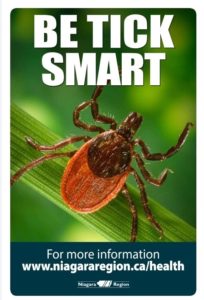 ‘Be Tick Smart’ signs have been installed at both the Welland Campus and Daniel J. Patterson Campus in Niagara-on-the-Lake to remind students, staff, faculty and visitors to be mindful of ticks on campus, paying special attention to areas such as gardens and fields with tall grassy areas, and paths, including the Wetland Ridge Trail at our Daniel J. Patterson Campus.
Whether enjoying the outdoors on campus or around Niagara, there are a number of precautions that can be taken to keep safe. Niagara Region Public Health and the Government of Ontario provide tips on protecting yourself from tick bites including:
- Cover up by wearing light-coloured clothes to easily spot ticks. Closed-toed shoes, long-sleeved shirts, long pants tucked into socks and special clothing designed to repel ticks are also recommended.
- Use insect repellents that contain DEET or Icaridin;
- Put clothes in the dryer on high heat for a minimum of 10 minutes to kill any ticks that may have attached to your clothing.
Remember to also check pets and children for ticks after spending time outdoors. On humans, it is common for ticks to attach to areas like the groin, armpits, hairline or behind the ears.
For more information, including how to identify different types of ticks, how to properly remove ticks, and Lyme disease statistics in Niagara, visit the Niagara Region Public Health website.
Additional resources
Government of Ontario website – Lyme disease: Learn how to avoid bites from blacklegged ticks
eTick website – Electronic submission for tick identification in Canada
