As Niagara College “Catalysts” focused upon Indigenous Ways of Knowing, Being and Doing (IWKBD), we found ourselves engaged in personal journeys of exploration, evolution and connection. We came to this project from various roles and responsibilities at the College, as well as a broad range of lived experiences. Our resulting trajectories – towards the work of honouring and realizing progress towards the Truth and Reconciliation calls to action – have also been uniquely tuned to our social locations and individual perspectives.
Below, five of us capture some of the insights gained through our experiences as IWKBD Catalysts. The vignettes capture a moment in time in what we’re all experiencing as an ongoing commitment. We continue to weave the tapestry of our connections to each other, the Indigenous community members we’ve come to know as dear friends and colleagues, and our own circles of relations and influence.

Tina Annett – Paramedic Program Manager, Welland Campus
Honouring Truth and Reconciliation in Paramedic Education
As the Paramedic Program Manager, I believe that truth and reconciliation must be more than words; it requires intentional action. In healthcare education, this means creating opportunities for both students and staff to deepen their understanding of the histories, realities, and experiences of Indigenous Peoples within the healthcare system.
One way I am working toward this is through sharing a virtual reality experience from the National Film Board called This Is Not a Ceremony. Created by Niitsitapi writer and director Ahnahktsipiitaa (Colin Van Loon), the experience exposes some of the dark realities of Indigenous people’s lives navigating everyday life in Canada.
Over the summer, this VR experience was made available to all students through the library. This year, I will be introducing the experience to paramedic staff and a group of paramedic students. I plan to ask them to write a reflection afterward to share what they learned and felt to assess whether the experience created an impact. If successful, I plan to make this experience a part of every student’s clinical experience, with the hope that staff will also participate.
My time spent as an EDI Catalyst has had a huge impact on me personally. It reinforced the need to act and seek opportunities that create space for reflection, growth, and change for myself and others. This VR experience is designed not only to build awareness but also to encourage accountability, which is what attracted me to it as a learning tool.
My hope is that paramedicine graduates enter the field prepared to serve all communities with empathy and cultural humility. Through this work, my aim will continue to foster compassionate, knowledgeable, and socially responsible paramedics who are committed to reconciliation in their practice.
Baljit Bhamber, Campus Safety Coordinator, Welland Campus
Campus Safety is committed to supporting Truth and Reconciliation by fostering an inclusive and respectful environment for all. Our team is working towards educating staff on the history, culture and the ongoing impacts of colonization on Indigenous communities, aligning with the Truth and Reconciliation Commission’s (TRC) Calls to Action. This includes participating in college-wide events that celebrate Indigenous cultures, integrating land acknowledgements into our practices and completing the 4 Seasons of Reconciliation.
We recognize the importance of cultural humility and are providing ongoing training to our security team to build awareness of Indigenous experiences and the barriers that continue to exist. Through this, we aim to create a safer, more welcoming space where Indigenous students, staff and visitors feel seen, respected, and supported.
Campus Safety is also focused on building strong relationships through open communication, trust, and mutual respect. By learning from the past and engaging with the present, we are working toward a future where Indigenous students and colleagues can thrive. Our efforts are part of a broader institutional commitment to increasing awareness and creating meaningful changes across the college community, guided by the TRC’s vision for reconciliation.
Bellan Dye – Library Technician, Daniel J. Patterson Campus in Niagara-on-the-Lake
“Context for Change” video essays
My ultimate goal was to find a way for voices to be heard and, in turn, find a way for others to connect and start or continue their journey. Personally, I would connect with Indigenous and non-Indigenous folks to improve myself and my outlook, hoping, perhaps unknowingly, that others would feel the same. What people said or showed me was always the key to it for me. I knew there had to be some way to ensure others had a chance to hear stories or see human expression telling these stories that would tap into the humanity in all of us.
For my part, I was able to reach out to so many people with experience, technical video recording expertise, and knowledge to help bring the project to life. With these partners, we were able to talk to five individuals to share on camera how they saw Truth and Reconciliation as a part of their lives. Even just being a witness to these conversations was having the effect I wanted for others: a chance to witness how individuals formed their experience based on how Truth and Reconciliation affected their lives and those around them.
The project is only part of a goal so many others share. Maybe, just maybe, it can change the world if people can experience these stories, experience these people and their humanity. And then look beyond these featured folks and see others in their world. And change their own world in their own way.

Maija Saari, Associate Dean of Culinary and Wine, Beer and Spirits. DJP Campus.
Talking Indigeneity and Decolonization with Educator-Settlers – Rising “TIDES” initiative
As an academic leader and educator, I felt drawn to reflect upon the pragmatic implications of the TRC Calls to Action as it might relate to academic curriculum, program delivery and the learning experience for both students in the classroom and faculty as learners. I’ve taken the opportunity of my time as an EDI Catalyst to think critically about why Indigenous perspectives are taken up – or not – by settler professors into curriculum and what that journey could be for those who are setting foot on that path. Where within our institution does the critical conversation sit naturally and comfortably? Where are opportunities lost and what happens in the aftermath of failed attempts? How might individuals – be they educators, disruptors or Knowledge Keepers from across disparate experiences – mutually support each other in an organic, invitational and fluid way that enlightens and lifts us all?
Talking about curriculum change can be both a very vulnerable and contested act, particularly for those seeking to challenge dominant discourses and create space for perspectives historically marginalized. What we teach signals to students what knowledge is valuable and whose perspectives “count”. Curriculum can reproduce systemic barriers and perpetuate exclusions across generations. Challenging existing curriculum also challenges the status quo – and that experience can be difficult and isolating within a program community.
The experience of immersing myself in the Indigenous community in Squamish in 2024 as part of Dr. Denise Findlay’s Gathering Our Medicine retreat was deeply moving and inspiring. To pay that forward, it felt important to follow the ethical-relational approach she uses in some way to support the creation of healing spaces where settler faculty could engage in conversations about Indigeneity and Decolonization and reflect upon the journey ahead of them. I’m hoping to champion a community of practice where faculty peers on various stages of their own journeys, as well as our Indigenous colleagues, might co-create approaches for inclusion of Indigenous perspectives in our classrooms and engage in mutual support and healing on the road to their own (un)learning.
To that end, I’m planning to participate in the new curriculum offered by the Centre for Academic Excellence and facilitate the development of an ancillary Community of Practice that can become a more informal method to keep the connections and conversation going. There is still much work to be done, but I hope to model my commitment to continuous (un)learning as an “imperfect friend” on my own journey and look forward to building relationships and community along the way.
Tallulah Williams – Project Officer, Global Education — An Invitation
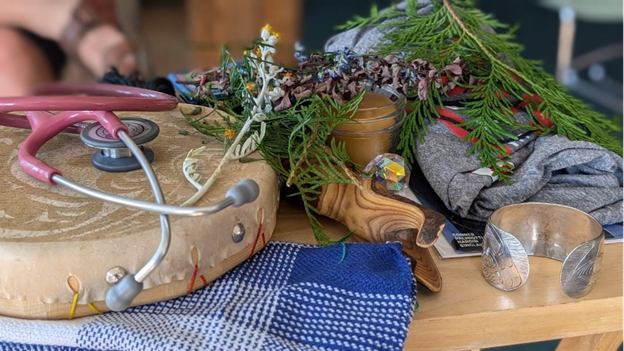
I’m on a continuous journey that has required individual change and honours the balance between knowing, being and doing as well as connecting to support truth and reconciliation. Instead of just telling you what I’ve been doing, I’ll share a teaching that was shared with me during a time of change – the Anishanaabe teachings of The Medicine Wheel. The medicine wheel represents interconnectedness, balance, and the cycles of life through a circle divided into four directions. Each of the four directions can take on different interconnected and interdependent aspects depending on the context, including the elements (earth, air, fire, and water) and the self (spiritual, emotional, mental, and physical). For the purposes of sharing how I’m supporting truth and reconciliation, in and outside of my EDI Catalyst role, aspects of the self have been paired with knowing, being, doing, and connecting to relate it to how I’m honouring Indigenous Ways of Knowing, Being and Doing into myself.
The graphic of the medicine wheel below shows what I’m doing on my journey of truth and reconciliation. My invitation to you is to continue to progress through your own journey of Indigenous Ways of Knowing, Being and Doing. Everyone’s journey will be unique and will bring opportunities to collaborate, connect, and make change collectively.
