Turtle Monitoring
Turtle monitoring has been conducted at the Daniel J. Patterson Campus of Niagara College to safeguard two ecologically significant species of great concern, safeguard nests, and develop an approach for monitoring that complies with provincial regulations.
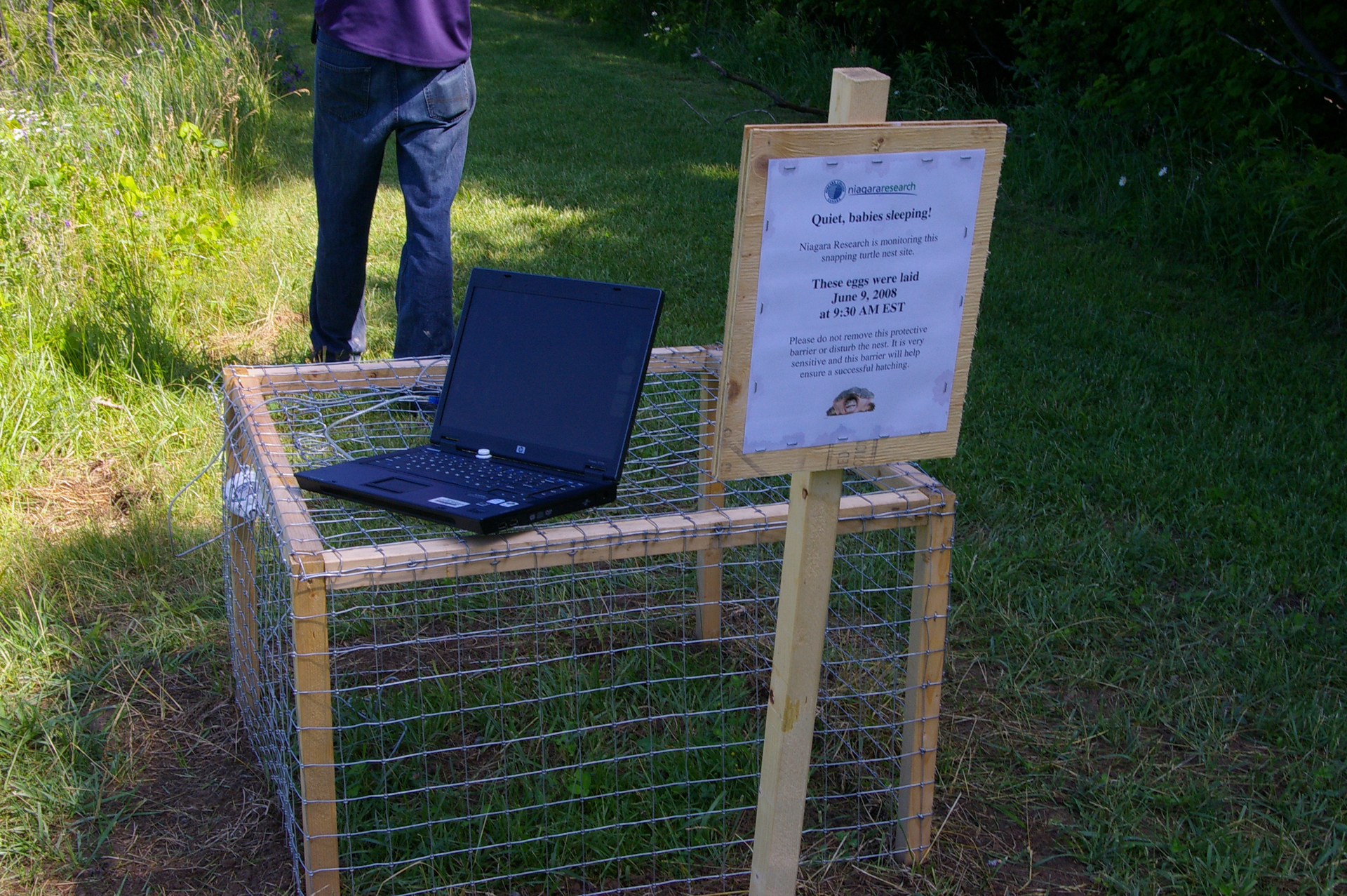
Since 1997, turtle population conservation has been the key objective of turtle monitoring at Niagara College’s Daniel J. Patterson Campus. Every year, in the spring and fall, the turtle monitoring is conducted according to the turtle monitoring protocol. Unlike sandy beaches, the wetlands provide the ideal habitat environment for hatching. In addition to monitoring, nest protection is used to safeguard two different species of turtles that inhabit in the wetlands. Wood and chicken wire are used to construct the nests.
Turtle Monitoring Protocol
The turtle monitoring protocol can be found here
Why is it vital to monitor and protect turtles?
Due to the destruction and loss of wetlands caused by construction as well as road mortality, the two kinds of turtles located in wetlands—painted turtles and snapping turtles—are extremely threatened. The sheer number of predators, including raccoons, minks, skunks, and coyotes, also poses a threat to their existence. Additionally, snapping turtles mature later in life than other turtle species, which results in a slow rate of reproduction. For this reason, it is important to safeguard both the adults and the young.
Turtles found at the Daniel J Patterson Campus
Painted Turtles (Chrysemys picta marginata)
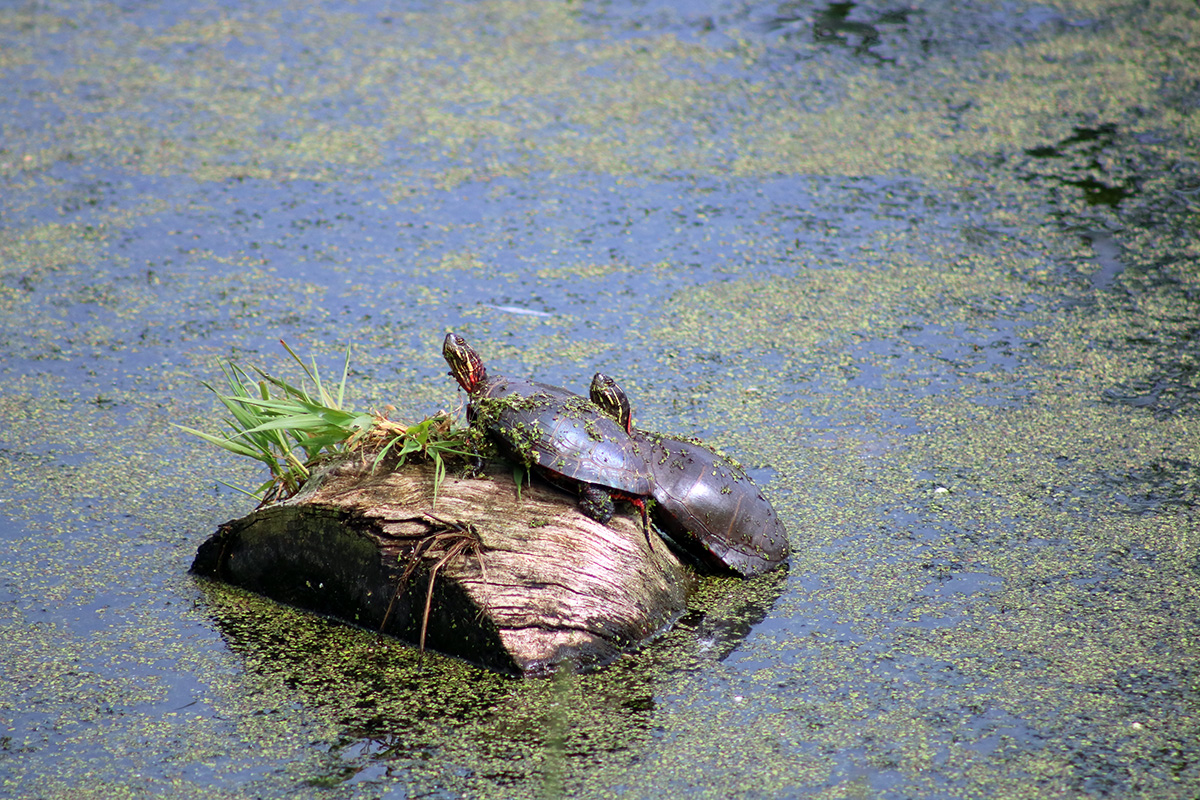
The painted turtles, also known as Chrysemys picta marginata, are a species of special concern in Ontario. They can be easily identified by their special features, such as the olive-to-black upper shell with red- or orange-colored margins around the shell and red-to-yellow lines on their neck. The lower shell is of a yellow or dark tan color with some dark, specific markings on it. They usually inhabit waterbodies that have enough aquatic vegetation as well as a place where they can bask at times. They prefer to hibernate at the bottom of the waterbodies where they typically reside. It usually takes seven to 10 years for a male and 12 to 15 years for a female to reach sexual maturity. Nesting occurs from late May to early July after the female finds a suitable area with sandy or loamy soil and sun exposure.
Snapping Turtles (Chelydra serpentina)
The largest freshwater turtle in Canada, the snapping turtle (Chelydra serpentina) is a species of major concern in Ontario. Snapping turtles, as the name suggests, have a snapping mechanism as a kind of defense since, unlike other turtle species, they are unable to retreat inside their shells to fend against attacks. Their distinctive features include a tan or olive-to-black upper shell and a long, triangular tail with spikes running over the tip. They live in freshwater bodies that have sufficient vegetation. They rarely swim; instead, they often walk on the waterbody’s bottom surface. They hibernate at the bottom of the waterbody, where they reside, but usually near the shore. It takes snapping turtles 15 to 20 years to reach sexual maturity. Female snapping turtles dig test holes at certain locations and then lay eggs at the most suitable spot during nesting, which takes place in late May or early June.
Turtle Projects at Niagara College

Students in Niagara College’s Ecosystem Restoration program work on a number of projects in the Daniel J. Patterson Campus wetlands as part of their course work. Prior years’ work centered on the number of turtles and the application of certain concepts to turn the wetlands into a turtle-friendly habitat. According to a 2023 population count, there were about 160 painted turtles living in the wetlands. In 2021, the students built and placed the basking platforms in the waterbodies at the wetlands so that the turtles could sunbathe during that period. The summer students who worked as sustainability technicians in 2023 built the turtle nesting cages that are used to protect the turtle eggs from predators.
What should you do if you see a turtle on trail path?
It is better to leave a turtle alone if you come across one along the walk, provided that it is not in danger. While painted turtles withdraw behind their shells for protection, snapping turtles will snap if they feel threatened because they will perceive you as a potential predator. To avoid snapping, it is recommended to handle the turtles by picking them up by the sides rather than putting your hand towards their mouth. If you spot a turtle on campus within the trail, reach out to the sustainability office and let us know when, where, and what turtle you saw!