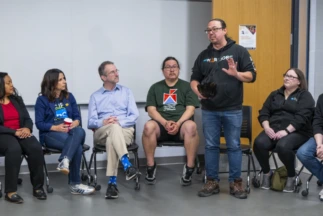
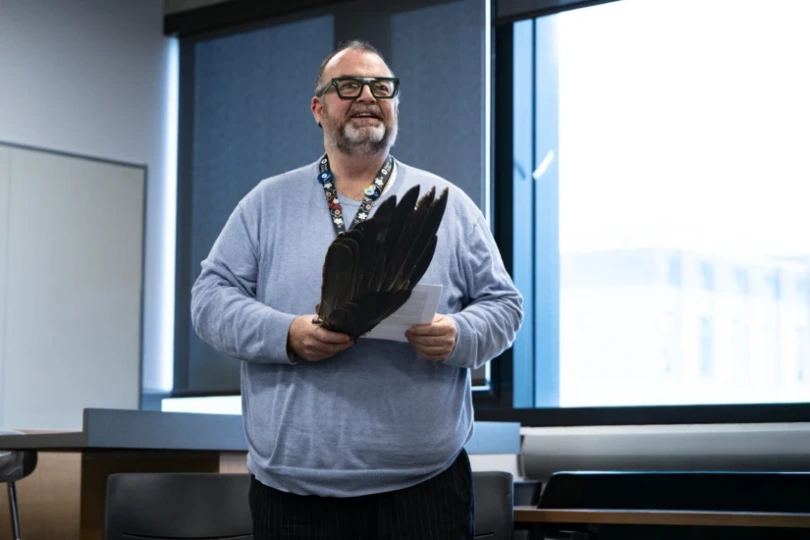
On May 14, Niagara College’s Indigenous Education department hosted its fifth annual Moose Hide Campaign event, bringing together students, employees and community members in support of ending violence against women and children through an Indigenous-led grassroots movement.
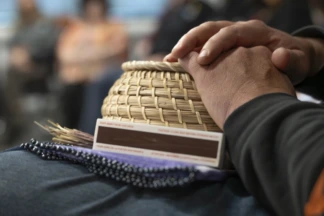
The day began at sunrise in the Indigenous Garden at the Daniel J. Patterson Campus in Niagara-on-the-Lake with a sacred fire ceremony. Members of the NC community gathered to connect, reflect and offer traditional medicines as part of the ceremony.

NC’s Moose Hide Campaign event invited participants to pledge to honour, respect and protect women and children, and to work to end violence against them.
“It was a powerful gathering, with ceremony led by my Anishinaabe brothers and a sharing circle held with care by colleagues,” said Karl Dockstader, Indigenous Education Cultural Advisor. “At the same time, it reminded us that there is more work to be done here, and that this responsibility continues beyond any single day”.
Special guests Dylan Ritchie, Bear Clan from Saugeen First Nation, and Chris Shawanoo, Turtle Clan from Stony Point First Nation, joined the event as teachers and fire keepers — spiritual stewards responsible for maintaining sacred ceremonial fires. Throughout the morning, they shared personal stories about their upbringing, the importance of preserving Indigenous culture, and the role Indigenous men play in ending gender-based violence.
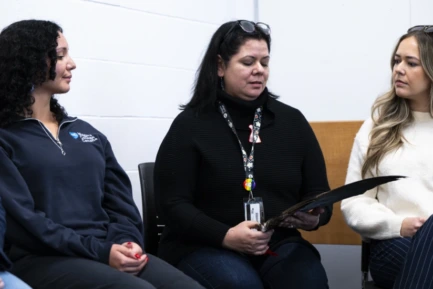
Later in the morning, participants gathered for a sharing circle, where employees, students and community members reflected on their reasons for attending while listening and learning from one another’s experiences.
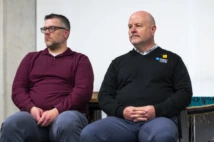
Dr. Chris McGrath, Vice President, Students, welcomed guests to the sharing circle and spoke about the College’s ongoing commitment to reconciliation through learning, reflection and action.
“The Niagara College community has been on a journey of reconciliation for many years,” said Dr. McGrath. “We continue to learn with our Indigenous employees and students about the ways that we can engage as a community to not only acknowledge the truth, but more importantly to take meaningful action that will help author new narratives about Indigenous Peoples’ strength, potential and flourishing.”
Dr. McGrath also highlighted the ongoing crisis of gender-based violence in Canada, sharing several statistics affecting Indigenous women and 2SLGBTQIA+ people:
- One in three women in Canada will experience sexual assault in her lifetime.
- Although Indigenous women account for approximately five per cent of all women in Canada, they represented about 26 per cent of women killed by an intimate partner in 2022.
- Forty-three per cent of Indigenous women have experienced sexual assault at least once since the age of 15.
- Eighty-six per cent of 2SLGBTQIA+ Indigenous women have experienced intimate partner violence in their lifetime.
The Moose Hide Campaign began in British Columbia more than a decade ago along the Highway of Tears and has since grown into a nationwide movement supported by Indigenous and non-Indigenous Canadians alike.
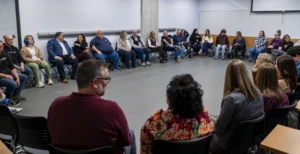
NC community members participate in a sharing circle during the Moose Hide Campaign event.
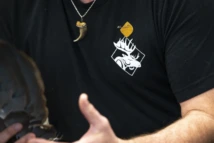
As part of the event, Moose Hide pins were distributed to attendees as symbols of their commitment to honouring, respecting and protecting women and children. By taking the pledge, participants committed to supporting truth and reconciliation, reversing the harms caused by residential schools, and fostering safer communities for women and children.
“The number of men showing up matters. What we do next matters even more. Abusive language, overtalking, belittling, gaslighting, minimizing, making women a punchline are not harmless; they are part of the same continuum as overt violence, reinforced by systems that fail to protect women, trans and queer people, especially those navigating multiple forms of harm at once,” said Dockstader. “Our responsibility is to listen, to show up, and to intervene in those moments, including with ourselves”.
The event followed NC’s observance of Red Dress Day on May 5, when red dresses were displayed at both campuses to honour Missing and Murdered Indigenous Women, Girls and Two-Spirit people (MMIWG2SLGBTQQIA+).
“The Moose Hide Campaign is a social movement born from the deep respect that Indigenous men have for Indigenous women, from traditions that are grounded in honour, caring and love,” said Dr. McGrath. “By wearing the moosehide today, I renew my commitment to not only speaking and standing with Indigenous women…but also to taking action to ensure that all women can fully live and express their truths and potential in ways that are free from risk, threat, and harm.”
To learn more about how you can help end violence against women and children, visit the Moose Hide Campaign website.