
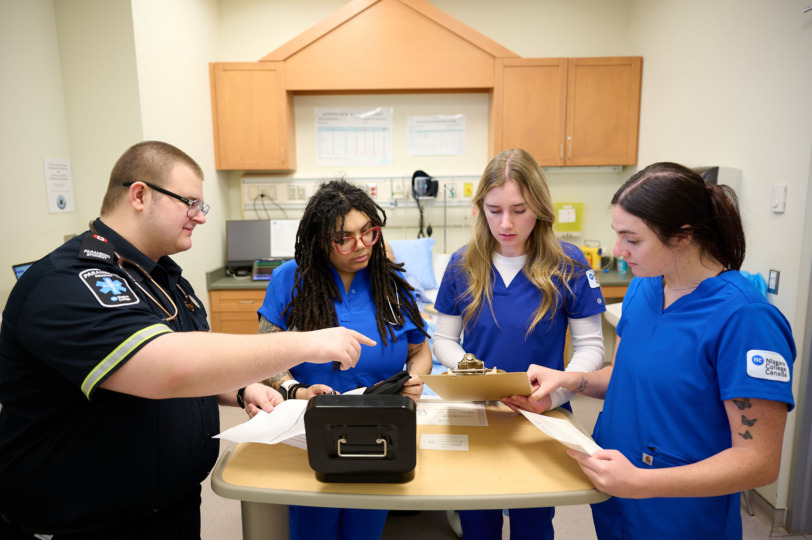
New research conducted at Niagara College has explored whether the fast-paced pressure of an escape room can be used as a learning tool to strengthen students’ collaboration skills across healthcare disciplines.
“Designing Interprofessional Collaboration: How Escape Room Features Shape Interprofessional Collaboration Competencies in Mixed BScN-PN-PSW-Paramedic Student Teams” examined how escape room design elements, including puzzle complexity, role-based tasks, time limits, team composition, and discipline mix, influence collaboration competencies in interprofessional student groups compared with traditional classroom teaching.
Led by Professor and Program Coordinator of NC’s Honours Bachelor of Science in Nursing (BScN) program Dr. Holldrid Odreman and his research team – formally known as Odreman’s Nursing Scholarship and Education Team (ONSET) – the pilot study engaged students from the BScN, Practical Nursing, Personal Support Worker and Paramedic programs within the Health Sciences Division.
“We’re starting with healthcare professional students because we know that they are going to be the ones who implement the idea of collaboration once they get into a clinical setting,” said Dr. Odreman, who noted that most students do not get the opportunity to work closely with peers from other disciplines before they graduate.
Thinking outside the box
Traditionally, the concept of interprofessional collaboration has been taught in the classroom through case studies, mock interviews and patient actors.
The pilot study was developed to explore the viability of an escape room being used as a non-traditional teaching method to help students understand the importance of interprofessional collaboration in patient care before they enter the workforce.
“An escape room allows students to not only work together, but to really think together, to problem solve together and to ask themselves, ‘Did I listen to you or not? Did I follow you or did you follow me?'” said Dr. Odreman.
“These are things that sometimes in the real clinical world, new practitioners, new nurses, new paramedics, new dental assistants, new PSWs don’t always sort out or learn how to do well until a number of years of practice.”
Collaboration takes shape through the escape
Twenty-five students were divided into eight interprofessional teams, randomized into two groups: Experimental (escape room) and Traditional (classroom setting).
For the experimental teams, ONSET researchers transformed one of the labs within the Myhal School of Nursing into an escape room environment.
“The overall picture of the escape room is that you’re solving a case of a patient who has gone from normal to showing certain signs and symptoms… you have to figure out what’s going on with that patient through a series of puzzles,” explained second-year BScN student Christian Baltus, who is ONSET co-investigator and research activities team lead.
Each team had 55 minutes to solve the puzzles, which were customized to the specific disciplines – nursing, PSW and paramedicine – and based on skills already taught in the classroom. Students were required to demonstrate their knowledge by answering the questions tailored to their profession and helping teammates answer theirs, working together to unlock boxes and complete other common escape room elements to move on to the next puzzle. During the process, students learned about other professions while strengthening their teamwork and collaboration skills.
Baltus says that current literature speaks to the need for more research on interprofessional collaboration in healthcare and that the study was inspired by a gap in this area of learning.
“I think that’s an issue because when it comes to working out in the clinical setting, communication, respect for one another, and knowing each other’s roles is what really ends up guiding patient-centered care,” he said.
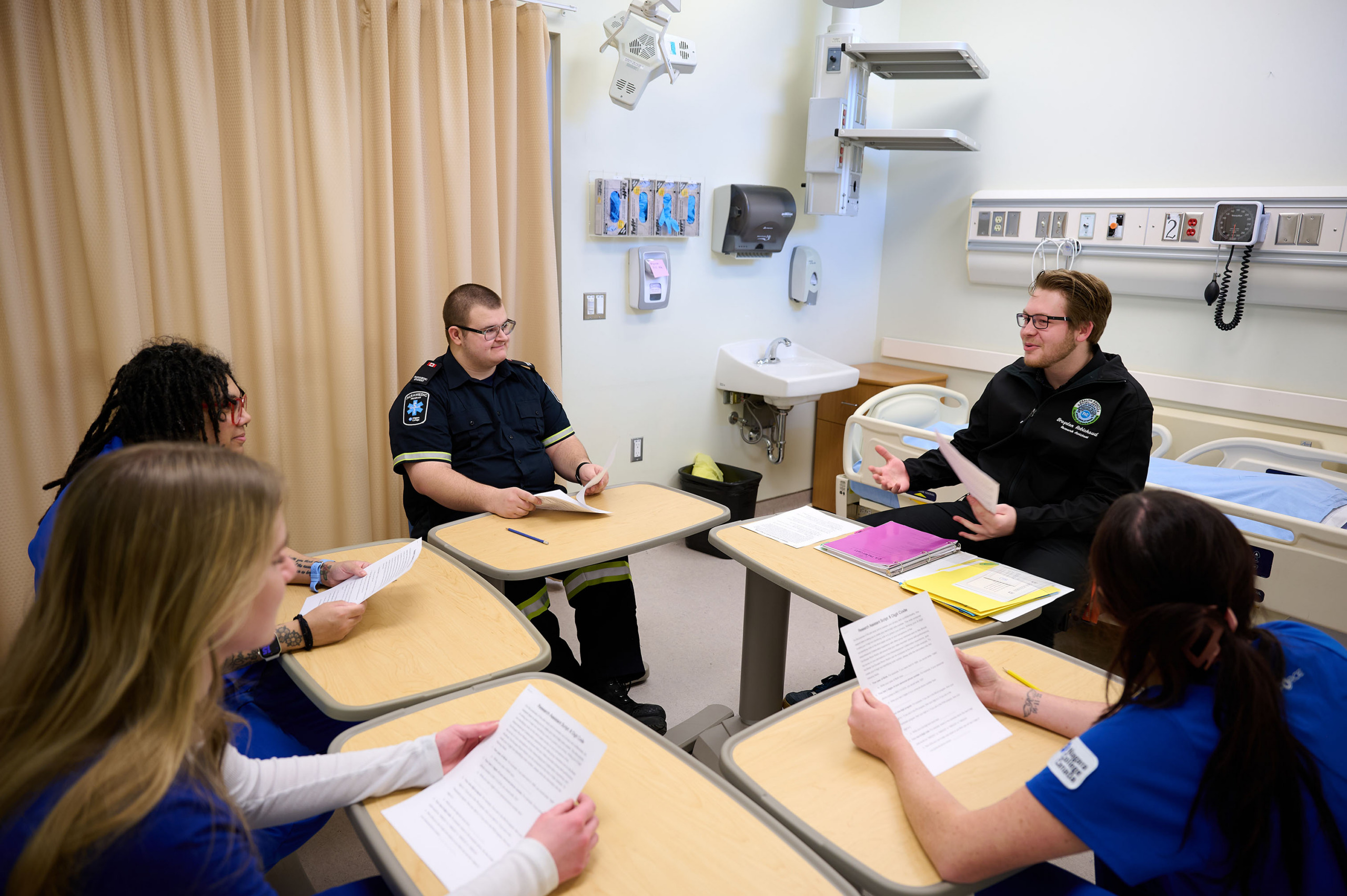
Second year BScN student and ONSET researcher Brayden Robichaud sits down with participants of the escape room study
Preliminary data from the research suggests that groups that went through the escape room experience exhibited richer task-related communication, faster convergence on shared plans, and more explicit role negotiation, which reflected team functioning and communication.
For the groups that went through the traditional classroom case-based experience, they showed a decrease in the ability to self-organize, negotiate roles, and coordinate actions.
Though results varied slightly between the escape room and traditional modalities, overall performance did not differ significantly between the two and core interprofessional skills were effectively supported in both learning environments.
“The beauty about the study was that the results showed us that we cannot only use a traditional way of teaching interprofessional collaboration… we now have proof to show that we can use the escape room to complement or enhance traditional methods,” said Dr. Odreman, who noted that incorporating a variety of modalities can better support the diverse learning needs of students across the Myhal School of Nursing.
“In terms of educational impact, the study highlights how educators should feel encouraged to adopt creative and active learning strategies that are just as effective as traditional modalities,” said second-year BScN student Isabelle Klapatiuk, who is a research assistant and communications director with ONSET.
“Evidence-based practice is extremely important when it comes to nursing and healthcare. Being able to be involved in that has just been a great experience,” added Klapatiuk, who first participated in research as a student volunteer.
The results of the pilot study have become a catalyst for expanded research into the topic. The team is continuing to explore the concept through a study called “Evaluating the Effectiveness of Escape Room Simulation on Registered Nursing Student Leadership Development in Interprofessional Teams: A Randomized Controlled Trial.” The project sets out to evaluate the effectiveness of an escape room-based simulation in developing leadership skills among RN students.
Inspiring research involvement in students
ONSET volunteer coordinator Brayden Robichaud has also grown into his research assistant role after supporting previous studies as a student volunteer.
“It’s honestly amazing to be a part of because there’s nothing like it,” said Robichaud, who is also in his second-year of the BScN program.
“This is not something I thought I would be interested in coming into the program and as much as it takes a lot of time, a lot of work, and a lot of dedication, I think it’s very much shown me what I’m capable of and what an actual team is capable of,” he added.
The team received additional support from first- and second-year BScN students who joined the study in volunteer research assistant roles. Maya Thibault, Marley Hogan and Mike Zammit took on participant recruitment, while Jeny Benjamin and Ada Iysa-Bello handled data collection.
Sharing the impact
Baltus, Klapatiuk, Robichaud and fellow ONSET member Ryan NcNally, a Master of Nursing student who is currently completing his graduate studies at the University of Toronto, presented a poster on the escape room pilot study at Niagara Health Knowledge Institute’s sixth annual Research Day, hosted at the Daniel J. Patterson Campus in Niagara-on-the-Lake on May 7.
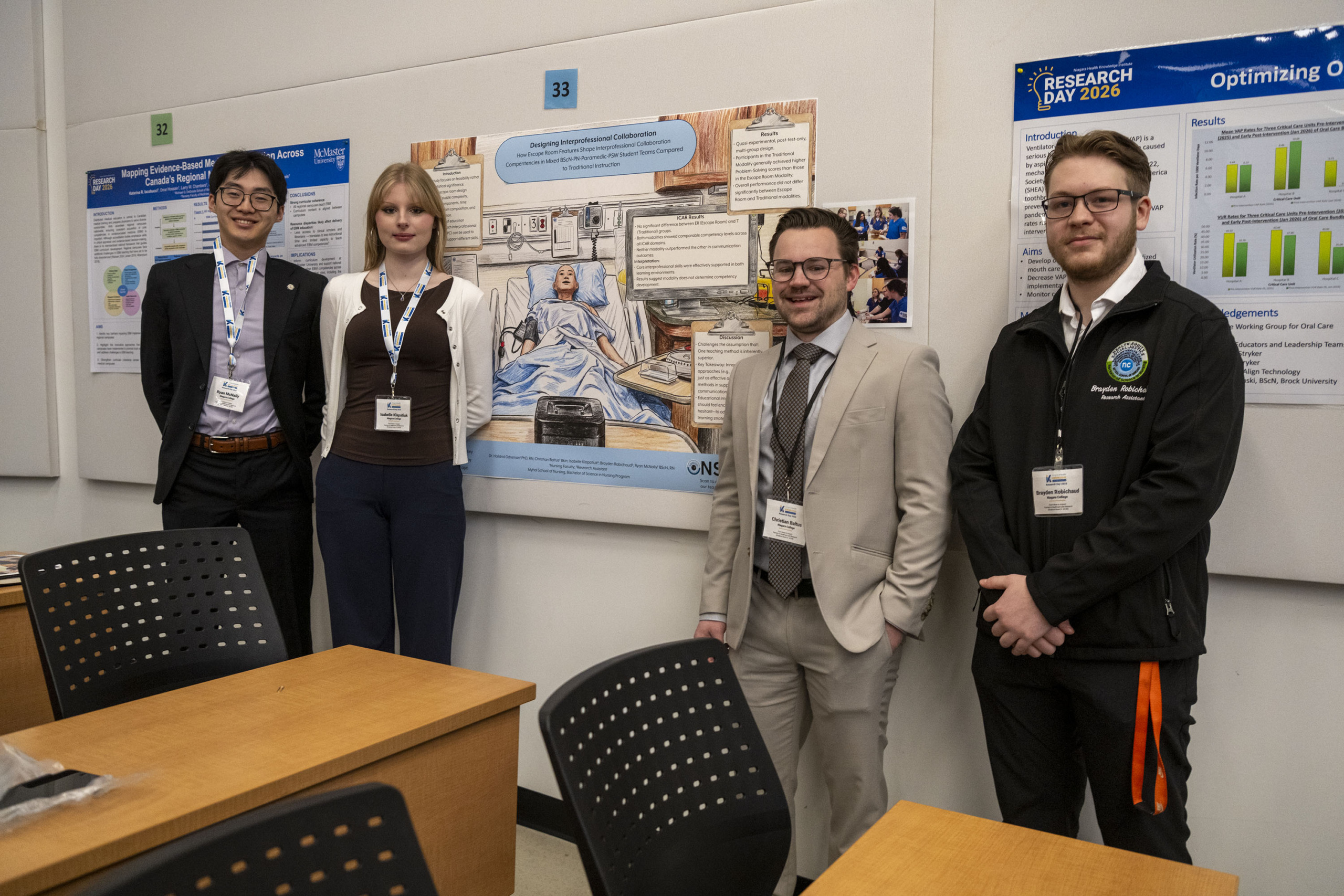
ONSET members (from left) Ryan McNally (U of T) and NC BScN students Isabelle Klapatiuk, Christian Baltus and Brayden Robichaud with their poster presentation at NHKI’s 2026 Research Day. The poster was designed to reflect the experience of a student participant, aiming to visually capture what it feels like to engage in the escape room environment itself.
The team also submitted an e-poster presentation on the study to the Registered Nurses’ Association of Ontario (RNAO) website for National Nursing Week, May 11-17.
“The opportunity to work with Dr. Odreman is an experience that changed my whole trajectory in nursing. Often, nursing students learn about research but few genuine opportunities exist to really be involved to the extent that I do now,” said McNally, who started working with Dr. Odreman in 2023 while completing his bachelor’s degree at Brock University where Dr. Odreman has also taught.
McNally noted that being the external research activities leader for ONSET, alongside his graduate studies at the University of Toronto, has pushed him toward a path in research and academia.
“The mentorship [Dr. Odreman] has offered is something I now aspire to model with the students I precept and the colleagues I work alongside at ONSET, as we all continue to learn and grow together,” he said. “I have made so many cherished friends and connections along the way, and I am truly grateful to be a part of something this special.”
Looking ahead
ONSET has been accepted to participate in the 37th International Nursing Research Congress, happening in Toronto from July 16-18. Baltus and McNally will present on a previous study titled “Virtual Reality Simulation Prebrief: Promoting Psychological Safety and Clinical Reasoning.”
The prestigious conference is part of the International Honor Society of Nursing (SIGMA) and brings together a vibrant community of students, faculty, clinicians, and leaders in the nursing field who are conducting research on technology, practice, well-being, community health, and more.
