
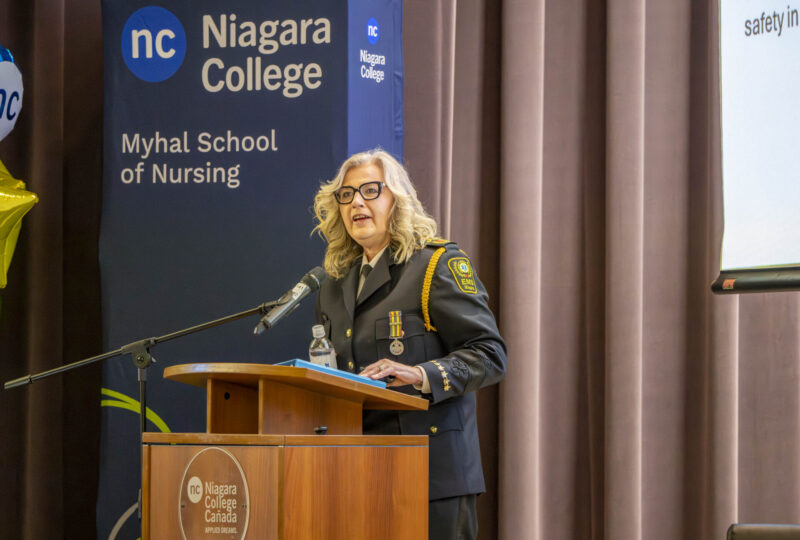
When Karen Lutz-Graul speaks about leadership, she isn’t talking about decorated uniforms or the authority of an office — although she has both.
The Chief of Niagara Emergency Medical Services recently visited the Welland Campus to speak to current students from the Myhal School of Nursing and School of Allied Health as part of a Connected Care conference for current students. It was a return to her alma mater for the NC alumna (Ambulance and Emergency Care 1990) and Luttz-Graul delivered a powerful message that met the moment: leadership belongs to everybody.
Addressing a diverse group of future nurses, dental assistants, paramedics, and pharmacy technicians, she spoke about what leadership is and what it isn’t – and why it’s more important than ever in today’s healthcare sector.
“It’s not about the uniform … leadership is a behaviour, not a title. Titles open doors, but they don’t create leaders; your actions do,” she said. “For paramedics – that’s my work – it begins when your boots hit the ground. People look to you instantly for reassurance and direction.”
Legacy of leadership
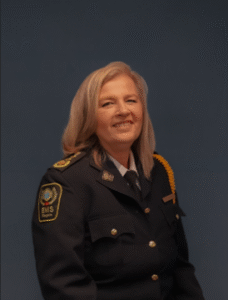
Lutz-Graul is a cornerstone of the Niagara healthcare community. With over 30 years of experience, she has risen from a frontline paramedic to a decorated leader, receiving the 2023 Women in Business Award and spearheading the Niagara EMS System Transformation Project.
“Leadership begins the moment someone decides to take responsibility for the moment they are in, and when people across health care choose to lead through everyday behaviours through courage, compassion, and commitment,” she said. “We don’t just improve our teams; we improve the lives of our patients around us and their experience.”
In today’s rapidly evolving healthcare sector, she noted that leadership is more important than ever.
“It’s all so high pressure, high stakes. Decisions often need to be made quickly, and those decisions directly impact patients’ lives,” she said. “Effective leadership helps create clarity, supports teamwork and the right choices even when they’re made under stress.”
She pointed out that leadership in health care is needed at every level.
“It’s not just managers, not just administrators, nurses, physicians, therapists, paramedics or pharmacists. We all communicate and advocate for our patients, and we have to take the initiative to solve problems,” she said. “Ultimately, our patients rely on our judgment and our presence. They trust health professionals.”
Five pillars of healthcare behaviour
Lutz-Graul spoke about five core behaviours essential for anyone entering the healthcare workforce.
The first was accountability; the importance of owning actions – both good and bad.
“I’ve never fired anybody for making a mistake,” she said. “I’ve fired people for lying about it.”
The second, reliability, is about being the person colleagues can trust when the pressure rises.
Respectfulness was third – treating every patient as a person, not a diagnosis.
“Know your patients’ names,” she said. “They are not ‘the person with shortness of breath.’ This is Mr. Jones or Mrs. Smith, who happens to present with shortness of breath.'”
It’s important to be curious, remain open to learning and ask, “How am I doing? Am I supporting you?”
The final pillar was humility – to put the team’s success and the patient’s evidence above one’s own ego.
Pause, assess, act, reflect
Recognizing that healthcare is a “high-pressure, high-stakes” environment, Lutz-Graul provided students with a practical framework to navigate the chaos of the frontline. She encouraged students to adopt a simple, repeatable model for decision-making.
Pause: Take a single breath to prevent a rushed mistake.
Assess: Look at the big picture – the patient, the environment, and the resources.
Act: Take decisive, informed action. “Not taking action isn’t an option,” she said.
Reflect: After the moment passes, evaluate what went well and what could be improved.
Compassion as strength
In a field often measured by clinical skill and technical accuracy, compassion is one of the strongest forces a healthcare provider can possess, she said.
“People may not remember exactly what you did or what you said, but they remember how you made them feel,” she said, quoting Maya Angelou.
Lutz-Graul shared personal stories where she learned the importance of compassion firsthand. She recalled a nurse who stood by her side when she was an 11-year-old patient, and – later in life- the pharmacy assistants who helped her navigate having both parents in palliative care simultaneously.
Call to action
Lutz-Graul challenged the students – the next generation of Niagara’s healthcare workforce – to make a promise to themselves.
“Compassion requires courage. It means choosing to truly see the person in front of you, not just the condition on the chart,” she said. “That means listening when someone’s afraid, frustrated, or in pain. And it means staying present in the moment, especially those that are uncomfortable.
“Anyone can complete a task, but it takes real strength to connect with someone on a human level.”
Whether in an ambulance, a dental clinic, or a hospital, she told students that leadership is not something to wait for; it is a choice made in ordinary moments that leads to extraordinary care.
She emphasized that leadership is not an individual action; it’s a team sport which shows up in different players at different moments.
“Think about it as a racing pit crew. Every second matters. Every role is critical. One person lifts the car, one person changes the tires, another manages fuel, another communicates timing. There is no room for ego, only teamwork,” she said.
“In healthcare, every role contributes to patient care. Respect for all disciplines and support staff is not optional. It’s foundational.”
Before they earn titles, they’re going to be handed responsibility, whether it’s somebody looking for answers, a family member waiting for reassurance, or a teammate relying on their judgment.
“In that moment, you’re a leader whether you want to be or not. It’s not about being the most experienced person in the room. It’s it’s about what you do when something’s on the line,” she said.
“In healthcare, what’s on the line is often somebody’s comfort, dignity or life. The reality of pressure is not the exception in your careers. It’s the environment.”
Connected Care conference
Lutz-Graul’s keynote address to students was part of NC’s “Connected Care: The Landscape of Preparing Today’s Learners for Tomorrow’s Healthcare System” conference, which was held on March 30 at the Welland Campus Applied Health Institute. Organized by the College’s Myhal School of Nursing in partnership with its Centre for Research in Education, the event marked the first time a collection of Niagara’s high-profile health leaders gathered specifically to speak to more than 200 students from a variety of health-related programs – from nursing and personal support worker, to paramedicine, dental, pharmacy and more.
View Niagara healthcare leaders inspire next generation of care
