
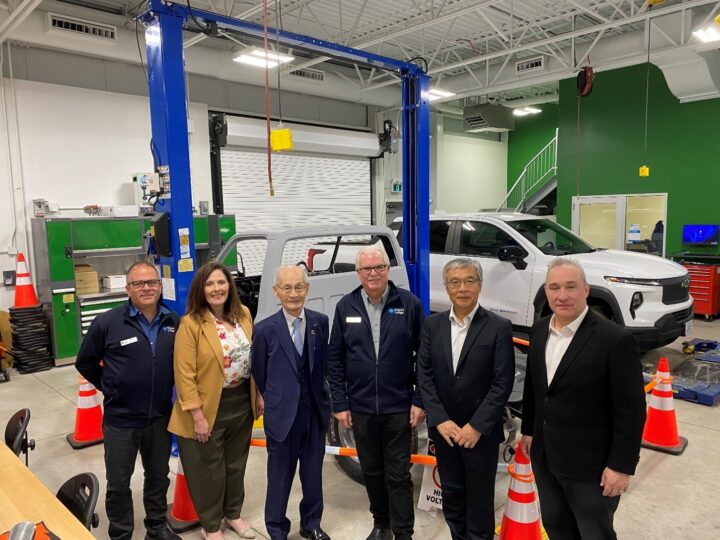
This fall, Niagara College had the honour of hosting Dr. Akira Yoshino – Honorary Fellow with Asahi Kasei Corporation and inventor of the lithium-ion battery, one of the most transformative innovations of our time.
On November 12, Dr. Yoshino visited the Green Automotive Technology Lab at the Welland Campus, where he was introduced to the College’s leading expertise in applied education, research, and innovation in green automotive technology.
“Niagara College was deeply honored to host Dr. Yoshino, Nobel Prize laureate and pioneering inventor,” said NC’s Duane Bender, Dean of Media, Trades and Technology, who led the delegation. “His visit reflected the powerful link between academic discovery and the applied learning that fuels innovation in the green automotive industry.”
Dr. Yoshino, an Honorary Fellow with Asahi Kasei Corporation in Japan, visited NC as part of a trip to Asahi Kasei Battery Separator Canada (AKBSC). The multinational company currently maintains an office at the College while construction progresses on its new battery separator plant in Port Colborne.
Former and current Motive Power program coordinators, Wayne Toth and Pete D’Elia, guided Dr. Yoshino on a tour of the Green Automotive Technology Lab, where students develop hands-on skills to diagnose and repair hybrid and electric vehicles – expertise for which there is growing demand.
Toth emphasized the link between student learning in the program and Dr. Yoshino groundbreaking discovery in the 1980’s. As portable electronics emerged, so did the need for small and lightweight power sources. This inspired Dr. Yoshino’s prototype, the blueprint for a wide range of electronics we use today, like smartphones, and laptops, as well as specialized aerospace, medical, and military equipment.
Lithium-ion batteries generate electricity by moving lithium ions between a positive cathode and a negative anode, producing power when discharging and storing energy when charging. The reversible flow of lithium ions between electrodes is a clever innovation that makes these batteries rechargeable and high-capacity.
Dr. Yoshino’s invention has revolutionized the automotive industry, powering advancements in electric vehicles, reducing reliance on fossil fuels, and cutting global emissions.
Since the lab opened in 2018, Toth says thousands of students have been trained on hybrid and electric vehicles – expertise needed in automotive repair shops with more than four million electric and hybrid vehicles on the road today in Canada.
Dr. Yoshino heard about NC’s focus on high-voltage safety, a skill set in high demand across industries. The College has trained first responders and continues to prepare police, firefighters, EMS, and others to safely handle hybrid and electric vehicle emergencies.
Dr. Yoshino also observed NC’s innovative EV truck conversion project, explored student work with hydrogen fuel cell technology, and learned about related research in Advanced Manufacturing through NC’s Research & Innovation division.
“It was a great honour and pleasure to host Dr. Akira Yoshino,” said Bender. “Our sincere thanks to Asahi Kasei Battery Separator Canada for arranging the visit.”
