
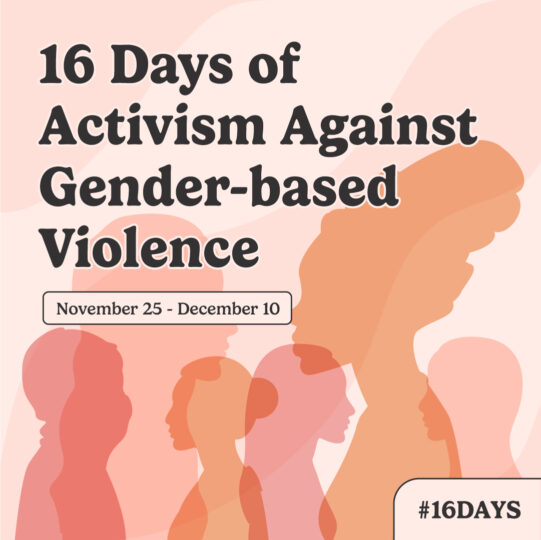
The 16 Days of Activism Against Gender-Based Violence (GBV) is an annual international campaign that begins on November 25, the International Day for the Elimination of Violence Against Women, and goes until December 10, Human Rights Day. This campaign started in 1991 to call out and speak up on gender-based violence, and to renew our commitment to ending violence against women, girls, and 2SLGBTQIA+ individuals.
Upcoming Events
November 28 at 6:30 p.m.
Join our movie night: A Better Man on November 28 at 6:30 p.m. at the Welland Campus, or watch for free on the National Film Board of Canada website
December 4 at 3 p.m.
Employees and students are invited to join our hybrid event for National Day of Remembrance and Action on Violence Against Women facilitated by White Ribbon.
“Building Allyship: Engaging Men and Boys in GBV Prevention” explores the history and work of White Ribbon and introduces approaches to building allyship.
A hybrid event, located at the Daniel J. Patterson Campus in Niagara-on-the-Lake, room N018.
Registration is not required. Zoom link.
December 8 at 11:30 p.m.
Male and male-identifying students are invited to join our virtual event “Dare to Disrupt Bro Culture”, facilitated by White Ribbon. This workshop is designed to foster understanding about the root causes of gender-based violence and explore ways to promote gender equality and healthy masculinities.
Virtual event, please register on the NC Engage App
Sixteen things you can do during #16Days
1. Learn more about gender-based violence, including warning signs of abuse, how to respond, and how to connect individuals with appropriate supports.
- Neighbours, Friends and Families – Neighbours, Friends and Families – Western University
- Complete the Preventing Sexual Violence Learning Modules + Survey
- Expand your understanding of gender-based violence – Canada.ca
2. Know the risks. The odds of experiencing violence are not the same for everyone. Indigenous women and girls, young women and girls, Black and racialized women and girls, 2SLGBTQIA+ individuals, women in Northern, rural, and remote communities, and people with disabilities are at much greater risk of experiencing gender-based violence. Learn more on the Canadian Women’s Foundation website.
3. Start conversations. Discuss the dangers of GBV with your own family, friends, and community. Raise awareness about GBV and its outcomes to foster a safer environment.
4. Know what to do if someone discloses experiencing violence to you.
Someone told me that they were sexually assaulted. What do I do?
5. Believe and support survivors. Survivors may feel ashamed, concerned that they won’t be believed, or worried that they will be blamed. Leave out any “why” questions when offering support. Remind them that it’s not their fault and ask how you can help support them.
6. Promote positive masculinities:
- Men are taught from an early age that “real men” don’t have fears or feelings. Repressing emotions is harmful. Encourage openness and emotional self-awareness.
- Encourage men to engage in partnerships based on mutual respect, equality, and open communication. Educate the importance of consent and respecting boundaries.
- Help men recognize when their actions hurt others and take responsibility.
- Promote gender equality – which also helps men and boys by creating a space for them to be their full and best selves.
- Call out behaviours like misogyny, homophobia and racism.
- Check on the men in your life.
- Create spaces where men can support each other.
7. Take action and intervene if you witness sexual or gender-based violence happening around you, by following the 4Ds:
- Direct: Address the behaviour head on and speak out against GBV. Directly engage with the aggressor only if it is safe for you to do so.
- Distract: the group from further harm being done. Not every moment has to be a learning opportunity, sometimes we need to prioritize stopping more harm from occurring
- Delegate: this can be indirect or direct. Ask for assistance by contacting someone in a position of authority or a friend.
- Delay: Follow up with the person who experienced harm. You can let them know what happened to them was wrong and say things like “I’m sorry that happened. How can I help?”
8. Watch a film or documentary related to gender-based violence.
 Join our movie night: A Better Man on November 28 at 6:30 p.m. at the Welland Campus, or watch for free on the National Film Board of Canada website
9. Read books about GBV through NC Libraries and Learning Commons, including:
- Take It As a Compliment
- Know My Name
- Shout
- Exit, Pursued by a Bear
- Not That Bad
- Luckiest Girl Alive
- The Beginning and End of Rape
10. Learn about the Sustainable Development Goals (SDG) and the Niagara College initiatives that are already contributing to their success. SDG 5 is focused on achieving gender equality. SDG 5.2 sets the goal of ending all forms of violence against women and girls by 2030.
11. Speak out when you see or hear harmful behaviours and get involved when you see situations where people with marginalized identities face unfair treatment.
You can “call in” and have private, constructive conversations with people who cause harm, or “call out” bias or discrimination openly and hold people responsible for their actions.
12. Became familiar with resources at the college and in the community that can support people impacted by gender-based violence, including:
13. Show up. Create safe spaces in your community where victims and survivors can comfortably share without fear of judgment, ridicule, or their personal experiences being shared with others.
14. Join the social media movement and share facts, statistics, and ways to stand up against gender-based violence and tag #16Days and #ConsentisKey.

15. Learn about safe dates & healthy relationships.
16. Support an organization by donating items money, or your time! Check out the Consent is Key website for a list of local organizations.
