
Niagara College is committed to advancing global education by empowering professionals who support higher education students and promote their well-being.
This fall, Niagara College’s Institute for Global Education and Training designed and delivered a customized hybrid for the Instituto Nacional de Aprendizaje (INA) in Costa Rica. As the training provider, NC developed the Psychological Tools Program – Applications of the Unified Protocol for Transdiagnostic Treatment of Emotional Disorders Course, equipping a cohort of 14 INA psychologists who work with higher education students with practical strategies. The program combined online instruction and in-person training, ensuring a comprehensive learning experience tailored to INA’s professional development needs.
This 21-hour program included three online sessions, focusing on foundational principles of the Unified Protocol, followed by an intensive, 15-hour, in-person training in San José, Costa Rica. Led by NC’s facilitator and subject matter expert Norelis Alvarez, a Registered Psychotherapist of Ontario, the hands-on experience equipped participants with practical tools and strategies to apply in their professional settings.
Running from October 7 to November 13, 2024, the program employed a dynamic methodology that integrated case studies, group exercises, and role-playing, ensuring a comprehensive learning experience. The primary objective was to equip the mental health professionals with theoretical and practical tools to conceptualize and address emotional disorders effectively, particularly in cases involving comorbidities.
Luis Villalta Sosa, a psychologist at INA, highlighted the effective methodology that can be easily implemented across different cultural contexts.
“One of the most valuable aspects of the program was discovering a fresh, well-documented approach that gives me the confidence to replicate it in my own practice”, said Sosa. “What I find especially valuable is its high degree of adaptability, making it easy to implement in different cultural contexts. Additionally, I deeply value its integrative approach, which validates all aspects of the human experience–feeling, thinking, being. This empowers the individual being consulted, as their emotions are respected in their full spectrum.”
Pioneering cohort
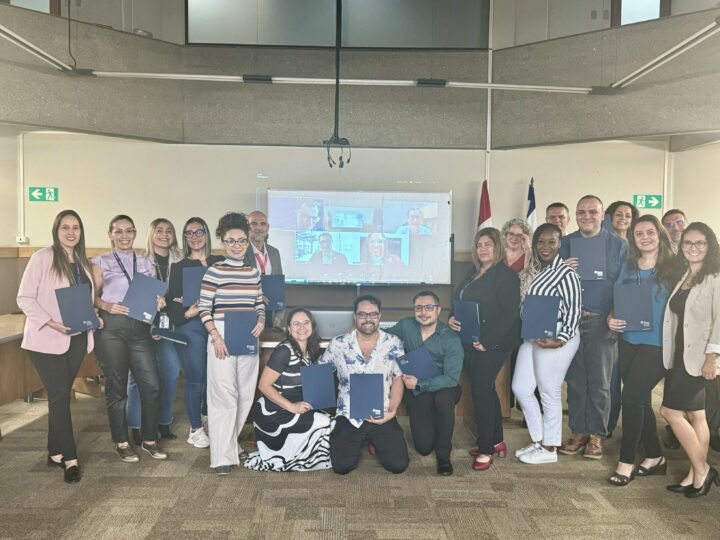
This group of professional psychologists was the first in Costa Rica to receive training in the application of the Unified Protocol.
Their achievement was celebrated at a graduation ceremony on November 27, 2024, attended in-person by esteemed guests, including Ionna Sahas Martin, Ambassador of Canada in Costa Rica; Alexander Leon, Trade Commissioner for Educational Affairs, Technologies, Agribusiness, and Market Access; Fernando Rodríguez Araya, Director of External Cooperation at INA; and, joining virtually, Joanne Maltby, NC’s Associate Director of Global Customized Training and Consulting.
Niagara College is proud to support global professional development through strategic partnerships. This collaboration underscores NC’s commitment to equipping professionals with the skills needed to make a meaningful impact in their communities.
Niagara College’s Institute for Global Education and Training
Bringing together the expertise of a highly skilled NC team with partner organizations worldwide, Niagara College’s Institute for Global Education and Training proudly provides educational solutions designed to inspire sustainable global change. For over 20 years, NC has collaborated with global institutions to develop and deliver customized education and training programs as well as capacity building projects, empowering learners and global partners to achieve their goals. Building on this expertise, NC launched its official global education hub in May 2024. This resource leverages NC’s world-renowned education and training programs while also offering newly developed modularized global programs. Aligned with the United Nations’ Sustainable Development Goals (SDGs), the Institute is committed to fostering impactful partnerships and advancing sustainable development through education.
