
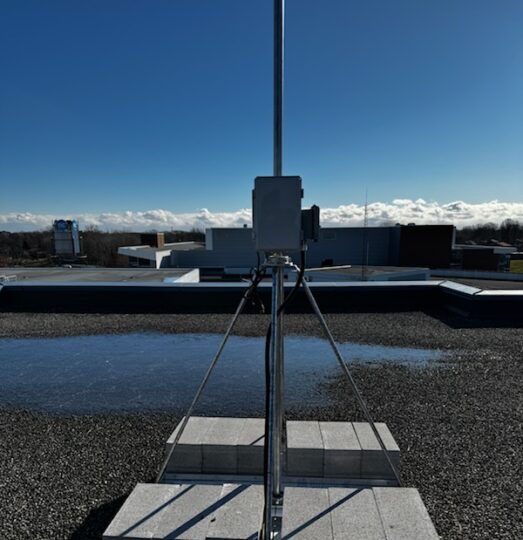
Installation is underway for a Motus tower at the Welland Campus which will track at-risk birds and other migratory species once completed this spring.
Located on the roof of the Simcoe building – selected as an accessible high point on campus – the tower will be positioned to pick up radio transmitters on tagged birds which broadcast unique identifiers as they fly overhead.
Data will feed into a network of hundreds of other towers across North and South America, as well as Europe, connected to Birds Canada’s Motus Wildlife Tracking System. This international collaborative research network uses coordinated automated radio telemetry to facilitate research and education on the ecology and conservation of migratory animals – birds as well as bats and insects.
The Welland Motus Tower will be the second at NC, just two years after the student residence building at the Daniel J. Patterson Campus in Niagara-on-the-Lake became the site of the first Motus tower on campus.
School of Environment and Horticulture Professor Martin Smith noted that while the DJP Campus Motus Tower is able to track birds migrating through North Niagara, the tower at the Welland Campus will be able to detect those flying along the south shore of the region – benefitting the international network as well as learning opportunities for the College’s Ecosystem Restoration students.
Currently, the DJP Campus tower is one of only two Motus receiver locations in the Niagara region – in addition to one in Thorold. The next closest stations are in Grimsby and Port Maitland, and across the U.S. border in North Tonawanda, New York.
“Each tower collects data that are like pieces of a puzzle, and all those puzzle pieces are put together through the network of hundreds of towers,” said Smith. “It’s the collective of the different data points which makes the system informative.
“We can use the data to see where birds were flying, how long it took them to go from station to station, whether they stopped to rest, and how many disappeared or got lost.”
It’s all part of the hands-on applied experience that gives NC’s Ecosystem Restoration students an advantage when they graduate. Students gain direct experience with monitoring techniques, hands-on training with the equipment and how to navigate the sophisticated monitoring system, and technical training which improves their employability.
Even before the tower becomes operational, Smith noted that students learn from the nuts and bolts of the initial installation process as they figure out costs, apply for funding, are involved with the purchase and assembly of the equipment, link the tower to the computer and internet systems, troubleshoot technical issues as they arise, and more.
The Motus tower is used by students who participate in an animal monitoring project for their Species Management course. Students also write formal proposals for funding grants as part of their Ecological Engineering course – an essential skill for many Ecosystem Restoration graduates as they pursue their careers.
Through their written proposals, different classes of Ecosystem Restoration students over the past few years have successfully gained funding to support both of NC’s Motus tower projects.
The DJP Campus tower was supported by a RBC grant for $4,000 and a student-led Go Fund Me Campaign which raised $2,800 to cover purchase and installation of the Motus tower, as well as a $2,531.69 donation from the Niagara Falls Nature Club and $1,000 from the World Wildlife Fund.
The Welland project is being supported by funds raised by students in 2023-2024, including $13,000 from the Niagara Community Foundation (NCF) and $6,000 from RBC.
In addition to supporting the Welland Campus tower, the funds received will enable 11 selected Ecosystem Restoration students to attend a three-day advanced ornithology micro-credential course, with a focus on the Motus system, at Birds Canada’s Port Rowen Observatory March 19-21.
