

The new pathway was thoughtfully designed to be both inclusive and sustainable.
In November, Niagara College completed construction of a convenient and accessible pathway connecting Glendale Avenue to the main building entrance to the Daniel J. Patterson Campus in Niagara-on-the-Lake.
Formerly a gravel walkway, the new paved pathway was carefully designed with accessibility in mind to ensure it can be used by all members of the College community. In alignment with NC’s commitment to sustainability and inclusivity, the Planning, Sustainability and Capital Projects (PSCP) team consulted with several departments including the Office of Sustainability, and EDI and Accessibility.
The pathway was constructed with concrete and ample space to ensures those with mobility devices can maneuver with ease. Rest areas are available along the way for anyone who might need to take a break, including those using mobility devices, experiencing pain, feeling tired, or just wanting to sit down and enjoy the view.
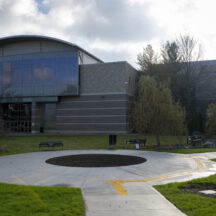

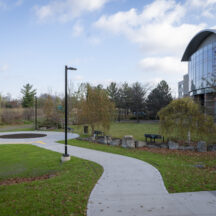
The College plans to install benches in the future.
NC’s Director of EDI and Accessibility, Samah Sabra says that pathway supports the action plan of the College’s EDI Blueprint with respect to increasing barrier-free access across the College, and in support of being more welcoming to members of equity-deserving communities.
“The pathway is an example of our efforts to create more welcoming and barrier-free outdoor spaces where members of our community can spend time alone in contemplation, or congregate with others,” said Sabra.
Improvements to the accessibility of campus spaces were influenced by feedback from students, including those who participated in an audit as part of professor Theresa Anzovino’s class.
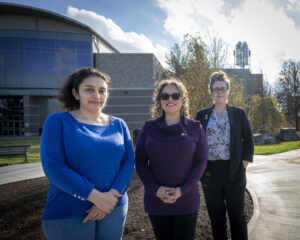
From L to R: Nazanin Nadri,
Planning & Development Senior Technologist; Samah Sabra
Director, EDI and Accessibility; Taryn Wilkinson
Manager, Sustainability.
“We heard from students that accessibility should not be limited to learning spaces, but should extend to indoor and outdoor recreation spaces to ensure the campus is fully accessible to all members of our community,” said Sabra.
The PSCP team opted for ECOPact concrete, an innovative, low-carbon concrete made with blended cement that, when compared to standard concrete, can reduce CO2 emissions by 30 to 50 per cent. It also features a Type III Environmental Product Declaration (EPD), which means the performance and environmental impact of the concrete has been quantified over its life cycle.
“By choosing ECOPact, we are supporting Niagara College’s commitment to sustainability,” said Taryn Wilkinson, Manager, Sustainability. “We hope all students, employees, and visitors enjoy this pathway, which embodies Niagara College’s dedication to accessibility and environmental stewardship.”
Students in NC’s Landscape Technician Program will be designing garden spaces along the path, and Horticulture Technician Program students will be planting and installing the garden beds.
“This project offers a great opportunity for our academic delivery of labs and real life experiences for our students,” said Matthew Orr, Manager, Grounds & Greenhouse Operations.
The project was designed and managed with the expertise of UEM Urban & Environmental Management Inc. as the consultant, and the construction was completed by Rankin Construction Inc.
