
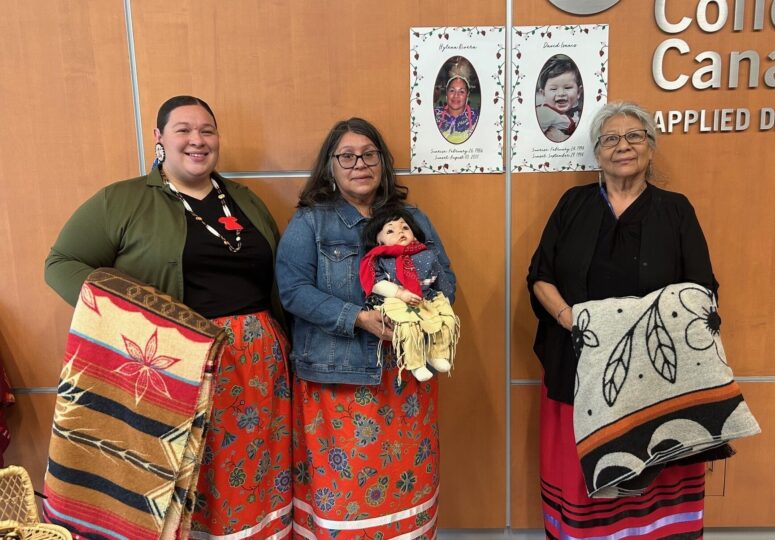
Linda John knows the grief of losing a child. She’s survived it twice.
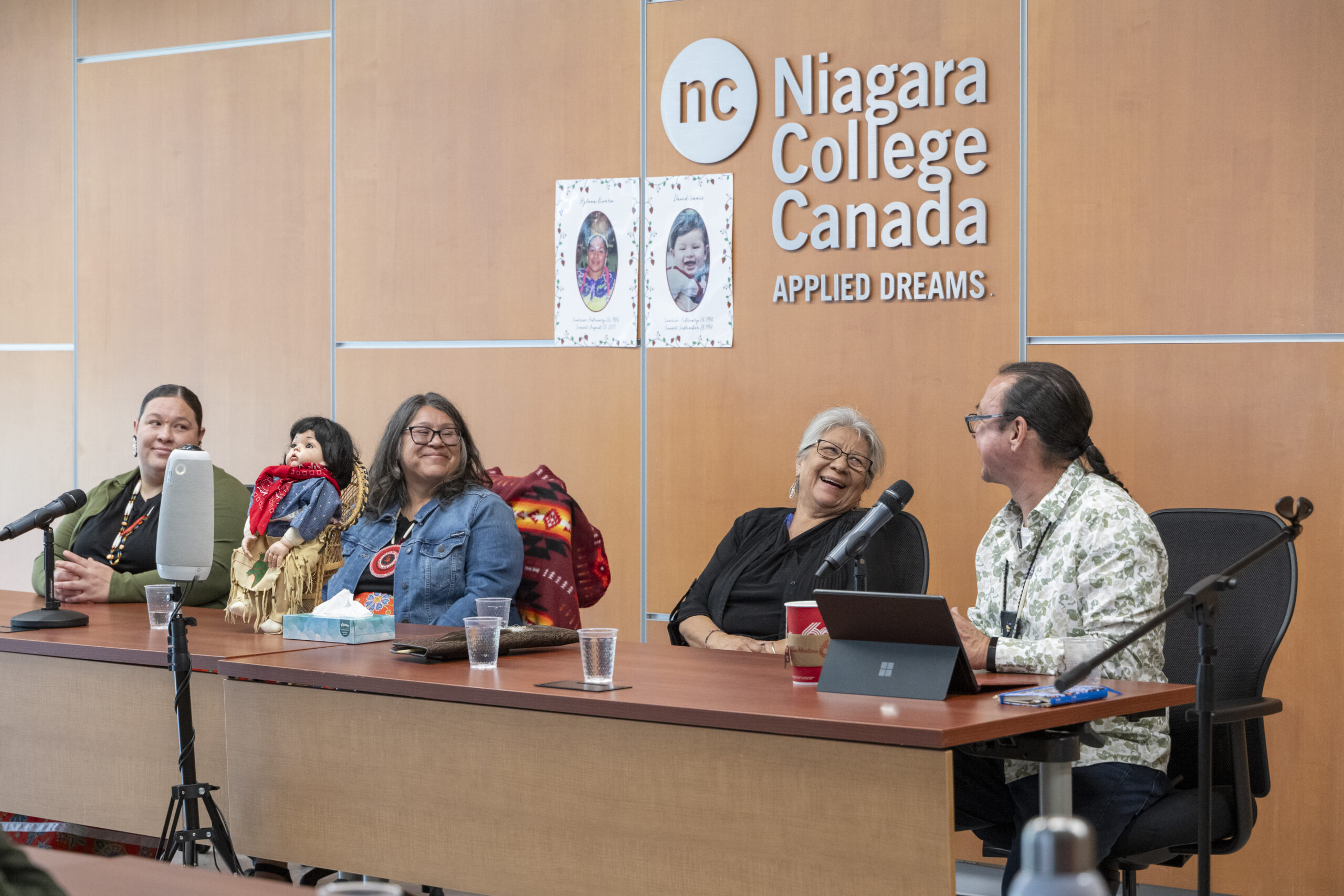
John, a long-time advocate for Missing and Murdered Indigenous Women and Girls and Two-Spirit People (MMIWG2S), was one of three panelists at Niagara College’s Red Dress Day event held at the Welland Campus, May 6. The event was organized by Indigenous Education, the Student Rights & Responsibilities Office and the Days of Significance Committee in honour of National Day of Awareness for Missing and Murdered Indigenous Women and Girls and Two-Spirit People, which takes place annually on May 5.
In 2011, John’s daughter, 25-year-old Hylena Rivera, was murdered by her partner — 17 years after John’s seven-month-old son David Isaacs died from shaken baby syndrome at the hands of his father.
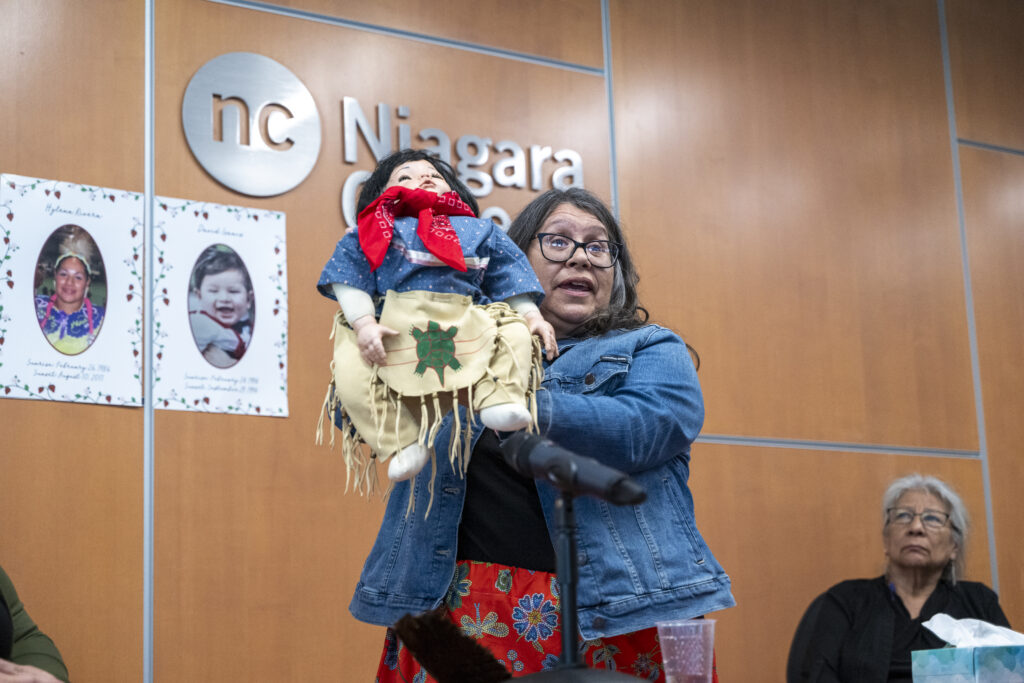
“I didn’t know about death until it happened to me,” John said as she cradled a doll she called “Baby David.” She said she sometimes brings it for support to the events where she’s invited to speak. It’s dressed in an outfit her son wore.
John admitted she was angry with her Creator about the deaths of her children, and she struggled to understand her purpose on earth if not to raise them. Today she believes He knew how strong she was going to become with true divine healing — and that she could use that strength to help others who had experienced the same kind of loss.
John and her daughter Jillian Isaacs are members of the Love Starts With Us Group, which provides counselling to those seeking support for Missing and Murdered Indigenous family members. The group, John said, focuses on healing as a family because it’s entire families that are impacted by the MMIWG2S+ crisis.
John also extends her advocacy to MMIMB supporting Missing and Murdered Indigenous Men and Boys.
“In 1994…we didn’t have counsellors. We didn’t have doctors on hand to help with our mental health or the wellness of our children and our family members,” John said. “We had to advocate.”
She said even when funding was finally provided to the local Friendship Centre in Fort Erie to counsel her family, it wasn’t enough. The funding ran out after only about 12 appointments.
But grief can span for years, and it affects each member of the family differently — a sentiment shared by Isaacs, who sat beside her mother on the panel.
“She was the mother of my siblings,” Isaacs said, motioning to images of her brother and sister pinned to the wall behind her. “She lost her children and I lost a brother and a sister. I’ll never know what that feels like (for her), and thankfully she doesn’t know what it feels like to lose a sibling. (They’re) two different stories impacted in a different way, but the same tears and the same hurt…same intergenerational trauma passed to our generation–and the same intergenerational healing. We have to put that balance there.”
Isaacs said she has and continues to learn about healing from her mother as they travel across traditional territories and cities in Canada to share their stories and support MMIWG marches, rallies and awareness gatherings, noting that “missing” is a term that isn’t exclusive to the women who never returned; it’s applicable to their family members, too.
“My sister has three daughters,” Isaacs said. “They are missing a part of themselves today. So when I hear people talk about missing women, my love goes to all the women that are in fact missing and their families have no closure, no justice. But I (also) look to the women and girls and my family and my community and I say ‘There’s a piece of them missing, too.'”
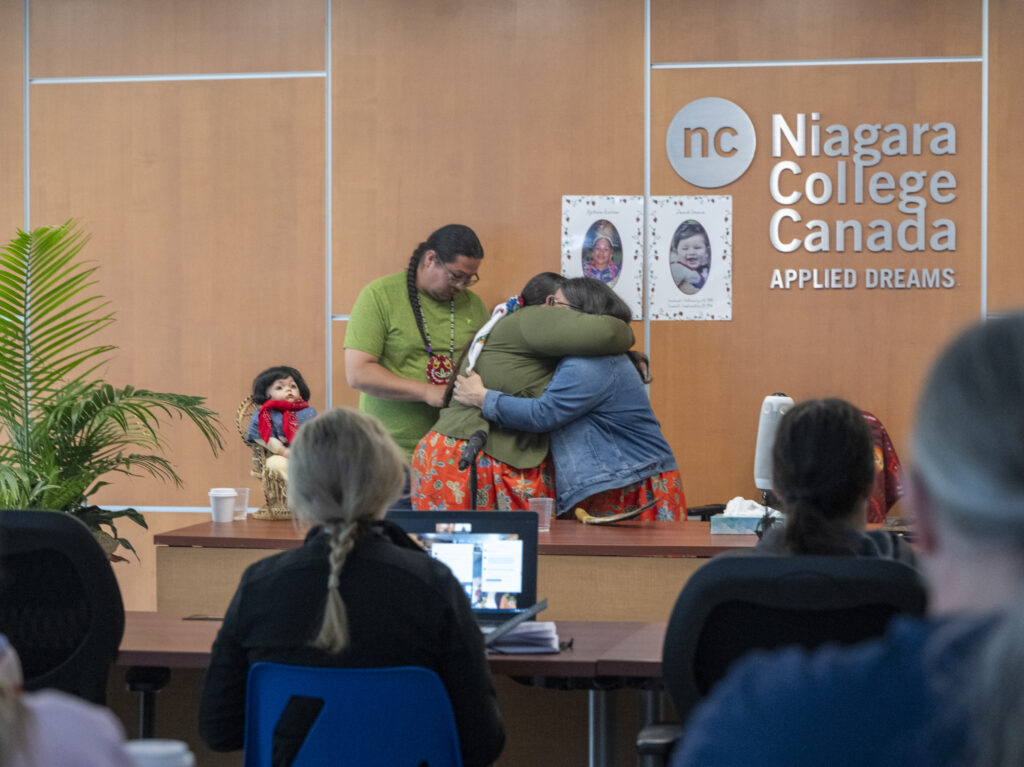
John and Isaacs were joined on the panel by Jackie (Tekaiatakwas) Labonté, who has worked with Indigenous organizations for more than 30 years. A member of the Mohawk Turtle Clan from Six Nations of the Grand River Territory, Labonté has worked with individuals and within groups sharing traditional teachings and facilitating ceremonies. She spent two decades working with individuals and families experiencing crisis situations and domestic violence and assisting them on their path of healing for healthy lifestyles.
For the past six years, Labonté has been at De dwa da dehs nye>s Aboriginal Health Centre in the Traditional Healing Program.
Labonté said she was introduced to the Sisters in Spirit movement when she was with the Niagara Regional Friendship Centre, describing it as the original Red Dress initiative. It was a program led by the Native Women’s Association of Canada and funded by Status of Women Canada to research and document the statistics of violence against Indigenous women in Canada. It was also intended to raise awareness and education about the treatment of Indigenous women.
“Sisters in Spirit came about as a result of what was happening with Indigenous women,” she said. “So we started holding events, and over time it’s built up to what it is today. But that awareness still needs to be put out there.”
She said May 5 might be National Day of Awareness for Missing and Murdered Indigenous Women and Girls and Two-Spirit People, but it shouldn’t be something only recognized for one day.
“It needs to be every day,” Labonté said, adding it’s her hope that by people continuing to share more stories, it will raise even more awareness and compassion.
“We can take little steps as we join together to be able to do something in a most positive, beneficial, good way.”
National Day of Awareness for Missing and Murdered Indigenous Women and Girls and Two-Spirit People–also known as Red Dress Day–was inspired by Métis artist Jaime Black’s REDress Project installation, in which she hung empty red dresses to represent the missing and murdered women. Red dresses have become symbolic of the crisis as a result of her installation.
Niagara College participated in Red Dress Day by hanging dresses at the Daniel J. Patterson and Welland Campuses and lowering the flags to half-mast. The Libraries and Learning Commons also had a display out featuring books about MMIWG2S.
