
Each year, Practice in Business Analytics students work with local, national, and international businesses in a variety of sectors including education, sports, non-for-profit, government, health, e-commerce, and more to solve real-world business problems. Working in teams, students gather and analyze data to develop solutions and recommendations that help businesses overcome difficulties and enhance performance. This hands-on experience is captured in the student Business Analytics Capstone Projects part of the capstone course, Practice in Business Analytics.
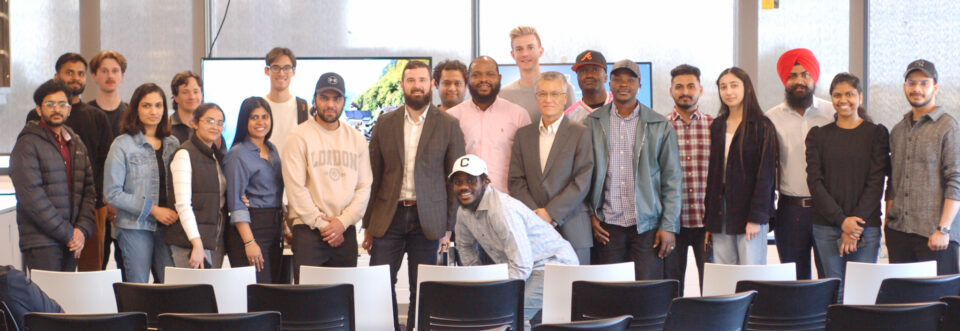
On April 15, eight student teams showcased their projects at the Daniel J. Patterson Campus in Niagara-on-the-Lake, presenting project highlights and answering audience questions during 15-minute presentations. These projects, featured on the Project Portfolio website, spotlight the collaborative efforts of student teams, highlighting industry partnerships and key components of the academic program. They also demonstrate the solutions, approaches, and tools mastered by students.
“The value of business education is on full display alongside our strong partnership with organizations like the Hope Centre and Niagara-on-the-Lake senior housing, a shining example of how community engagement and practical education can create positive change,” said Evan DiValentino, Interim Dean, Business and Environment.
The Project Portfolio website was a project created by Business and Management Studies Program Coordinator and Professor Nick Farnell, which earned him a 2023 President’s Award for Innovation in Student Learning and Success for his innovation.
“It is to the credit of committed and passionate Business Analytics’ faculty that these students are graduating with the skills and confidence required to succeed in a variety of industries similar to those represented in these projects,” said April Tyrrell, Associate Dean, School of Business & Management. “We are grateful to our faculty for the way they have inspired students to grow both personally and professionally.”
Below is a recap of the Winter 2024 term’s Business Analytics Capstone Projects that partnered with and provided support to local organizations surrounding the NC community. A recorded livestream of all Business Analytics Capstone Project presentations from April 15 is also available for viewing here.
Hamilton Cardinals Baseball

Partnering with the Hamilton Cardinals baseball club, part of the Intercounty Baseball League (IBL), students were tasked with analyzing league data to help the club gain a competitive edge. As the team underwent ownership changes, they aimed to leverage analytical insights to enhance their performance and win more games in the upcoming season.
Drawing inspiration from the MLB’s statistical analysis-driven decisions, the student group focused on ballpark factors, pitching, and competition analysis, aiming to provide actionable insights that would give the Cardinals a competitive advantage.
Facing the challenge of limited prior analysis within the league, students used dynamic web scraping and data structuring techniques to gather essential data from platforms like Pointstreak. Their insights were consolidated into an accessible dashboard, offering a breakdown of analysis for all nine teams within the IBL. This dashboard will help equip the Cardinals with valuable information to prepare for games, from ballpark factors to scoring trends, with the hope of translating insights into on-field success in the upcoming season.
Niagara College Registrar
Students were challenged with developing a predictive model to assess college student success and crafting a visually informative, interactive dashboard showcasing enrollment patterns and success trends at Niagara College. This initiative aimed to optimize student enrollment efficiency and support academically engaged students facing conflicts, encompassing both domestic and international cohorts. Through in-depth data analysis, the project sought to uncover patterns and create tailored strategies for both student groups.
Encountering hurdles in streamlining enrollment procedures, identifying academic conflicts, and implementing interventions for student success, the student team navigated challenges diligently. They curated a comprehensive dataset including enrollment, academic, and demographic data for both domestic and international student populations. Leveraging predictive modeling, specifically the K-Nearest Neighbors (KNN) algorithm, the project aimed to predict student success and identify at-risk students effectively.
In addition to the predictive model, students produced a descriptive analysis report and developed a Power BI data visualization dashboard highlighting enrollment trends and student success metrics. This multifaceted approach aimed to provide stakeholders with actionable insights to enhance student enrollment processes and support academic success at the College.
Niagara-on-the-Lake Senior Housing

The student project encompassed a collaboration with concerned residents and a survey team from Niagara-on-the-Lake council and aimed to evaluate the need for senior’s housing in the community. By analyzing survey data and comparable sources, the project sought to gather comprehensive insights into seniors’ housing needs and preferences. The primary goal was to inform the development of tailored housing solutions promoting independence, safety, and well-being.
Recognizing the complexity of seniors’ housing needs, the project addressed diverse challenges such as varying health conditions, financial constraints, and individual preferences. Through a multi-stage process involving comprehensive research, data collection, and analysis, the project aimed to identify key trends and insights. The findings will help guide the formulation of recommendations for housing solutions tailored to different segments of the senior population, presented alongside implementation strategies and potential collaboration partners.
With the evident and growing need for senior housing in Niagara-on-the-Lake, collaborative efforts from residents, developers, government, and social organizations are essential. The project highlighted the urgency to address significant challenges, including the diversity of seniors’ needs and financial limitations, to develop suitable and accessible housing options.
Welland Fire Department
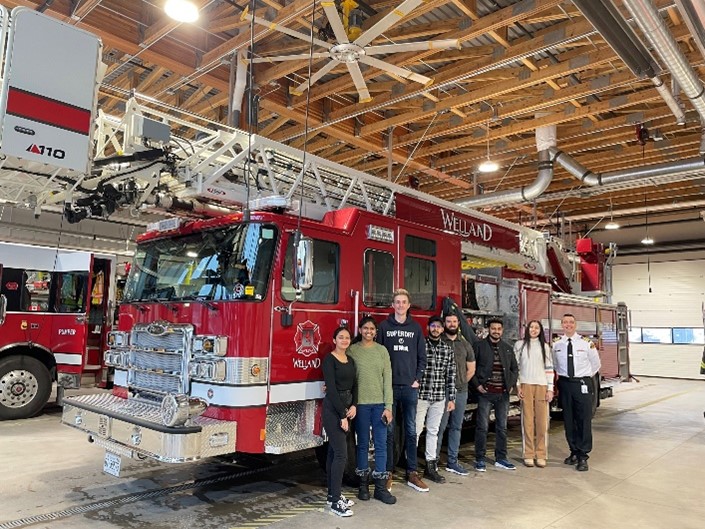
Students partnered with the Welland Fire Department to analyze emergency response times and identified fire-prone areas, aiming to build a predictive model based on this data. The extensive dataset from the Fire Department underwent thorough cleaning and sorting to facilitate meaningful analysis and visualization. Using Excel’s functions and Power BI, students created insightful visuals, including heatmaps, graphs, and station-specific data.
Students’ key findings revealed high-response areas such as Cordage, Market Square, and White Pigeon, with Fire Department No. 3 recording the highest number of rescues. Additionally, students were able to identify top locations with shortest and longest response times.
To dive deeper into analysis, the student team explored factors influencing longer response times, like distance from stations and population density, to identify fire hotspots and improve emergency management.
Welland Hope Centre

In collaboration with The Hope Centre, a local organization offering vital support to individuals and families in Welland facing various challenges including poverty, mental health issues, addictions, food insecurity, and housing instability, this student project aimed to enhance stock management and operational efficiency. The primary focus was on developing a sophisticated forecasting model to optimize resource allocation. Additionally, the students aimed to leverage geospatial mapping to pinpoint underserved areas within the Welland Region, aiding the establishment of satellite food banks to better serve those in need.
Despite its pivotal role in the community, The Hope Centre encounters obstacles such as limited outreach to Welland’s vulnerable population and the challenge of acquiring sufficient donations. These challenges are further compounded by uncertainty in food bank demand. To address these issues, the student project proposed a multifaceted solution. First, they implemented a robust forecasting model, effectively mitigating demand uncertainty and ensuring optimal stock levels. Furthermore, they provided geo-mapping tools to identify and reach more vulnerable individuals in the region, expanding outreach efforts and strengthening community support initiatives.
Through this collaborative effort, the students aimed to bolster The Hope Centre’s impact and sustain its vital role in community support.
For more information on all Business Analytics Capstone Projects from the Winter 2024 term, visit the Project Portfolio website here.
