
With the solar eclipse on the horizon, Photonics students at Niagara College are putting a unique “lens” on this rare cosmic phenomenon.
Photonics is the study of the physical science of light waves. The total solar eclipse – the first in Canada since 1979 – is a unique opportunity for NC students in Canada’s only Photonics Engineering Technician and Technology programs to apply their learning.
“Be it the filters in your solar eclipse glasses, the telescopes used to monitor the eclipse, the camera in your smart phone snapping a selfie during Totality, or the internet’s fibre-optic backbone transmitting that picture around the world, the demand for optics technology is pervasive and the study of Photonics is critical” said NC Photonics Professor and Program Coordinator Alexander McGlashan. “The expertise of Niagara College Photonics graduates support industries in aerospace, life-sciences, defense, entertainment, agriculture, industrial manufacturing, telecommunications, and more. If you want to make the future, you can do it in Photonics.”
The rare astrological event presents scientists with unique conditions for study and experimentation. During a solar eclipse, scientists use instruments like telescopes, spectrometers, filters and sensors to study the solar corona – the outermost part of the Sun’s atmosphere that will be uniquely visible during the eclipse – and better understand solar winds.
The very instruments used by scientists in these experiments are built and tested by Photonics technicians and technologists, and student projects at NC are focused on the manufacturing of these instruments.
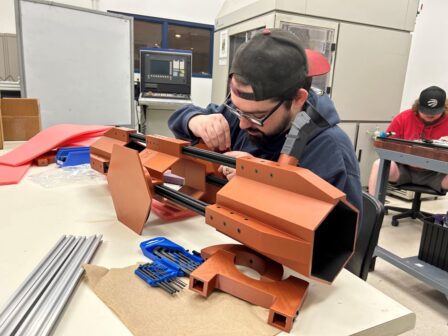
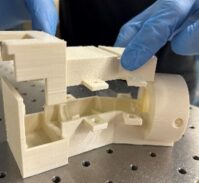
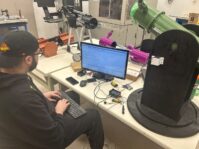
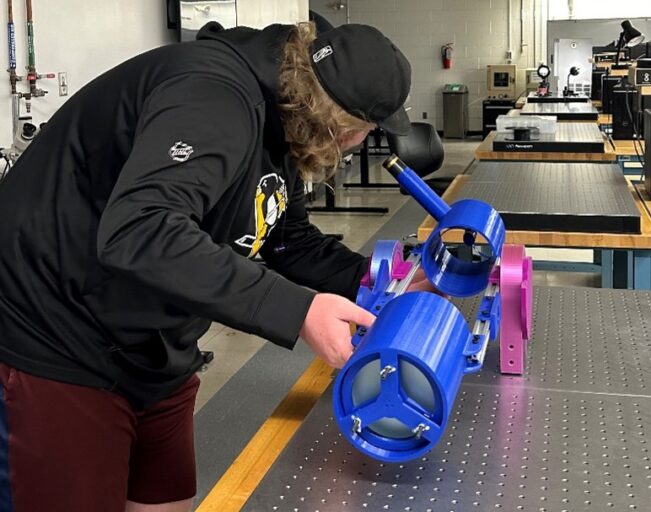
For their capstone project this winter, third-year students designed, built and tested a 4in aperture Newtonian telescope with 900mm focal length. Students also designed and assembled spectrometers that can be connected to the telescope, allowing spectral analysis of distant stars.
Students will share their project journey at the Eclipse on the Escarpment event hosted by Brock University.
“Our goal is to highlight the contributions that technicians and the technologist bring to scientific discoveries as the makers of the scientific world,” said Photonics Professor Cristina Simionescu.
Students Robert Gallagher, Vince Iuliano, Darian Tough, Eric Nicolescu and Samantha Turpel modelled their optical designs with Synopsys CODE V, their mechanical designs with Autodesk Fusion 360, and program interfaces using NI LabView and Python. Mechanical parts are 3D printed, and applied optical manufacturing and testing techniques are used to align and test their systems.
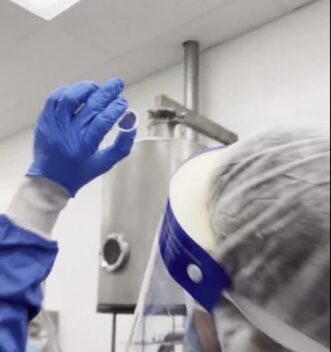

Telescopes alone are not the only optical devices that scientist use during an eclipse. They also use various optical filters, including the neutral density filters we know as “solar filters” as well as infrared or UV filters. Photonics technicians manufacture and test high quality scientific filters according to various standards depending on the final application, including ISO standards.
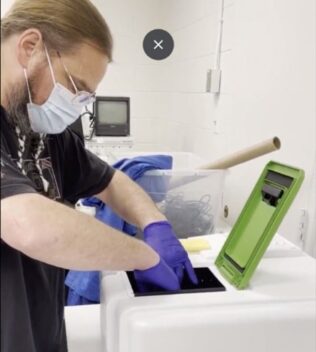
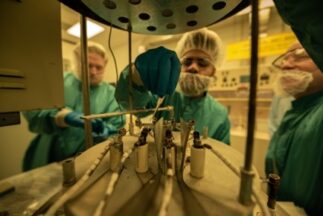
The Photonics program at NC is the only college-level program with a teaching cleanroom where students learn to operate vacuum deposition systems, constructing their own optical filters and characterizing them with photometric and spectroscopic equipment.
Optical filters are an essential part of all modern technology, from eyeglasses, medical diagnostic equipment, smart phones, to self-driving cars, telescope, and Martian rovers.
Learn more about the Photonics Engineering Technician and Technology program.
