
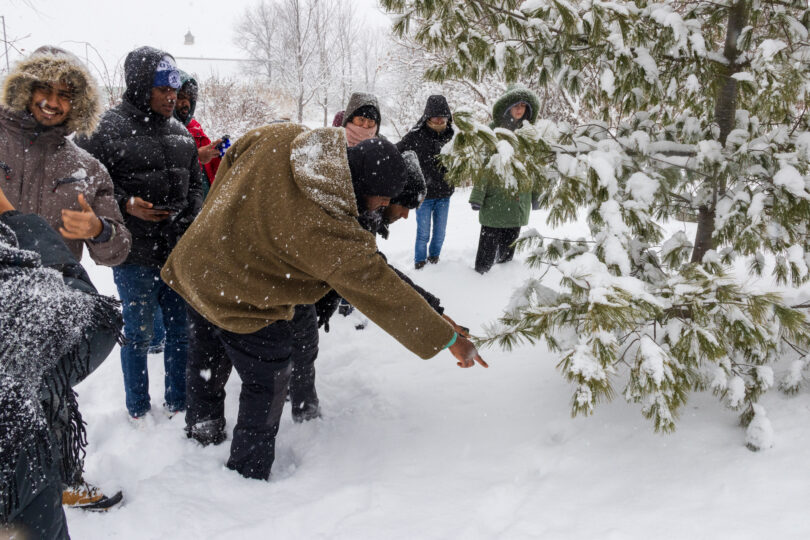
Nature-loving NC students trekked through deep snow this January to hunt for animal tracks on the Daniel J. Patterson Campus in Niagara-on-the-Lake. A UNESCO-designated World Biosphere Reserve, NC’s campus is home to a wide range of species and the grounds are stewarded by students, staff and faculty.
“Mammals can be very shy creatures, especially around loud animals like us, so animal tracking gives us a chance to see what else calls the DJP campus home and gather information about their behaviour,” explained Katie Bristow, Sustainability Program & Outreach Coordinator. “It can include what food they eat, the routes they travel, and what areas they avoid.”

Students participating in the animal track identification workshop.
Intense flurries proved to be a challenge for the group who had to move quickly before animal tracks were covered by fresh snow. Twenty-six students from NC’s Hospitality and Tourism Management program spent almost two hours tracking wildlife, identifying tracks of rabbits, dogs, coyotes and deer around the Wetland Ridge Trail lagoon and into the escarpment.
The search for animal tracks was led by Haadeon Scott, a second-year Environmental Technician Field and Laboratory program student.
“Haadeon is a very passionate outdoors man who loves connecting people with nature and loves bushcraft,” said Bristow.
“My knowledge of nature and bushcraft drew me into the Environmental Technician program because I wanted to know how to preserve the land,” said Scott, who hopes to join the army reserves after graduation and work for a provincial or federal agency in environmental conservation.
“I love the concept of utilizing environmental tactics to preserve the natural world so that I can help everyone live in a lusher, greener, healthier place,” he said.
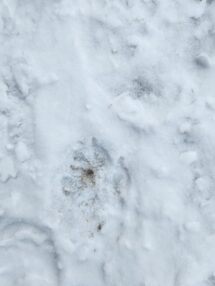


The animal tracking initiative supports student learning and helps the Sustainability Office maintain their Biodiversity Inventory.
“Students learned that the wildlife here is active during all times of the year,” explained Scott. “During the wintertime they will travel from location to location and eat food that they have stored away, an example being squirrels.”
“It aids us in certifications for campus like the Audubon International Cooperative Sanctuary certification,” said Bristow.
Bristow says that the effects of climate change and El Nino have created warmer winter conditions which have delayed their efforts to track wildlife.
The practice of monitoring campus wildlife supports many of the UN’s Sustainable Development Goals (SDG’s) to which the College is committed as part of their signing of the SDG Accord. The SDG’s to which the practice of identifying animal tracks most closely aligns are:
- Target 4.7. By 2030, ensure that all learners acquire the knowledge and skills needed to promote sustainable development, including, among others, through education for sustainable development and sustainable lifestyles, human rights, gender equality, promotion of a culture of peace and non-violence, global citizenship and appreciation of cultural diversity and of culture’s contribution to sustainable development.
- Target 11.4. Strengthen efforts to protect and safeguard the world’s cultural and natural heritage.
- Target 11.7. By 2030, provide universal access to safe, inclusive and accessible, green and public spaces, in particular for women and children, older persons and persons with disabilities.
- Target 12.8. By 2030, ensure that people everywhere have the relevant information and awareness for sustainable development and lifestyles in harmony with nature.
- Target 13.3. Improve education, awareness-raising and human and institutional capacity on climate change mitigation, adaptation, impact reduction and early warning.
