
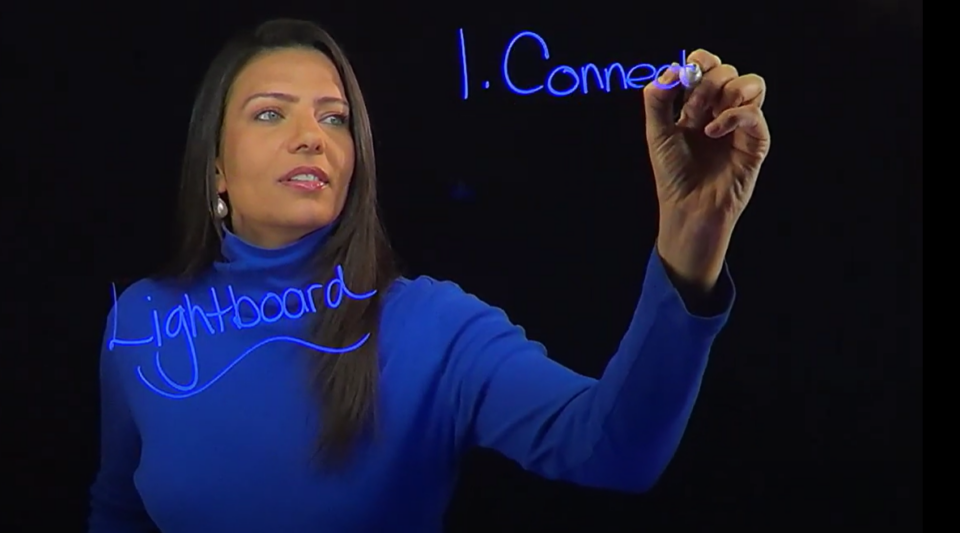
When the onset of the COVID-19 pandemic led Shauna Gupta to teach online instead of on campus, she missed the connection she had with the students she was used to seeing every day. And she didn’t want them to feel equally disconnected from their instructor and their peers.
That’s when the English for Academic Preparation Professor turned to YouTube to learn more about an educational technology tool she’d heard of before: a lightboard.
A lightboard is a transparent whiteboard that’s made of glass and illuminated around the edges so the writing on it glows. The glass is positioned between the speaker and a camera and when the presenter is being filmed writing on the lightboard, the image is mirrored so the viewer sees the writing correctly.
When used in an educational setting, a lightboard allows an instructor to reach auditory learners who learn best when they hear the content, and visual learners who need to see the information to truly absorb it.
“It’s really helpful because it’s a nice, strong, colourful visual — especially when you’re breaking down sentence structure and grammatical structures,” Gupta said.
Knowing it was already being used as a teaching vehicle by post-secondary institutions elsewhere, Gupta believed it would be the perfect way to put herself and her lessons directly in front of her students while her classes were conducted remotely.
“I was really missing being in the classroom,” she said. “I missed being a teacher, and everything that goes with being a teacher.”
Lightboarding, she noted, enables teachers to create a more connected and personal feel in their online classes.
“This set-up is highly conducive to creating a natural link between the teacher, the student and the content, creating the atmosphere of a live lecture [that invites] your students to join you in your thought process as you provide a detailed explanation of the content,” she said. “It is a novel approach to instruction as it creates a dynamic and highly communicative online classroom environment.”
With her boyfriend’s help, Gupta set out to construct a lightboard of her own that would reconnect her with her students to make their online learning experience better.
“[He’s] super tech savvy with lighting and cameras and physics — all the technical aspects,” Gupta said. “He helped me quite a bit to set it all up. It was a fun COVID-19 project.”
In total, it cost her about $350 in material to make it from items she picked up at Lowe’s, plus the time she spent researching how to build it.
“We looked at a lot of YouTube videos and DIY projects and there are a lot of people who’ve already done it. So, [we] kind of copycatted them and put it together,” she said. “It was fun. It’s fun to learn new things.”
Gupta even started a YouTube channel “just for fun” called Grammar Glass, where she posts grammar lesson videos with the help of the lightboard. She currently has about 20 videos on the channel that teach grammar concepts like verb tenses and English sentence structure.
She also applied to participate in a research study led by Michael Justason, Program Chair, Civil Engineering Infrastructure Technology at McMaster University, into the effectiveness of lightboard teaching.
But it was the way she was able to improve the online learning experience for her students that lit Gupta up. She finds teaching with Lightboard inspirational in itself.
“It has this very entrepreneurial, 21st century energy to it. To me, that’s the biggest thing,” she said. “I can teach grammar any way. They can learn grammar any way. But it’s kind of the spirit in which you’re teaching.
“[It’s] teaching other things beyond the curriculum, like in other ways that you don’t even have to talk about. It’s present in the way you’re teaching, or the energy [in which] you’re teaching it.”
For the impact she had on her students by introducing lightboard technology to the way she teaches, Gupta was one of 15 people selected to receive the first-ever President’s Award for Innovation in Student Learning and Success.
The Award celebrates the outstanding efforts of NC employees and the innovative spirit of the NC community.
“It recognizes individuals and teams alike, including unique collaborations that often involve students and community members,” said NC President Sean Kennedy.
Specifically, the award acknowledges people who’ve made an impact on student engagement, learning, or success in remarkable ways by innovating aspects of their work or by creating new opportunities.
“It is wonderful that Niagara College has recognized this highly innovative Ed Tech tool,” Gupta said of winning the award. “In my opinion, lightboard technology has the potential to be a powerful piece of Niagara College’s new strategic vision, presenting Niagara College as a leading-edge, trailblazing academic destination.”
Gupta’s students saw it as a positive learning tool, too.
“[My students] loved it; they thought it was so cool,” she said. “They really loved that their teacher was putting in so much effort and that I was inspired.’
Even with on-campus teaching, Gupta said Niagara College could still benefit from having its own lightboard studio where faculty members could teach live or remotely. Having a lightboard studio could also create opportunities for students enrolled in other programs at the College.
“When other universities do it, they have a whole tech team doing the recording, doing the uploading, doing the lighting,” Gupta said. “I was doing it all on my own.”
Gupta’s homemade lightboard can be seen in action on her YouTube channel Grammar Glass – Lightboard Teaching Studios.
