
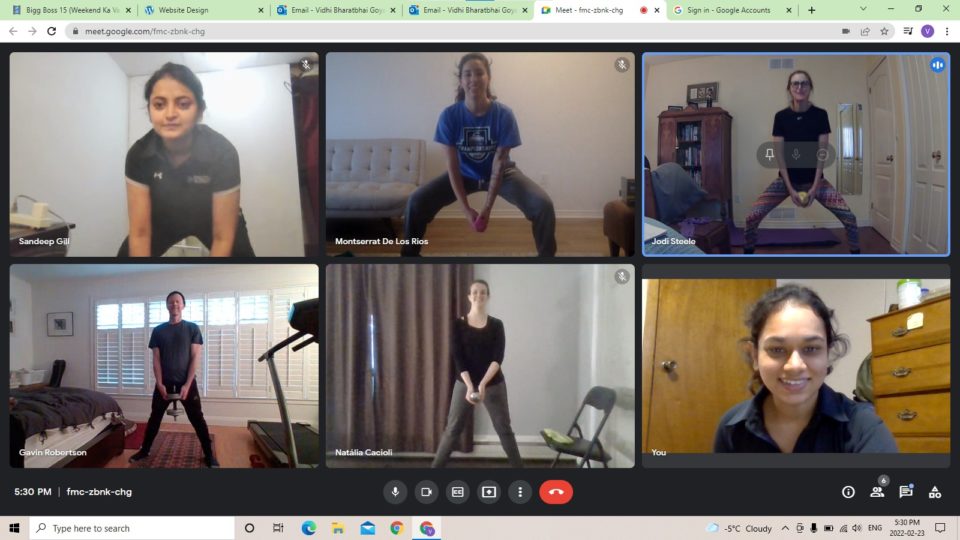
It’s a vintage year for physical fitness among Niagara College wine students.
Thanks to a new collaboration with the College’s Exercise Science and Health and Performance (ESHP) program, NC’s Winery and Viticulture Technician students have been shaping up for a successful harvest season with fitness classes over the Winter term.
The idea for the collaboration stemmed from College Winemaker and Professor Gavin Robertson who knows the physical rigours of working a grape harvest firsthand. He noted that while many may conceive of wine-making as black tie tastings, sniffing and swirling, meditative barrel topping and science lab work, its physical aspects, which are integral to long-term success, can often be overlooked.
“Harvest involves working on your feet for several weeks straight during the fall, with only an occasional day off, literally running around damp, cold, slippery wineries, up and down stairs, catwalks, ladders, through an obstacle course of moving machinery, vehicles and endless tripping hazards,” he said. “The job is incredibly demanding in terms of strength, stamina and balance and it’s really easy to roll an ankle or strain your back – an injury that could put you out for the harvest season or longer.”
In 2019, he approached faculty members within NC’s School of Justice and Fitness with the idea to incorporate athleticism into the wine student experience, before students go into the field for their winery harvest practicums. The idea was embraced and a fitness program first launched in early 2020, before it was stalled due to the onset of the COVID-19 pandemic. The initiative sprung back full force in January 2022, when ESHP students pivoted to an online delivery.
The training program for wine students was custom designed for their specific needs. ESHP students toured the NC Teaching Winery and vineyard to become acquainted with what a day in life of a harvest cellar hand is like.
Two ESHP students, Sandeep Kaur and Vidhi Bharatbhaii, are leading the classes as part of their 75-hour program placement requirement. Kaur and Goyani, who were both physiotherapists in India before enrolling in NC’s ESHP graduate certificate program, lead three 45-minute virtual classes per week. They provide all instructions and safety measures, as well as a weekly program sheet so the wine students have a written program when the placement concludes.
Goyani noted that the classes incorporate circuit training, which involves whole body strength along with aerobic training, to prepare the wine students for long days on their feet during the harvest and for lifting items such as ladders and hoses overhead which can weigh up to 40 pounds.
The virtual sessions incorporate gear such as resistance bands and other items easily found around the house, while still providing an intense workout.
Goyani values the experience she is gaining in delivering the sessions in an online platform and creating a training program for the students. “The way you give commands and instruct students to maintain proper posture while doing exercise is very different virtually, than in person,” she said. “But I got to know how to do it after one or two sessions.”
For Kaur, it’s the first time she has run exercise sessions online and believes the experience will help her in the future. “The best thing about running an exercise session is that I’m training myself along with the students,” she said. “Working with students and helping them to become comfortable with all the exercises to improve their endurance is rewarding for me.”
ESHP professor Jodi Steele said the placement is in perfect alignment with the ESHP program, as the students provide exercise programming, are able to adjust for special populations and health considerations, and use an online platform. She views it as an opportunity for students to apply their skills while helping other students.
“Online platforms are here to stay. They may be the wave of the future,” she said. “I think it is wonderful opportunity to collaborate with another program and offer a needed service to NC students.”
First-year Winery and Viticulture Technician student Natalia Cacioli Pancheco uprooted her life in San Paolo, Brazil, where she worked on the marketing side of the industry, to move to Canada and pursue winemaking and viticulture at NC. She got a taste of working the harvest last fall.
“These are very long days, and besides carrying heavy bins of grapes and equipment, we need to be prepared to stand for many hours,” she said. “I was aware that viticulture and winemaking have nothing to do with the fancy and glamorous side of wine tastings and events, but that was the lifestyle change that I was looking for in the first place.”
She has been attending the sessions twice a week and is thankful for the dedication of the fitness team.
“I’ve worked mostly in regular nine-to-five jobs in front of a computer, so I definitely need some physical trying to keep up with the heavy work in the vineyard and winery,” she said. “I think this training program will be important not only to get me prepared to do the work itself, but also to help me avoid injuries and I’ll feel much more confident to do what is required.”
Montserrat De Los Rios, who is also a first-year student, has been attending classes twice a week in preparation for her first harvest this fall and as a fun way to stay active with her classmates.
“It’s definitely helpful. During COVID, I haven’t been able to go to the gym regularly,” she said. “They’re short programs but they can be as intense as I want to make them – we have the option to use any weights we want and were provided with resistance bands which are great. Plus they give us modifications on the exercises to make them harder or easier.”
The wine students are in better shape since they began the virtual training in January, Robertson said. In addition to preparing them physically, it also helps prepare them mentally and imparts an awareness that winemaking and grape growing is a hands-on vocation.
“If they can carry that level of fitness through to the harvest they’ll be set up to hit the ground running and really thrive, and not just survive, during their work term next fall,” he said.
