
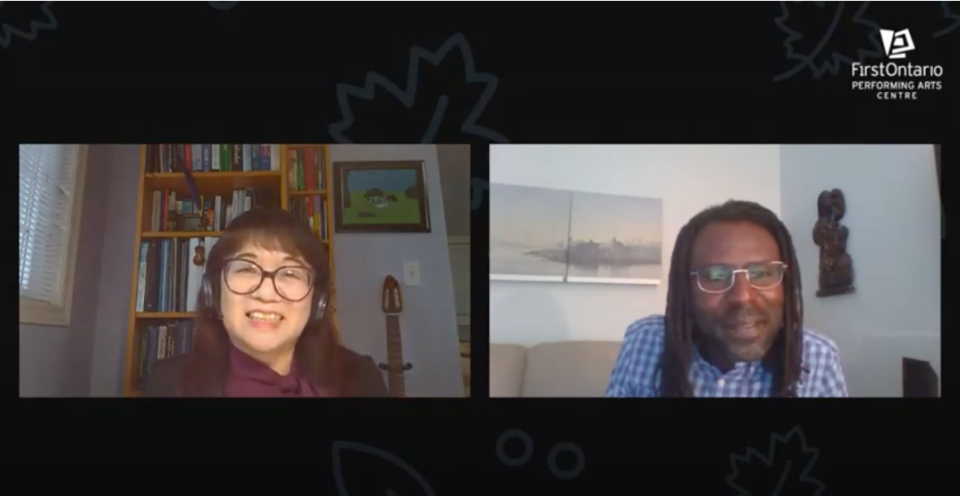
Jolie Phuong Hoang knows hate can happen at any time.
The Niagara College math professor, who originally hails from Vietnam, has experienced anti-Asian racism since immigrating to Canada as a teen in 1984. But Hoang, who is also an author, has experienced plenty of kindness and caring, too, particularly on the job.
“I have to say, where I live and also where I work at Niagara College, I see such a caring a community, welcoming and respecting of diversity,” Hoang said. “I always feel a sense of belonging and confidence.”
Hoang made the comment last week during the latest instalment of Local Reflections on Racism, an online discussion hosted by the FirstOntario Performing Arts Centre in partnership with the Niagara Folk Arts Multicultural Centre and the Niagara Anti-Racism Association.
Hoang, who has written about her family’s escape to Canada from war-torn Vietnam, was a featured speaker in the series intended to promote racial justice in St. Catharines and Niagara.
Her first book, Anchorless, was released last year and has won several awards. Written from the perspective of Hoang’s father’s ghost, the story is about the sacrifices her family made in the name of freedom from communist Vietnam, including living in a refugee camp in Indonesia for 14 months.
Hoang’s father was the only member of her immediate family who didn’t survive escaping Vietnam in the 1980s.
Writing the story helped Hoang better understand what her parents did for their children while also helping to grieve her father’s death, she said.
“When I write, I discovered the beauty of the English language. I embrace it. I think it’s so beautiful.”
But it’s also rife with harmful words, too, which she made a point of learning when she arrived in Canada.
“Facing discrimination, whether it’s intended or unintended, is very disappointing and traumatizing. Awareness is very important,” Hoang said. “As a newcomer to Canada, when I arrived in Canada, I believed I should learn the vocabulary associated with racial slurs and also the definitions of words related to the topics.”
Hoang advocated for newcomer transition programs to teach racist vocabulary, and explore the concepts racism, dominant culture, ethnicity, stereotypes and privilege, to help people better cope when faced with anything from overt hate to more covert micro-aggressions.
“Learning the vocabulary, building conversation around these topics will encourage the sharing of individual experiences,” she said.
Still, coming to Canada paved the way to a bright future, she noted. It’s where she had the freedom to achieve becoming both a college math professor and now a published author.
“I felt that Canada embraced me, my sisters and brothers. It’s a land of opportunity and it allowed me to practise my freedom and achieve my dreams,” Hoang said. “When I first arrived, that’s how I experienced it. Often, I forget I experience racism or discrimination. Maybe I forget or it’s minor. I’d hear from my friends, ‘Jolie, be careful. Someone just yelled a comment that’s not kind.’ Every immigrant has a different experience, however.”
Hoang is currently working on her second book, Three Funerals for My Father, which will be published by Tidewater Press in October. This book tells the story of her family’s escape from Hoang’s own perspective and serves as a plea on behalf of the millions of refugees currently seeking asylum across the globe.
“In terms of the evolution of my writing, I feel I’m ready to tell the story. I’m ready to put my real thoughts on paper,” Hoang said. “I have to share my true experience.”
A recording of Hoang’s discussion is available for viewing on YouTube.
