
Sometimes high-stress situations can do a person good.
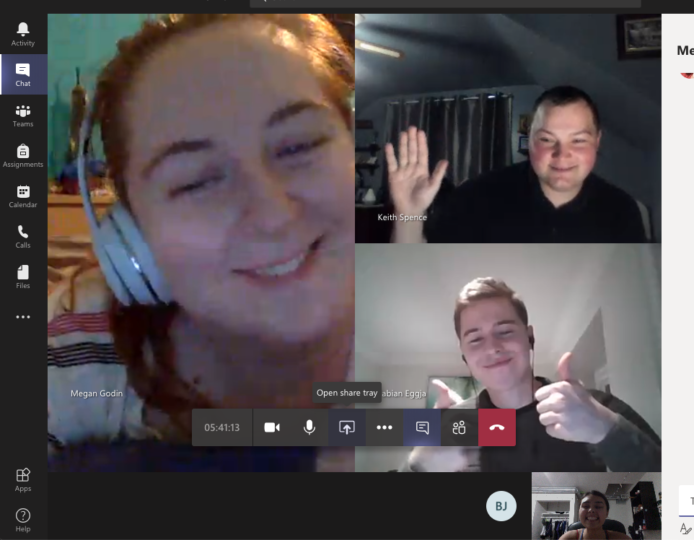
Take Megan Godin. Last week, the third-year Business Administration-Marketing student at Niagara College, found herself participating in the first NC Sustainability Hackathon.
The stress? It came from having to find sustainable business solutions in a short time for a local entrepreneur and do it with a group of people she didn’t know. But Godin wouldn’t change a thing about the event devoted to helping businesses survive and thrive sustainably in a pandemic.
“It was very high-stress,” Godin said. “I found it great education-wise but also personally because I made really good friends. It was really outside my comfort zone so it was a great experience for me as well.”
Godin was one of more than 130 students from various College business programs to participate in the virtual NC Sustainability Hackathon, which was co-organized by business professors Cammie Jaquays and Melanie Sodka, and happened during Global Entrepreneurship Week, Nov. 16-22.
During the week, 26 student teams used case studies from five entrepreneurial ventures based in Niagara and the GTA, their own in-depth research and the skills they’ve learned in class to determine sustainable solutions that create shared value and focus on the three P’s of sustainability: people, planet and profit.
Engaging for good
The businesses involved in the NC Sustainability Hackathon were The Exchange Brewery, Heartsease Bakery, Suzanne Barr Food, The Niagara Herbalist, and non-profit Fido Niagara. They were chosen as case studies for the competition because of their reputations for making community and social responsibility priorities in their business plans.
Though the goal of the hackathon was to help businesses, it was also to do what Godin experienced: connecting with other business students who’ve had limited opportunity to do so because of the pandemic.
“This is why we did this. It was to create a platform for engagement in a virtual world. Our mandate was to get people working together online and forging connections,” Jaquays said. “Connections were made or renewed and because they had to work on an interactive platform like Microsoft Teams, those connections were made, which was very cool.”
The student teams, made up of those in their second or third year of studies, had one week to collaborate virtually on ideas and submit their proposals to Jaquays and Sodka in a two- to three-minute recorded presentation. The business professors then chose two winning projects for each entrepreneur. In some cases, an additional honourable mention was given.
Students were also required to hand in a daily individual assignment, including a reflective journal, competitive research analysis and a business model canvas.
A taste of entrepreneur life
The scope of the hackathon brought out students’ competitive spirits and allowed them to take risks, Sodka said. Students stepped up and produced projects that she and Jaquays are proud to present to the entrepreneurs.
“They went out on a limb and took risks,” Sodka said. “That’s what we wanted from this — to be out there and produce something they are proud of at the end.”
Student Frank Liu, whose team posted a winning presentation and sustainability action items for Fido Niagara, spent as many as four hours each day working on the individual assignments. In addition, he started each morning with a conference call with his team to divide and conquer tasks that would help the non-profit organization that fosters pets for vulnerable people in the region. They would reconvene later in the day to review the results.
The academic exercise gave Liu, who’s studying supply chain and operational management, the chance to use his analytics skills honed during his studies and work experience outside school.
His team, made up of international students from India, Colombia and Liu’s native China, offered him insight into how different cultures approach work, and how to turn those differences into effective collaboration. Together, the team suggested Fido Niagara better leverage social media, and build partnerships with local academic institutions and businesses to gain exposure and donations.
“Everyone has their own experience and expertise and everyone can share and inspire others,” Liu said. “After this hackathon, I have more confidence. I have useful knowledge and it helped with my language skills.”
Meanwhile, the NC Sustainability Hackathon helped second-year general business student Kristy White get more acquainted with technology, including Microsoft Teams, as she and her team worked on a plan for Suzanne Barr Food. Her team got an honourable mention for suggestions that included hosting virtual kids cooking tutorials, and collecting empty jars from the brand’s line of sauces and using the money saved to fund the participation of children facing financial barriers.
“That was the biggest challenge — learning the technology we had to learn,” White said. “It was just so much easier to collaborate (on a Teams meeting). It didn’t take long to come up with ideas but it was definitely a group effort.”
The winning teams will present their ideas to the entrepreneurs early next week.
