
Niagara College continues to make a global impact in the agriculture and environmental sectors by supporting an area of the world that is vulnerable to climate change.
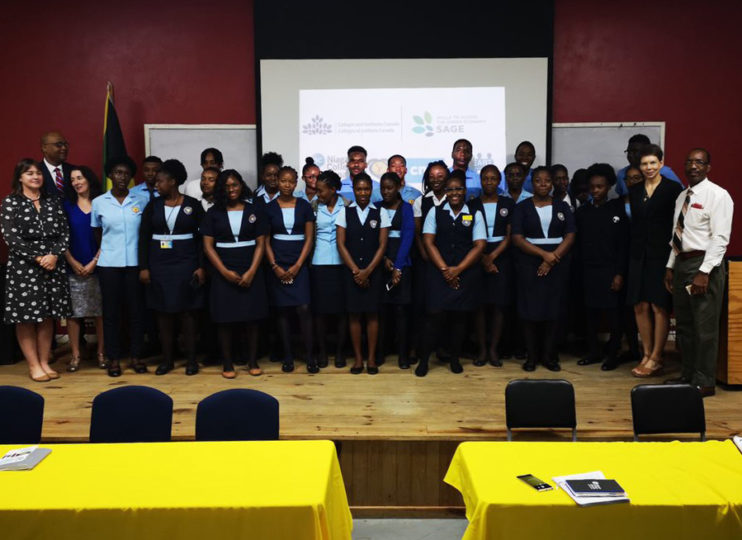
Through a three-year project entitled “Skills to Access the Green Economy Program (SAGE),” Niagara College, working in collaboration with College of the North Atlantic, will support its partners in Jamaica, HEART/NSTA Trust Ebony Park Academy and Moneague College, to develop a globally recognized agri-food processing program for students to work in the agri-food sector.
Presenting SAGE Institutional Partnerships!!! SAGE-05 #Jamaica @collegecan partners @niagaracollege College of North Atlantic @CNA_News local partners @moneaguecolleg and Ebony Park HEART Academy. Focus of partnership is #ClimateSmartAgriculture Funding from @CanadaDev pic.twitter.com/PvXb84HQaL
— SAGE (@CICan_SAGE) February 11, 2020
“A major multinational strategy has been in place with the Caribbean Agricultural Research and Development Institute building resilience in food security and agricultural sector development,” explained NC professor and academic program coordinator of Culinary Innovation and Food Technology, Amy Proulx, PhD, who will be collaborating on the project. “Climate change and increased catastrophic weather events have put pressure on the Caribbean Community CARICOM nations to become very proactive in agri-food industry development. The fundamental success of any industry goes first to the people and their skills, and that comes through quality education and training. Enhancing the quality of agri-food education in Jamaica will be important for building the resilience of the sector.”
Funded by the Government of Canada, the project is part of a five-year program through Global Affairs Canada to share the expertise of Canada’s colleges and institutions with education institutions and employers in six Caribbean countries – Belize, Dominica, Guyana, Grenada, Jamaica, and Saint Lucia. Led by Colleges and Institutes Canada (CICan), the project’s overall objective is to strengthen demand-driven and competency-based training programs offered by Caribbean institutions and to attract and retain marginalized students for those programs. This involves creating and delivering preparatory programs such as psychosocial/mental health supports, skills training, and career counselling, as well as exposure to the workplace.
“Niagara College’s strong focus on competency-based education and training is one of the reasons I really enjoy my work – we always tie our teaching and learning to practical and real-life applications,” said Proulx. “Niagara College has built a great relationship with many of the top Canadian organizations that focus on skills and competency development in food science, including Food Processing Skills Canada and the Canadian Institute of Food Science and Technology. We train people to be innovative in their business practices, in their teaching strategies, and in their career paths.”
Through this initiative, NC continues to support the United Nations’ 2030 Agenda for Sustainable Development, which outlines 17 Sustainable Development Goals (SDGs). Developing skills training programs focused on SDG 13, climate action, this project will also target SDG four, quality education, and eight, decent work and economic growth.
The project’s gender-sensitive skills training programs encourage the participation of women, youth and vulnerable populations and include a gender mainstreaming component, therefore supporting SDG five, gender equality. Aligned with Canada’s Feminist International Assistance Policy (FIAP), the project aims to increase participation of small and medium enterprises in gender equitable workforce planning, development, skills training, and certification.
Due to the COVID-19 pandemic, NC’s Global Education and Partnerships team has worked with funders and partners in Jamaica to adapt its partnership to incorporate online delivery methods. Developing the capacity of NC’s partner institutions in Jamaica, three key areas will move online in 2020: Technical Vocational Education and Training (TVET) leadership, academic programming and gender and social inclusion. College partners are also considering online delivery options for students and its impact on vulnerable populations.
Each year, Niagara College continues to welcome students originally from Jamaica to study at its Canadian campuses in a wide-variety of programs and has an established pathway with Excelsior Community College (ECC), located in Kingston, Jamaica. This pathway program allows students in ECC’s business programs to advance their studies at NC – students who complete ECC’s Associate Degree programs in Business Studies, Supply Chain Management, Humanitarian and Emergency Management or Coastal and Marine Tourism Logistics, will be granted direct entry into the third year of NC’s International Commerce and Global Development program, a four-year Ontario College Bachelor’s Degree program. Through the pathway, students will be able to graduate with an Honours Bachelor of Business Administration degree from Niagara College in approximately two years or four semesters.
Niagara College and Excelsior Community College have a well-established relationship, having previously worked together on a three-year joint project in which NC supported development of a Logistics Management program at Excelsior in collaboration with Marine Institute (MI). Completed in 2017, this project is already producing work-ready graduates, specializing in supply chain, humanitarian and emergency management, and coastal and tourism logistics.
Niagara College has been involved in global development projects for more than 25 years and has a strong history of supporting education and tourism projects in Caribbean countries including Jamaica, Grenada and Saint Lucia.
More information on Global Education and Partnerships and how to get involved in global education projects, can be found at ncglobal.ca/getinvolved/.
