

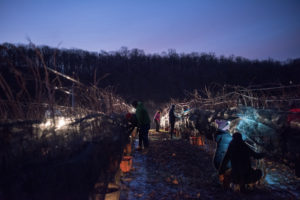



The sky was still dark and the moon shone brightly as a group of wine students and faculty began their day with ‘grape expectations’ at the Teaching Winery in the early morning hours of January 9.
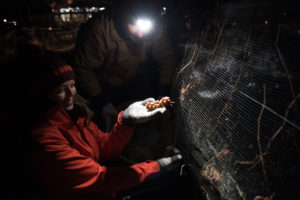
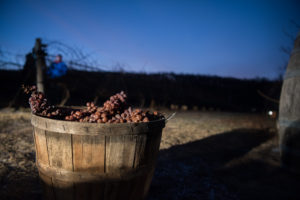
It was only 6 a.m. but the vineyards soon became a flurry of activity. Bundled up in warm layers to face the sub-zero temperatures, about 50 students ventured through the rows where frozen Vidal grapes awaited their gloved fingers. In the frosty morning air, they worked to pluck frozen grapes from the vines to later transform the fruits of their labour into one of Niagara’s sweetest treasures.
The Icewine harvest is an annual rite of passage for wine students at Niagara College. Held annually at the on-campus Teaching Winery, the activity equips students with an applied learning experience like no other.
“There’s no other school in the world that does this,” said Canadian Food and Wine Institute dean Craig Youdale. “Our wine students are able to experience all aspects of Icewine production right on campus – from picking frozen grapes off the vine in our vineyards, to pressing the grapes, producing and bottling at our Teaching Winery.”
It was a completely new experience for first-year Winery and Technician student Chris Anderson. Hailing from Texas, Anderson noted that the morning in the vineyards was “colder than he was accustomed to” but that it was precisely what he signed up for.
“This is exactly what I love about the program. Everything is so hands-on,” he said. “This is why I came to Niagara from Texas.”
While he is not an Icewine drinker, Anderson valued the knowledge and personal experience gained. “I can now speak to people about everything it takes to make Icewine,” he said.
For Thomas Hartlen, second-year Winery and Viticulture student, his second time participating in the Icewine harvest felt like a luxury, compared to how cold it was last year. The Nova Scotia native noted that, for him, the Icewine harvest represents what the program is all about.
“It’s all about the effort and the work that’s put into every single bottle of Niagara wine that’s made,” said Hartlen.
Participating in the experience has also changed the way he views Icewine.
“A lot of people expect Icewine to be nothing but sweetness … but they don’t understand that sweetness does come in from the strict standards that are put into place,” he said. “There’s a reason; we can’t do it any other way because that’s not who we are here in Niagara.”
That the bar is set high when it comes to VQA standards was a fact that students learned first-hand that day. Wine professor Ron Giesbrecht noted that because the temperature proved to be slightly warmer than expected at minus seven degrees, the product will not be classified as Icewine – since eight degrees is the minimum required for VQA Icewine designation. Instead, the 2019 vintage will be labelled a Select Late Harvest.
It proved to be a valuable learning experience for wine students.
“This shows the students the fine lines they must be aware of and properly adhere to when making VQA wines,” said Giesbrecht. “It’s also part of makes Icewine special – that it’s not without risk. That’s why it’s expensive and why there’s a hard line at minus eight degrees because we want to protect the quality.”
As a Select Late Harvest wine, Giesbrecht pointed out the end product for this 2019 vintage will be a quality dessert wine that is not quite as sweet as Icewine, or as expensive.
“It’s a bargain for consumers because it’s almost at Icewine levels but they’re paying less than half the price for a bottle,” he said.
