
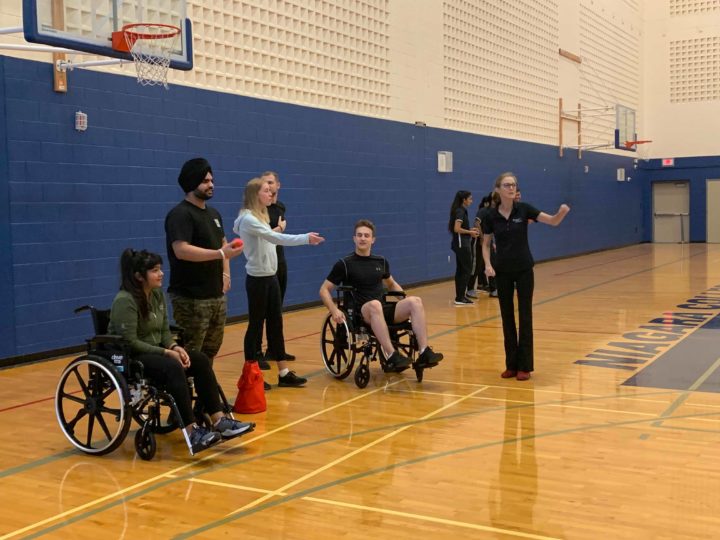
Second-year Fitness and Health Promotion students got out of their classroom and into the gym for a lesson in Paralympic sport on October 30.
The lesson was part of School of Justice Studies professor Jodi Steele’s Special Populations course, where students are exposed to patients with cancer, cerebral palsy and geriatrics. Many students in the Fitness and Health Promotion program expect to work with able-bodied clients or children, but Steele noted that there is a high demand for jobs focusing on special population client groups.
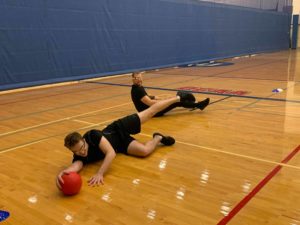
Fitness and health promotion students play goalball while wearing goggles impairing their vision.
In light of the Tokyo 2020 Paralympic Games, students were introduced to two of the most popular Paralympic sports: bocce and goalball. Students who played bocce, which is typically played by athletes with cerebral palsy, used wheelchairs in order to experience what it’s like to throw a ball without using one’s lower extremities. Goalball is typically played by those with visual impairments, so students wore goggles that blocked their vision.
Quickly into playing, student Rahim Bardi, who also plays basketball for the NC Knights, realized that each sport is much harder than it looks.
“When you have to do something without being able to see, you try to rely on your other senses, but it’s really hard to focus,” he said.
Bardi said he aspires to become a physiotherapist and he believes that this type of experiential learning will serve him well in his career path.
“Getting to participate in things like this definitely enhances your learning and adds useful tools to your belt, so if you come across a client with cerebral palsy in the future, you have a better understanding of the condition and how to support them,” he said.
Incorporating initiatives like this into her curriculum is a must for Steele in order to complement lecture-based learning and ensure her students are fully engaged in what they’re learning. Her Paralympic Games event also served another purpose – empathy training.
“I want my students to develop empathy because it’s such a crucial soft skill to have in the fitness and health industry,” said Steele.
She has asked every student to submit a short reflection essay on their experience, saying she wants deep insights into how they felt during the games, whether they were frustrated with their teammates and how they handled it.
“Once you experience something first-hand, it will make it easier for you to know how to approach that situation when you’re faced with it in the future,” she said.
Related post:
Welland Tribune: Niagara College students face challenge of Paralympic sports
