
One last look at the @StCatStandard/@niagaracollege #Niagaravotes team who did a great job of producing our election results broadcast! Proud of you all! pic.twitter.com/bsoleTsfsW
— Grant LaFleche (@GrantRants) October 24, 2019
Second-year Journalism student Lindsay Tweedle isn’t accustomed to being in front of the camera, but that’s where she found herself on election night, co-hosting a live broadcast with award-winning St. Catharines Standard reporter Grant LaFleche.
“This was such an amazing opportunity for me,” she said.
Tweedle was among a group of nine of her Journalism classmates, as well as a production crew of 24 students from Broadcasting – Radio, Television and Film – led by faculty members Charles Kopun, Susan Pedler and Dutch VandenBerg – who volunteered to participate in Canada’s federal election night coverage with The Standard/ Niagara dailies.
While federal election coverage in a professional environment for a real news broadcast is not an experience college students are typically exposed to, this was the second time The Standard has partnered with Niagara College’s Journalism and Broadcasting programs for its election coverage. Last year, the partnership was born – the first of its kind in Ontario – just in time for the municipal election.
For The Standard, the partnership enabled them to produce a show they couldn’t otherwise do, “and do it at a high level,” said LaFleche. “It also allowed us to provide students with a real-world professional experience in news on the craziest night of the year.”
For both The Standard and NC’s Journalism and Broadcasting programs, the partnership has proved to be a success. Election coverage is not easy even for seasoned journalists, noted LaFleche, where they must keep up with moment-to-moment changes while accuracy is crucial. He applauded how well the NC students performed.
“They were fantastic. You have to remember these are students just learning their craft, and they were assigned to the biggest news night of the year and were expected to produce professional-quality news reporting and a broadcast … I cannot say enough about how hard they worked and how well they operated under very stressful conditions,” he said.
“It is a testament to the kind of education these students are receiving from Susan and Charlie and Dutch, that they can come into our newsroom and produce a high-quality, professional broadcast that helps inform viewers.”
Students who participated both enjoyed and valued the experience.
As co-host, Tweedle analyzed local and national election results and joined LaFleche in interviewing panellists on a number of high-profile election issues.
“Election night was a lot of fun. There was a great energy that night,” said Tweedle. “I certainly have some great experience to put on a resume but I also got some hands-on experience thinking on my feet, being flexible, working in a high-pressure environment and being part of a federal election show.”
“Knowing how to get information, being sure it’s right, being engaged in news and politics – all that comes from the Journalism program and its instructors,” she said. “Our instructors spent so much time preparing us for election night and that’s absolutely why it went as well as it did.”
Journalism students on the ‘decision desk’ run by Kopun, broke down polling numbers as they came in from Elections Canada, and passed on the latest results to the hosts they became available. Others wrangled analysts into the studio for the broadcast.
Journalism students also took on assignment reporting and photography for The Standard’s online and print newspaper editions as well as for the election night broadcast.
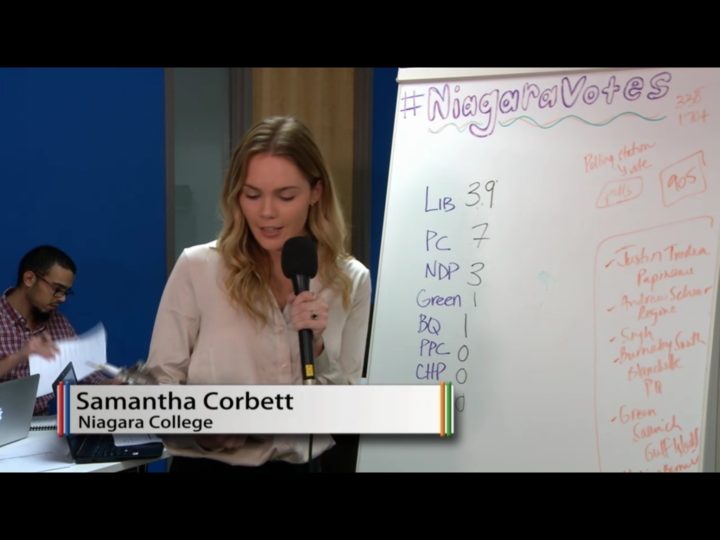
Journalism student Samantha Corbett contributed as a reporter and photographer for a young voter article in the newspaper, and appeared on TV as a host for the decision desk.
“It was intimidating trying to be on TV while making sure your numbers are right and being around the pros, but I absolutely loved it. I think we all had so much fun,” said Corbett. “It was fast-paced, which made it really exciting.”
Corbett noted that she felt her professors helped to set her up for success, and ensured that she was comfortable and confident for her TV appearance.
“For writing, everything I learned in the program allowed me to reach deadline and understand what an interesting story consists of with proper structure,” said Corbett, who is a resident of Niagara-on-the-Lake. “I think having both TV experience and writing/ photography for a real local paper on my resume really shows that I am capable of adapting under pressure, as well as having hands-on experience gives me a small idea of what to expect in the future.
“The federal election is quite a big deal for Canada, so to be a part of that, even in a small way, is really amazing.”

NC students work from The Standard’s St. Catharines office on the federal election broadcast.
Kopun was pleased that all of the second-year Journalism students embraced the opportunity to put their skills to the test on election night and work alongside professional journalists – especially since the election fell during their mid-term break week.
“This was really an unparalleled opportunity for students to work with professionals and be a part of news coverage for an election – especially a federal election,” said Kopun. “There are a lot of deadlines and there is a lot of pressure and I was very impressed by how well the students performed and became a valuable part of the team.”
Broadcasting students produced the live show. They performed the duties of camera operators, floor directors and technicians who put video packages on the air, edited, created graphics, assembled commercials and more.
“The pressure of live TV coverage coupled with expert analysis from political voices provided me with an opportunity to be a part of a type of show I’ve never been a part of before,” said Matt Robinson, who is in his third year of the Broadcasting program (television production). “The fact that we had live stats coming in from Elections Canada and we were able to dedicate a team to continuously update the graphics to match theirs during the show was pretty exciting as well.”
Robinson, who is originally from Ingersoll, noted that the skills he learned in class prepared him well for the experience.
“This was one of the most technically challenging shows I’ve been a part of. There were lots of moving pieces that took a team of skilled people to put into place,” he said. “I appreciated the hybrid nature of this show. It made me apply skills that I would use on a mobile sports production, as well as use things we learned in scripted in studio productions.”
VandenBerg noted that the overall production took months of planning from the technical side. It involved building a multi-camera studio environment on location at the St. Catharines Standard office, two host sets in total. Field reports filed from location were live-streamed to the site and their Facebook page. New this year were sponsor obligations, which became an added responsibility for students.
“It is opportunities like this election show that give students real-world experience,” said VandenBerg. “They are able to apply what they learn in our program and implement those skills into professional settings like this with real clients and real expectations.”
VandenBerg noted that the production was three hours and 46 minutes long – continuous live coverage and updates. The Standard reported 14,000 hits on its page and Broadcasting’s analytics on the stream page totalled 12,642 live views.
“Overall, it was great exposure for our School of Media and Niagara College, and an incredible experience for the students and faculty,” he said.
