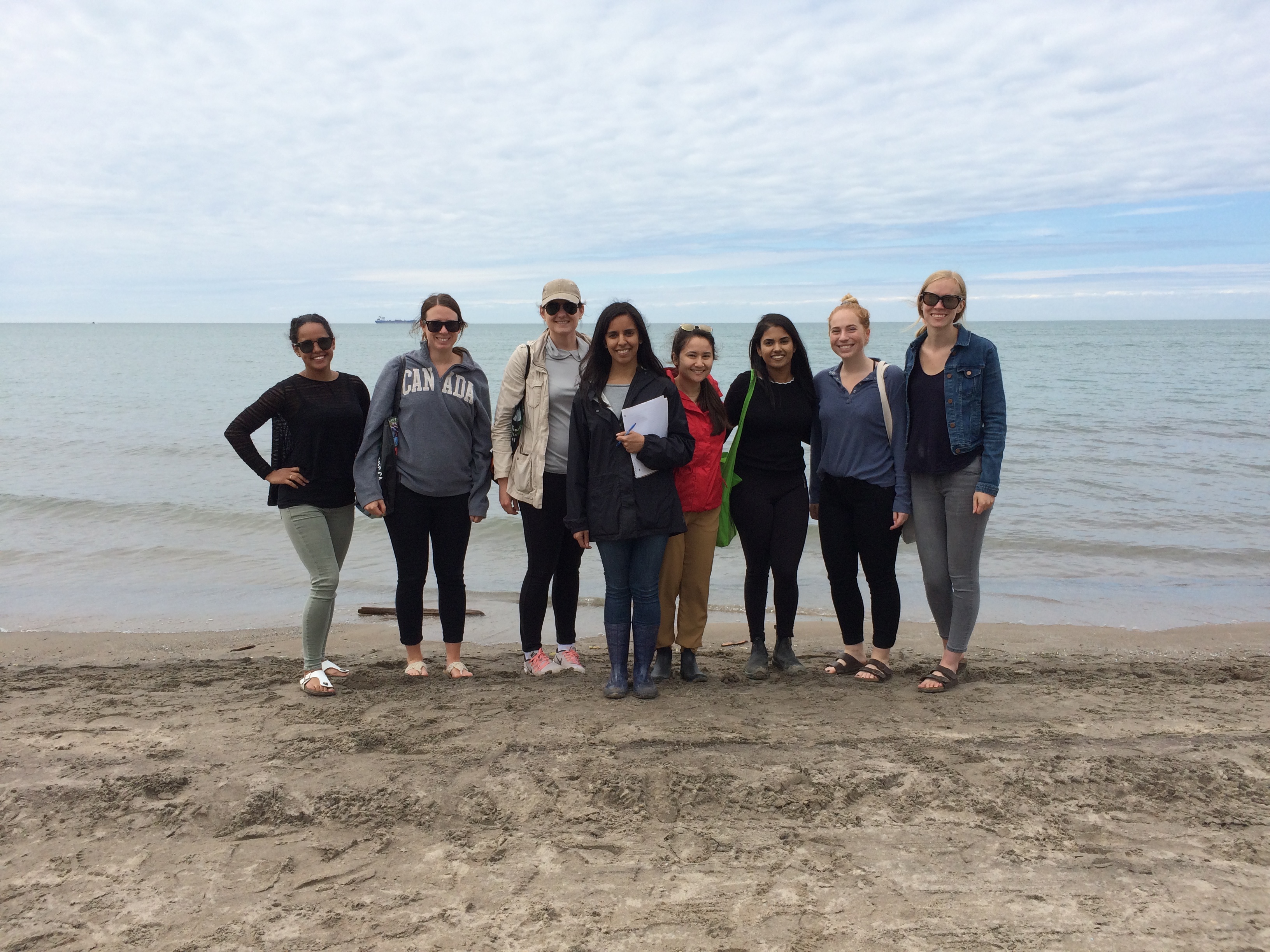
A group of Niagara College students and faculty are helping Provincial and Federal environmental experts keep a close eye on the growth of algae on Lake Erie, thanks to a Cladophora monitoring project spearheaded by the Niagara Coastal Community Collaborative.
For the past two years, the Collaborative, a recently formed group of citizens, scientists and government and academic representatives – including several from Niagara College – has been gathering boots-on-the-ground data to better understand how the growth rates of green algae are affected by various environmental factors.
Cladophora is a green, slimy algae found naturally along the Great Lakes coastlines, which grows on submerged rocks, logs and other hard surfaces. As the algae dies off, wind and wave action cause it to wash up on the shoreline, fouling beaches and producing unpleasant odours. While Cladophora may contain e. coli and should be regarded with caution, it does not present the same level of public health threat as that of blue-green algae; it’s mainly a nuisance to homeowners, beachgoers and others who visit Lake Erie.
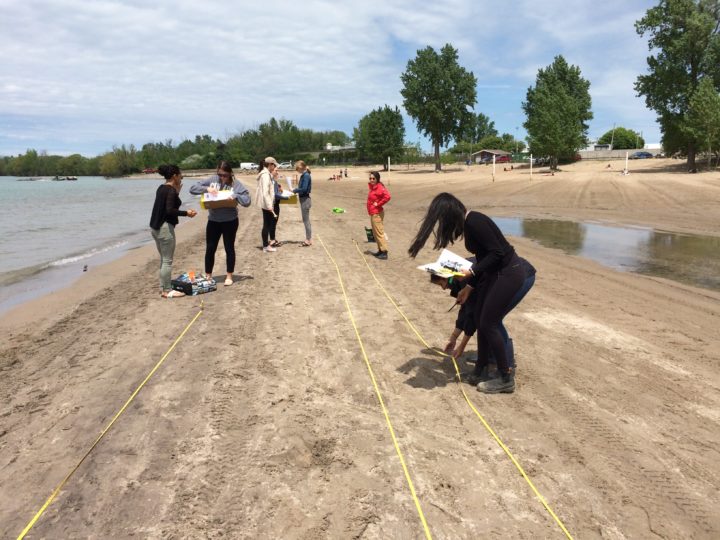
Each summer from June to September, Annie Michaud, a professor in NC’s School of Environment and Horticulture and member of the Collaborative, leads a group of volunteer citizen scientists, including 10-12 of her own students and alumni from NC’s Environmental Management and Assessment (EMA) program, in examining and recording the volume of green algae they find, both in-water, and washed up on 13 of Lake Erie’s beaches.
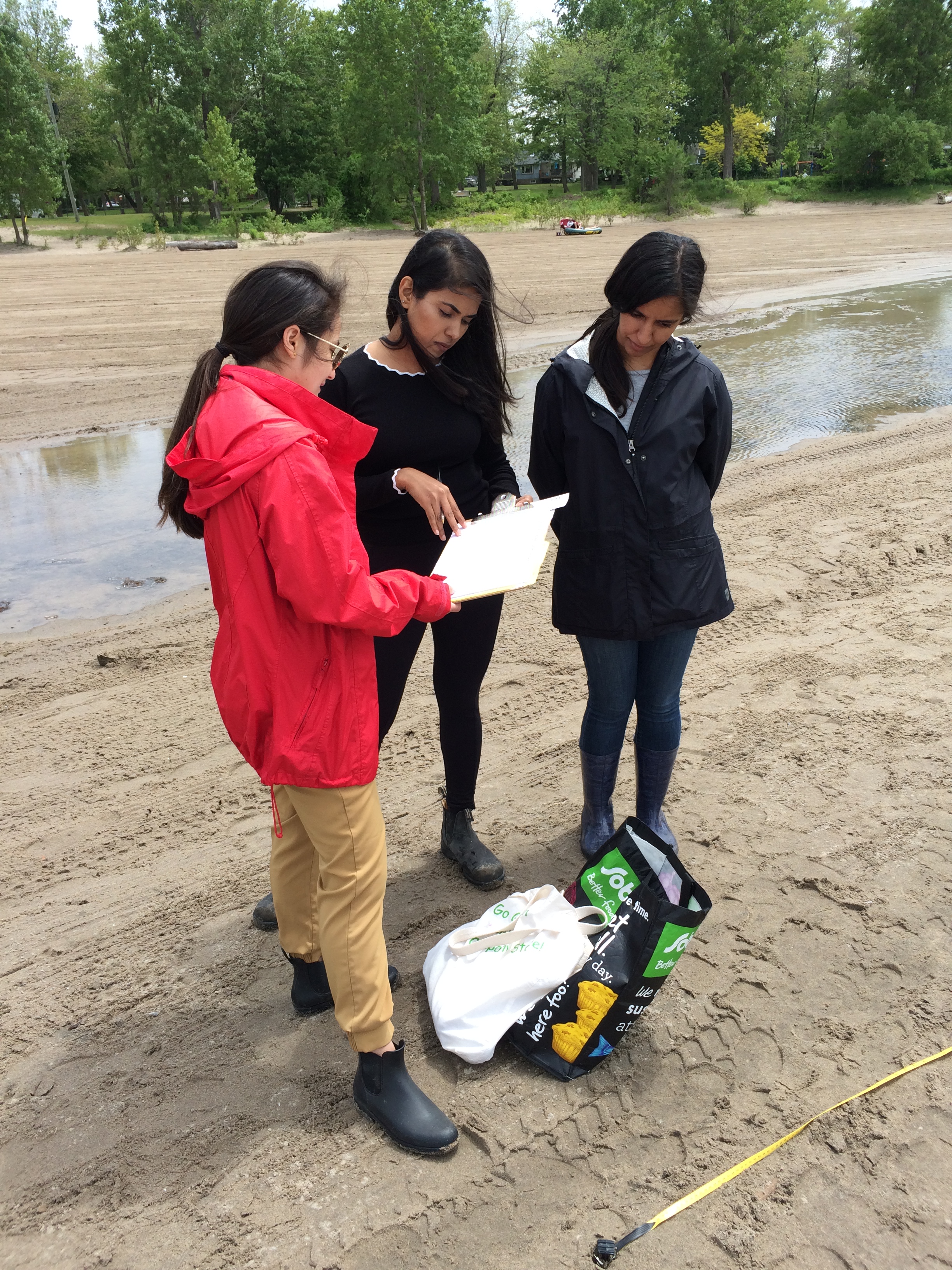
Colleen Chan, Shanilka Fernando and Nitasha Dhillon work to identify the volume of algae washing up on Lake Erie’s beaches
Students mark out 100-metre lengths of shoreline, broken into five-metre segments. They then visually survey three random segments and estimate the volume of algae according to four categories. Enough to fill a backpack is considered “sparse,” while enough to fill a wheelbarrow is deemed “moderate.” If there’s sufficient algae to fill a pickup truck, it’s considered “abundant,” while the amount needed to fill a dumpster would be “excessive.” Volunteers repeat this process week after week, throughout the summer months, creating a long-term data set that shows seasonal trends and changes in Cladophora wash-up levels.
It’s valuable work experience that will pump up the resumes of students who choose to volunteer in the program. “Volunteers get to practice hands-on many of the scientific processes and protocols that we talk about in class, like water sampling and monitoring, as well as community engagement,” says Michaud. “It provides students with valuable work experiences and connects them with the work done by scientists at Environment and Climate Change Canada – connections that can go a long way in helping to launch a career.”
Kennedy Laufman graduated from NC’s EMA program in April 2019, and volunteered for the Cladophora monitoring program. For Laufman, a side-benefit of the program was the ability to advocate for the importance and impact of citizen science “Often when we were out we would get questions from bystanders at the beach who would wonder what we were doing,” says Laufman. “We had lots of opportunities to educate people who essentially have this right in their backyard.”
Doing so not only gives volunteers valuable real-world experience gathering environmental data, it also supports scientific agencies in their goal of maintaining levels of algae below that which produces nuisance conditions. The data gathered by Laufman and other volunteers will be used to create accurate predictive models for algae growth in the future, and help identify ways to mitigate and control its spread.
“Prior to the establishment of this monitoring program there were little to no records of how much, where, and when Cladophora was washing up,” says Julia Hatcher, Great Lakes Project Officer with Environment and Climate Change Canada. “With this monitoring data, scientists will have a better understanding of how the in-water observations correlate with what is being washed-up onshore.”
For Hatcher, the project illustrates the power of citizen science to support government led science activities. “The engagement of citizen scientists gives researchers access to data at a greater geographic scale and frequency. In this case, Environment and Climate Change Canada does not have the capacity to evaluate the beaches every week; however, Collaborative members are able to travel a short distance to their local beach to provide consistent observations of changing conditions throughout the season.”
Hatcher also said that the prominence and importance of citizen science is growing in the scientific community. More people have been getting involved in programs that are engaging the public in citizen science activities on the Great Lakes, and as technology, such as rapid testing and data management tools advance, and the proportion of environmentally minded citizens grows, the hope is for these trends to continue.
“Projects such as this can also be very empowering for local community members,” says Hatcher. “A community more fully engaged in the health of their local ecosystem is better positioned to engage in local decision-making and advocate for any environmental concerns that may arise.”