
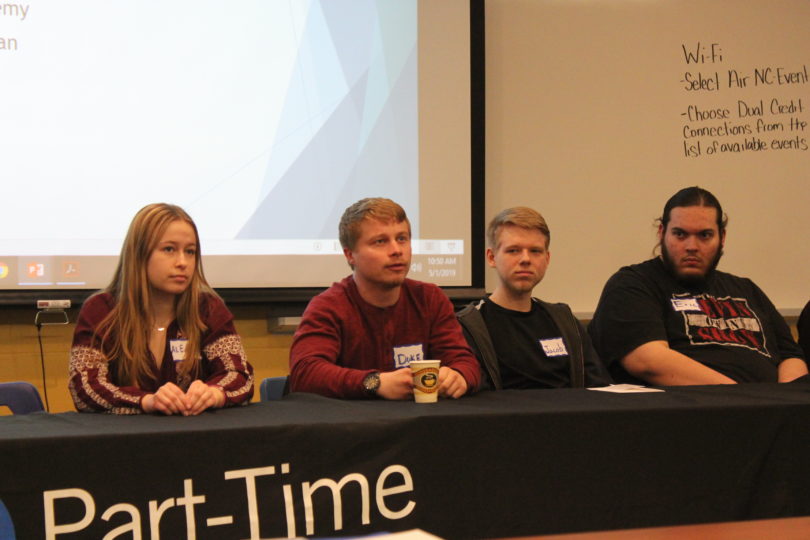
On May 1, guidance counsellors, student success staff, co-op teachers, and administrators from the District School Board Niagara (DSBN), the Niagara Catholic District School Board, and Niagara College gathered at the Welland Campus for Dual Credit Connections, a half day networking and professional development workshop.
For over two decades, NC, the DSBN and Niagara Catholic have been partners in the School-College-Work Initiative, of which the Dual Credit and Niagara LINK programs are a part. Through the programs, students can take college credits while they are in high school, helping with the transition to post-secondary, and providing high school support in a college environment. These credits count towards both the Ontario Secondary School Diploma and a post-secondary certificate or diploma.
“The relationship between Niagara Catholic and Niagara College is outstanding, benefiting students as much as both partners,” said Jennifer Pirosko, coordinator of Student Success at Niagara Catholic. “All staff have the same priority – helping students grow and achieve their full potential. We continuously learn from each other as we integrate systems and work together to provide a smooth and engaging transition for students.”
“There is a clear link between higher levels of educational attainment and an improved quality of life. We’re so pleased with this partnership, which allows us to come together as caring educators and support students in finding pathways to postsecondary education. There’s no doubt this program changes lives. The positive impact of this program was obvious on the faces of each student we honoured at graduation,” said Andrea Jagoe-Lynett, DSBN student achievement leader.
In both programs, instruction and support is provided collaboratively by an NC professor and a secondary school dual credit teacher to students facing challenges. Both provincially-funded programs target students who are at-risk and disengaged with the potential to succeed. For students aged 18 to 21, the Niagara LINK program aims to re-engage those who are not currently attending secondary school or who are at-risk for leaving school before graduation.
“We have a fantastic partnership with the school boards. Everything about this program is set up for student success,” said Linda Ismailos, professor at NC who has been teaching dual credit courses for six years. “It is experience with success that builds confidence, so if we can give students an experience with success – day by day in the classroom and with assignments – it builds their confidence which in turn builds motivation,” said Ismailos.
During the annual Dual Credit Connections workshop, eight students from the Niagara region shared their experience with the program to a room full of local educators, many of whom supported their success.
“As a high school students you’re like, ‘I get to go to College? Cool!’ The program gave me the confidence to pursue further education,” said Duke Rybak , who completed the dual credit program in 2012. Duke went on to pursue NC’s Electrical Engineering Technician program.
“The program was an escape from the loop of trying to get my high school education. It worked so well for me,” said Aleah Sawatsky, a graduate of the Dual Credit program.
The College environment offers students a glimpse of life after high school and is different from some of the elements of a typical secondary school environment. Dual Credit and LINK students get an NC student card and have full access to on-campus activities, facilities, resources and supports.
“Students in the program have an easier time with transition due to the breadth of support from both Niagara Catholic and Niagara College staff. This is particularly useful for students with a need for accessibility and health and wellness services, transition counselling and accommodations,” said Pirosko. “There are many factors that affect a student’s ability to succeed and most often the change in structure and social setting gives students the confidence and strength to overcome barriers to graduation. Being immersed in the post-secondary environment while in high school enables students to see themselves at college in the future.”
“Research shows that students with exceptionalities often have a lower level of confidence or self-efficacy to move into post-secondary, and a lot of that is around the fact that they don’t know where they’re going to get the support from. Once they have an orientation and they know what to do, where to go and how to advocate for what they need, their confidence comes back,” said Ismailos.
About one in four students have an IEP (Individualized Education Program) which means they have been identified by their school boards as having some kind of learning challenge.
“The College is tremendous at how well they take those IEP’s and provide the accommodation that these students need. In the college environment, students learn to advocate for themselves,” said Ismailos.
Within the Dual Credit program, students can take the Connecting to College steam, two general elective offered four afternoons a week. They can also opt for the Technology, Arts and Culture stream, one or two specialized credits offered two or four afternoons a week. Courses include Psychology of Personal Well-Being, Traditional Indigenous Knowledge, and Communication in Healthcare. More focused technology courses include Blueprint Reading for the Construction Trades, Dimensional Design – 2D and 3D Design, and Drawing Techniques.
Dual Credit and LINK students learn to use Blackboard, NC’s learning management system, to find course content and submit assignments. More importantly, it teaches them to be independent learners.
For Jacob Kopeschny the Dual Credit program allowed him to experience a new type of learning not offered at his school. “I went to an art school, so it was great to have the opportunity to take carpentry.”
“Many times for disengaged students, it is the change to a new environment that enables a student to connect, grow and succeed,” said Pirosko.
Alexa Schonewille, an NC professor who taught a Dual Credit course for the first time this year reflects on her students. “I couldn’t tell that they were at-risk students because they loved being in my class and at the College,” she said. “They really matured over the semester.”
“A lot of these students suffer from anxiety. By the end of the course, they talk about how they’re so comfortable in the college environment, and they have the freedom they’re looking for,” said Ismailos.
“Students are so pleased with themselves for having done well in a college course and they develop the confidence to take on a college program” said Ismailos. “One of the best parts of my job is walking through the hallway and seeing students from previous years coming up to me and saying, ‘hey, I’m a Niagara College student now,'” said Ismailos.
