A new Niagara College research study is putting builders in the shoes of older adults.
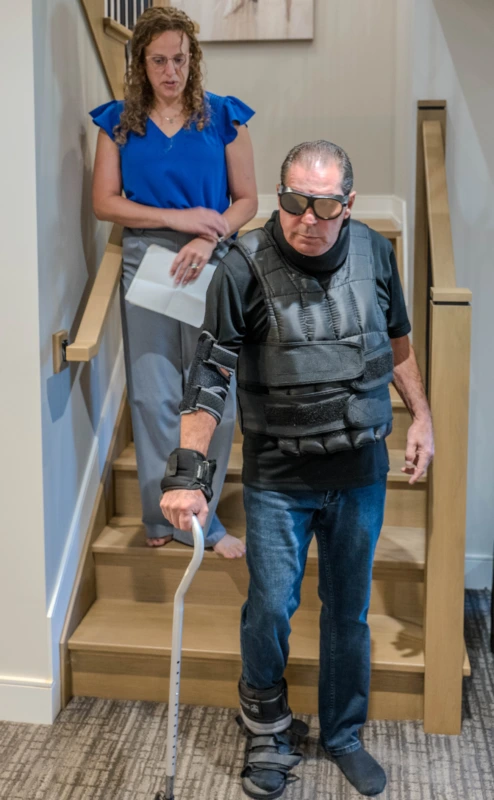
As more Canadians explore aging in place and multigenerational living, members of the Niagara Home Builders Association (NHBA) wore aging simulation suits as part of the NC study to explore how an experiential approach can inform future housing design and renovation practices.
“We saw an opportunity to leverage Niagara College’s expertise in health simulation, which we use to prepare our students for real-world experiences, together with our longstanding partnership with local builders through the NHBA, to explore an important question: how can we better design homes for aging in place?” said Sinéad McElhone, Dean of Health Sciences at NC. “By putting builders in the shoes of those who will navigate these spaces, we can generate insights that benefit our students, our community and the industry.”
An aging simulation suit is a wearable, experiential training tool designed for younger people to physically experience the sensory and mobility challenges of older adults and how these conditions can make everyday tasks more difficult.
The suit – with weighted cuffs and limbs, resistance straps and neck brace – can be customized to mimic muscle weakness, dexterity, and stiffness to simulate conditions like arthritis and sarcopenia. Impaired vision goggles simulate degenerative eye conditions, and headphones can reproduce the effects of hearing loss.
Chuck McShane, CEO of the NHBA, and Ed Lucchetta, owner of Lucchetta Homes, were among the local builders who participated in the pilot. The study took place in a multi-level home in Welland’s active-adult community at Hunter’s Pointe, a subdivision built by Lucchetta Homes.
“Creating homes that allow people to age safely, comfortably, and independently is an important part of building the communities of the future,” said McShane. “Through our partnership with Niagara College, we have an opportunity to explore practical solutions that can be incorporated into both existing homes and new construction.”
NC facilitators customized the aging suit for McShane to simulate the experience of someone who had suffered a left-sided stroke accompanied by vision loss. McShane then completed activities of daily living, including getting out of bed, navigating stairs, picking items up from the floor, and taking medication. McShane also tried wearable gloves designed to simulate the tremors associated with Parkinson’s disease.
“Aging in place is about more than accessibility; it’s about giving homeowners the ability and dignity to remain in the homes and communities they love while making everyday life safer and easier to navigate,” said McShane. “As our population continues to age, the residential construction industry has an important role to play in developing innovative housing solutions that meet people’s needs throughout every stage of life.”
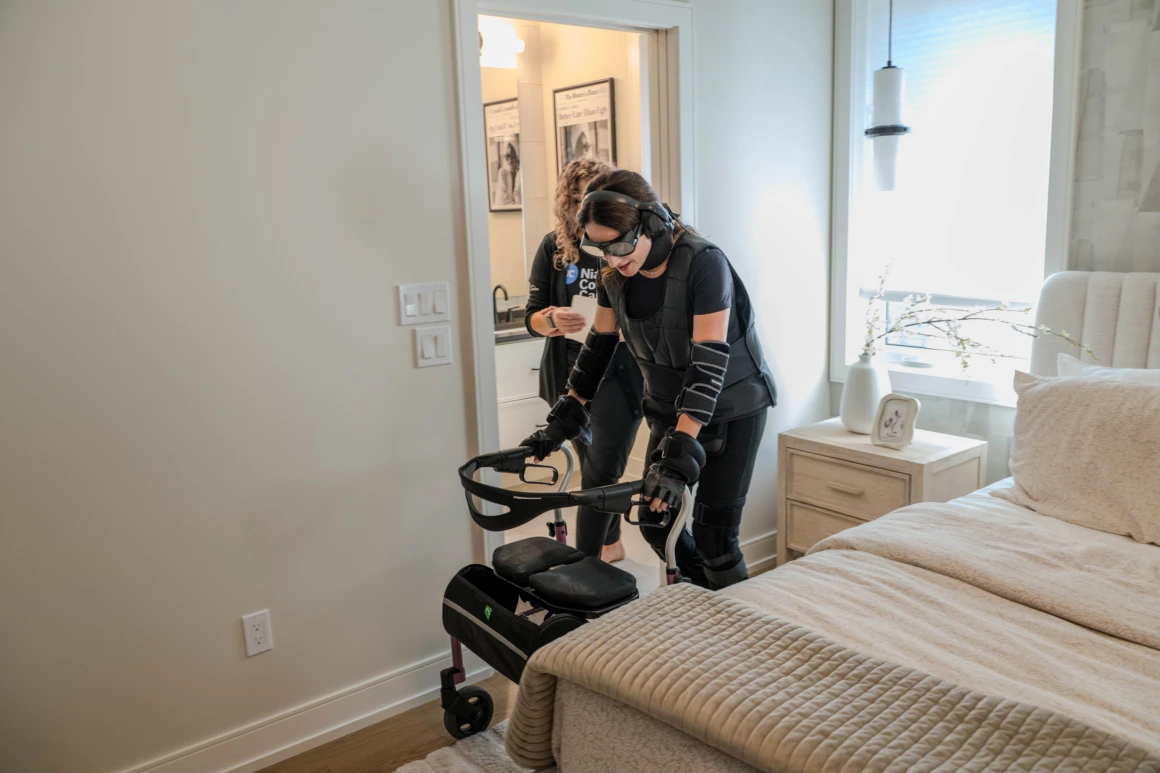
Facilitators gave other participants simulations of conditions such as sarcopenia (age-related muscle loss) with restricted neck movement, while another wore a bariatric suit designed to simulate the physical challenges of COPD, including restricted breathing and shortness of breath.
Professor in the Myhal School of Nursing, Alison Cousineau, and Simulation Lab Technicians Julianna Pennings and Fitz Morrison, guided the customization and use of each aging simulation device. The technology is an experiential learning tool for students in the Health Sciences division, including those in Nursing, Personal Support Worker, and Massage Therapy programs. Students in the Schools of Community Services and Justice and Fitness also experience the wearables.
“These simulations help students step into their future patients’ experiences, building empathy, understanding, and appreciation for the person behind the patient,” said Cousineau.
Following the experience, participants debriefed with facilitators to help inform abstracts and a research paper on the study. The findings will be shared at the Ontario Homebuilders Conference with NHBA members and at the Niagara Health Knowledge Institute Research Day, an annual health research conference hosted by Niagara Health at NC.
Cousineau said caring for an aging parent and adapting a home to meet their changing needs can be an eye-opening experience.
“Experiences like that really underscore the need for partnerships with builders to consider accessibility and aging in place from the beginning, creating homes that can better support people as their needs change,” said Cousineau.
Lucchetta said designing for aging in place means creating homes that can adapt as the needs of homeowner’s change.
“Features like wider doorways, accessible layouts, main-floor living and adaptable bathrooms can be incorporated seamlessly into a home without compromising its style or functionality,” said Lucchetta.
The Aging in Place pilot was a joint venture with NC’s School of Trades who helped shape study, drawing on its expertise and relationship with the NHBA to bring the partners together. The pilot marks the NHBA’s first collaboration with the College’s Health Sciences programs.
“This aging suit actually didn’t start in healthcare,” added Pennings. “It started in the trades in the automotive industry to better improve the safety of vehicles. I love how this has come full circle back to the trades through a different lens.”
“We’re proud to work alongside Niagara College to help educate, innovate, and find plausible solutions that can benefit homeowners across Niagara, Ontario, and North America,” said McShane.
McElhone says the College is exploring ways to expand upon the study to include paramedics, occupational therapists, personal support works, and other professionals who deliver healthcare in patients’ homes.
A leader in applied education, Niagara College offers diploma, bachelor degree, post-graduate and apprenticeship programs at specialized campuses in Niagara-on-the-Lake and Welland. Consistently ranked among Canada’s top research colleges, NC is also involved in educational projects and partnerships around the world that provide students with important hands-on-experience. NC welcomes students from across Niagara, Ontario, and around the world who are studying in in-demand programs that support key sectors and industries in Niagara and beyond, with graduates making important contributions in all corners of our community. Learn more at niagaracollege.ca.
– 30 –
Broadcast-quality video and B-roll are available to media upon request.
Media inquiries:
Jessica Torok
Communications Consultant
905-932-1520
[email protected]