
Embracing equity will be the topic of discussion at Niagara College’s panel event in honour of International Women’s Day (March 8).
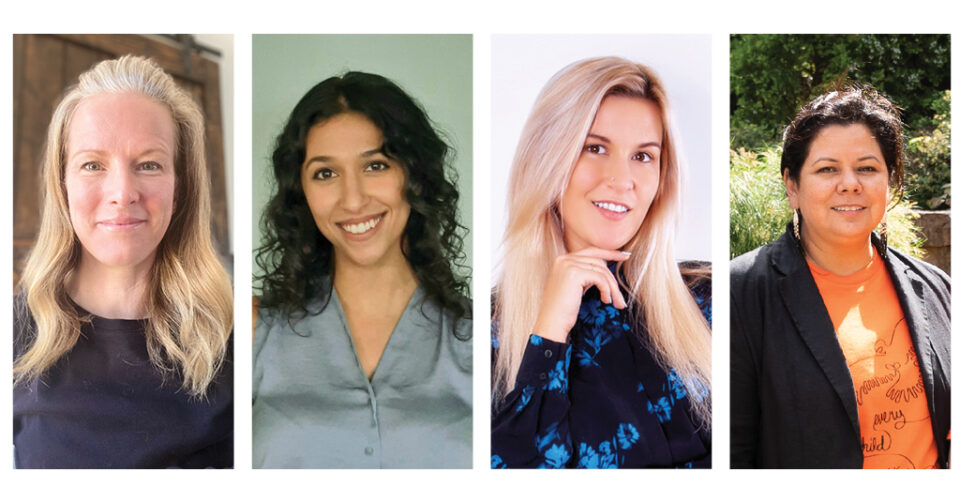
Hosted by the Centre for Organizational Excellence, the event will feature four speakers from the NC community who demonstrate a commitment to advancing equity for students and employees through their work on campus, in the community and abroad: Elysia Dardarian, Sexual Violence Prevention and Response Coordinator; Leah Hogan, Associate Director, Indigenous Education; Sam Jemison, NCSAC President; and Jamie Oresar, Professor, School of Academic and Liberal Studies.
Open to employees and students, the hybrid event will take place in advance of International Women’s Day on March 7 from 1 to 2 p.m. at the Daniel J. Patterson Campus in Niagara-on-the-Lake, room N018. Those unable to attend the event in person can participate virtually via Zoom. Registration is required for either format.
Meet the panelists
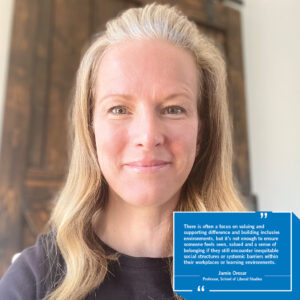 Jamie Oresar is a Professor in the School of Academic and Liberal Studies. She is a subject matter expert in equity, diversity, social inclusion, and decolonization, with interests in globalization, sustainable development, and gender studies.
Through her work, Jamie encourages people to think of EDI concepts as interrelated but distinct concepts.
“Diversity initiatives are concerned with diverse representation of people, identities, experiences, perspectives, and knowledge systems. A focus on inclusion is concerned with shared power, voice, and inclusive organizational culture. But equity efforts are concerned with identifying and eliminating systemic barriers to access, opportunities and advancement that are embedded in our social structures, processes, and practices.”
Jamie notes that ’embracing equity’ highlights an important shift away from the typical EDI discourse that combines all three concepts together under an umbrella acronym.
“I think this year’s theme for International Women’s Day distinguishes ‘equity’ from ‘diversity’ and ‘inclusion’ in the EDI discourse to focus more on the ways in which barriers for women and feminized individuals are institutionalized or present within our systems.
How do you actively support and embrace equity in the classroom/through your work?
In the classroom, I have the privilege of teaching a Sociology course that focuses on equity, diversity, inclusion, accessibility, and decolonization. It’s through this course that I get to join students in critically examining systems of oppression like racism, classism, colonialism, sexism, heterosexism, ableism, ageism and so on, and the ways in which they result in complex experience of privilege and oppression depending on how aspects of our identities intersect.
I was also able to work on an interdisciplinary team to co-create and co-teach an Introduction to Mental Health elective course that examines mental health, substance use, and concurrent disorders using a biopsychosocial approach. Now in its 3rd year of being offered, this course always fosters such meaningful dialogue and incredible insight into how mental health issues impact individuals, families, and communities, while investigating the integration of supports and services available to Canadians.
Can you tell us about a project or initiative that you’re involved in that demonstrates a commitment to creating a more equal and inclusive world.
Outside of the classroom, I am honoured to be a part of team of gender specialists who are working on Global Engagement projects in Jamaica and Kenya. This work involves connecting with a number of Technical and Vocational Education and Training (TVET) institutions to examine gender inequality and address gender barriers through capacity-building, policy and procedure development, and implementation of other gender mainstreaming initiatives.
Also, this past year, I was grateful to participate in a joint project with Brock University and Niagara College, funded by an eCampus Virtual Learning Strategy (VLS) grant, to build a VR simulation that examines anti-ableism in living, learning, and working environments using real-life situations based on lived experiences of persons with disabilities. These simulations provide immersive experiences that will help deepen understanding of accessibility, authentic inclusion, equity, Universal Design for Learning, accessible education standards, and AODA requirements and will help post-secondary institutions across Ontario build accessibility into programs of study and training as an open resource available through the eCampus VLS Collection.
One of the things I am most proud of is the work I’ve done with my colleague and friend, Theresa Anzovino (NC Professor), co-authoring two editions of the text, Walk a Mile: A Journey Toward Justice and Equity in Canadian Society. Adopted by 26 universities and colleges across Canada, it is the first text of its kind to combine both cognitive and affective dimensions of studying equity, diversity, and inclusion. As we are currently editing the 3rd edition of the text, I am reflective of how impactful the research and writing process has been on my own learning and professional development over the years.
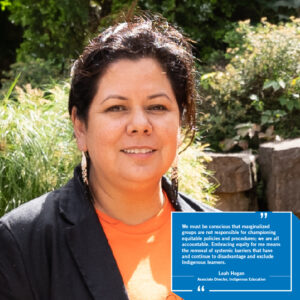
Leah Hogan is Associate Director of Indigenous Education at NC. Throughout the course of her career, Leah, who is a proud member of the Oneida Nation of the Thames (Bear Clan), has been actively advocating for Indigenous students to provide a rewarding experience where students see themselves reflected and celebrated in all aspects of their academic journey.
How do you actively support and embrace equity through your work?
We need to ensure our supports are appropriate and relevant to our learners. Therefore, we will make space for Indigenous student voices in our strategic planning and direction. Over the next 18 months, we will listen to Indigenous students’ stories to understand their journey to and through post-secondary. We will ask intentional questions to understand their needs better and commit to responding to them.
Can you tell us about a project or initiative that you’re involved in that demonstrates a commitment to creating a more equal and inclusive world.
During the pandemic, I led an initiative supporting Indigenous learners’ access to reliable and free internet. The digital divide is a real issue for marginalized communities, and the pandemic exacerbated the problem. I advocated that every Indigenous student who required internet was granted free internet during their academic year and other academic supports. Our community and colleagues rallied together to understand the emerging needs during an uncertain time.
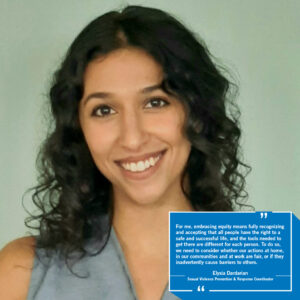
Elysia Dardarian is the Sexual Violence Prevention and Response Coordinator in NC’s Student Rights and Responsibilities Office. In her role, Elysia leads educational programming through workshops and events on topics such as sexual violence, consent, healthy relationships, being an active bystander, toxic masculinity, and how to respond to disclosures of sexual violence. She responds to disclosures and reports of incidents related to sexual and gender-based violence, and offers safe, inclusive, non-judgmental support to students.
How do you actively support and embrace equity through your work?
Power inequities in the home and in our communities allow gender-based violence (including sexual violence, domestic violence, and intimate-partner violence) to occur. Gender-based violence is also deeply connected with systems of inequity, such as sexism, racism, and colonialism. By educating our college community on topics surrounding gender-based violence (i.e. sexual violence, consent, healthy relationships, and toxic masculinity), I’m able to connect with students and have them consider what harmful and appropriate actions look like. The hope is to plant seeds in our community to help individuals reflect on their own personal biases and help break these power inequities.
Can you tell us about a project or initiative that you’re involved in that demonstrates a commitment to creating a more equal and inclusive world.
I help facilitate our Consent is Key Campaign, which plays an integral role in highlighting the College’s dedication to addressing sexual and gender-based violence. Our campaign focuses on educating the NC community through events and workshops and online through our website and on Instagram (@consentiskeync). For example, we partnered with Draw the Line and Gillian’s Place to host a workshop dedicated to challenging gender-based violence by learning about toxic masculinity. The goal of this campaign is to challenge myths that perpetuate this issue and educate the College community to be better informed, creating a campus atmosphere where sexual and gender-based violence is not tolerated.
I am also currently working on updating the College’s Sexual Violence policy to ensure it includes inclusive language and recognizes that sexual violence disproportionally impacts individuals from marginalized communities.
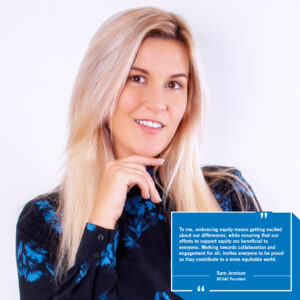
Sam Jemison is President of NC’s Student Administrative Council (NCSAC). In her role, Sam works on behalf of the student Board of Directors to amplify the voices of NC students in their communities and through government. Working alongside the College, the NCSAC team works to enhance the student life experience outside of the classroom, ensuring that students have access to good health coverage, opportunities for social interaction and more.
How do you actively support and embrace equity through your work?
I actively embrace and support equity by listening and constantly reminding myself that no issue is too small, and no idea is too big. Where my mind may see barriers, others may see opportunity; and vice versa. Working together to explore new and creative ways to help students, even if untraditional, can contribute to moments where we are able to remove barriers and see students reach further success without undue hardships holding them back.
Can you tell us about a project or initiative that you’re involved in that demonstrates a commitment to creating a more equal and inclusive world.
Through the support of the NCSAC Board, I am proud to serve on the Board of Directors for a new provincial advocacy organization called Ontario Student Voices. The organization works to bring the voices of college students across the province together to tackle equity issues far larger than any one student government could tackle alone. Bringing more voices together, while leveraging our unified voices and resources, will help to share best practices and identify areas of opportunity where we can imagine, and then bring to life, a better and more equitable world for all college students in Ontario.
