
When a group of Niagara College business students suggested partnering drones with a roadside assistance program, Armen Keulayan was all ears.
The director of sales and marketing for Drone Delivery Canada had the idea already written on a whiteboard at his office. It was exactly the kind of concept Keulayan was seeking to potentially expand operations for the Toronto-based drone logistics firm when he chose to have Drone Delivery Canada participate in last month’s NC Sustainability Hackathon.
Drones could deliver small tools to fix a flat tire, send an epipen in a medical emergency or even bring an extra set of keys should someone lock themselves out of their vehicle, students proposed.
“To me, that’s genius because CAA covers a broad range of areas in Canada and some of them are remote,” Keulayan said. “Some of the creativity of using drones for the greater good of humanity — where could drones be beneficial; where can it give back to society in terms of being green or if people are in trouble and need medical attention — I love how their minds got together and came up with a creative solution. It’s nice to see a younger generation see it as a viable product and business of the future.”
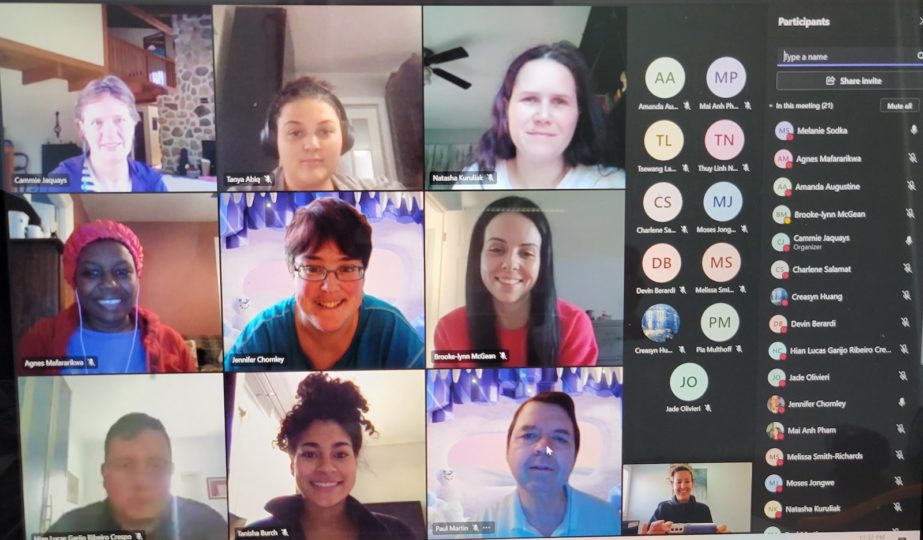
The second annual NC Sustainability Hackathon was a week-long intensive brainstorming session for 125 NC students studying entrepreneurship this term. During the hackathon, students worked in small groups to learn the ins and outs of one of two participating businesses, and collaborate on solutions that focus on the three P’s of sustainability: people, planet and profit.
In addition to Drone Delivery Canada, students created proposals for local charity Community Crew, which makes school lunches for more than 1,500 Niagara children.
Students compiled their ideas and put them together in a PowerPoint presentation that was judged by professors Cammie Jaquays and Melanie Sodka. The top three proposals were presented to each organization at the end of the week and winners were chosen.
“The dichotomy of the two companies we were working with really provided great opportunities for students to learn both sides,” Sodka said. “Let’s take a social enterprise and make it more sustainable and let’s take a for-profit and make it more sustainable.”
Third-year accounting student Tanya Abiq was part of the group that pitched the partnership with CAA to Drone Delivery Canada.
Not only did her group win first place, they were invited to meet with Keulayan to discuss their idea further, which also included assisting stranded cyclists who need to do minor repairs to get pedalling again and even assisting boaters on the water.
“There were situations I didn’t think of,” Keulayan said. “Sometimes you get stuck in the day-to-day (operations) and seeing things from students’ perspective opens your eyes to other avenues for business.”
To get to that point, however, Abiq and crew had do a lot of research on both drone rules and regulations, which are federal jurisdiction, and CAA’s operations.
“Now I feel like I know a lot about drones,” Abiq said. “It’s quite interesting to see how much goes into it behind the scenes. There are lots of rules and regulations in place.”
Additionally, the hackathon provided the kind of applied learning experience that only stands to benefit Abiq after she graduates.
“Working in teams was a really good experience — having to brainstorm and do research and organize with three other people,” she said. “I want to be an accountant so it’s very methodical, very technical (work), so the creativity and going outside the box, which I had to do during the Hackathon, is not something I’d normally be doing.”
That was the whole point, Jaquays noted.
“It was a really excellent experience for students in terms of personal and professional development and the quality of the work. This was the second year (for the hackathon) and it was really better than ever,” Jaquays said. “Melanie and I had a really hard time choosing which ones to move forward. Students really had to think and push themselves on what sustainability is and creating shared values for the organizations.”
