
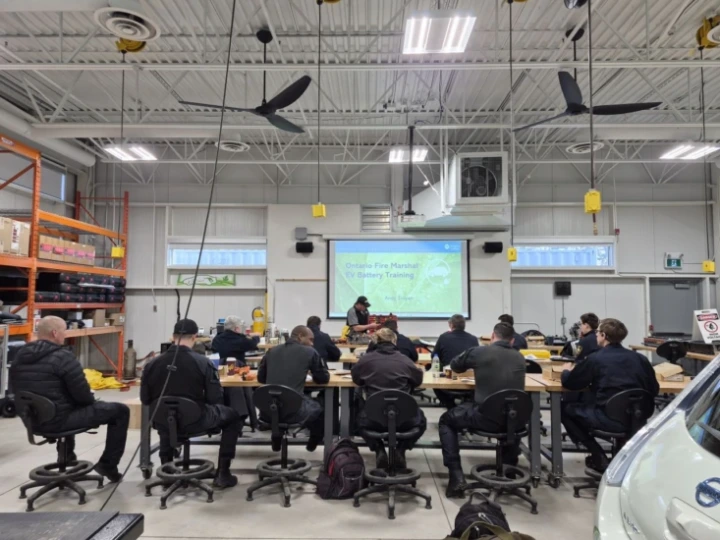
Members of the Ontario Provincial Police, Office of the Fire Marshal, and Office of the Chief Coroner of Ontario took part in specialized electric vehicle (EV) safety training at Niagara College this spring.
NC’s Alternative Fuel Safety training program equips first responders with the knowledge and practical skills needed to safely respond to incidents involving electric, hybrid, and hydrogen-powered vehicles. The program, launched in 2025 thanks to a $450,000 commitment from RBC Foundation, continues to strengthen emergency response preparedness across Ontario.
NC’s Andrew Troyan, Motive Power Technologist, developed and led a customized, hands-on training course tailored to first responders and fire investigators to help them safely respond to EV-related incidents involving battery fires and toxic gases at collision scenes. The two-day training course helped responders understand the unique hazards associated with high-voltage EV systems.
“Participants learned how to safely remove high-voltage batteries on a pickup truck and smaller passenger vehicle, identifying disconnect points and understanding how battery locations vary between vehicle models,” explained Troyan.
Troyan had the help of Motive Power program student Bailey Melnychuk, who has been doing her co-op with NC. Melnychuk demonstrated a variety of scan tools for participants that are commonly used within the automotive industry to diagnose vehicle issues and view live data – tools her professors have strong emphasized in the classroom.
“Diagnostic tools are especially important for first responders who need to quickly assess the status of the batteries when arriving at a scene involving an electric or hybrid vehicle,” said Melnychuk.
Using knowledge from her electrical and scan tool courses, she answered first responders’ questions about how vehicles communicate with diagnostic tools.
For Melnychuk of Airdrie, Alberta, moving to Niagara for school was a big part of the appeal, and her co-op helped her build community in a new place.
“I just wanted to chase a dream I’ve had for a while and see where it takes me,” said Melnyhuk. “What better place than the Niagara Region, home to the unofficial Eighth Wonder of the World?”
Some highlights of the program for Melnychuk have been the support from her instructors and representing women in the trades.
“They treat students like family, and they want nothing but the best for us. No student is ever afraid to ask for help,” she said. “The automotive field is still very male-dominated, but it has been an honour to be part of the small group of women learning in the automotive garage and to help inspire young girls. I’ve had prospective students ask if the program is right for women, and I can honestly say it’s not only welcoming, but a place where you can be yourself.”
While the training focused on emergency response and vehicle safety, Melnychuk has her sights set on a similarly fast-paced environment: a career in motorsports, be it in the pit-lane or behind the wheel of a high-performance vehicle.
“I hope it will allow me to travel and see different parts of the world, that would be an absolute dream,” she said.
Melnychuk says that even in motorsports, high-performance EV’s are beginning to gain traction. Understanding the risks associated with EVs is becoming increasingly important.
“There most certainly is a connection between the two,” said Melnychuk, referring to EV safety and motorsports. “The racing class of F1 has begun to test out all electric formula cars. Understanding how electric vehicles work and the dangers behind them is important not just for mechanics, but for everyone else within the race team, and for those who work on the track, from standby medics, engineers, and even the driver themselves.”
For more on NC’s Alternative Fuel Safety Training, visit: niagaracollege.ca/trades/ev-training
