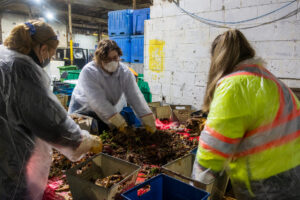
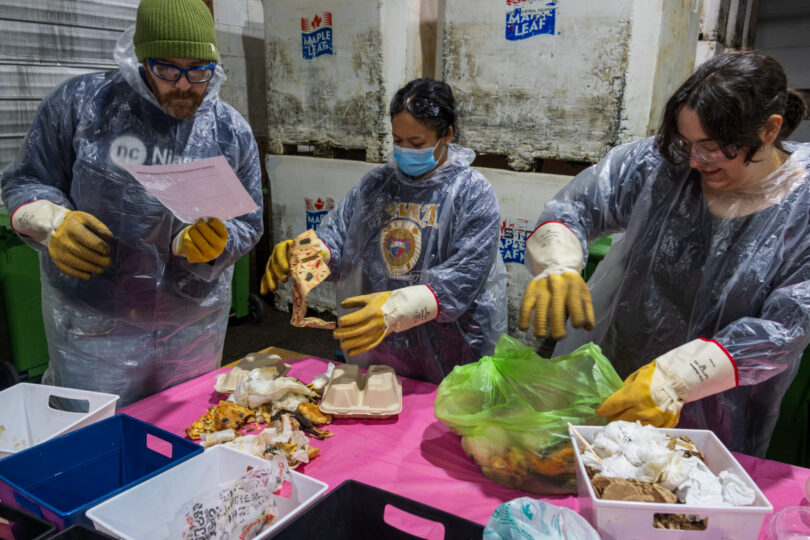
A group of students from NC’s School of Business and Environment had a chance to dig into a real-world sustainability project that aims to help businesses in the City of Guelph reduce their food waste.
On Friday, March 6, nine students were joined by several faculty and the NC Sustainability team for a hands-on organics waste audit at Davidson Environmental – an organic food waste disposal and recycling company based in St. Catharines which serves Southern and Southwestern Ontario. They worked alongside staff from the City of Guelph, SWR, and Davidson Environmental to analyze waste from 22 downtown Guelph businesses.
“Partnerships like these help our students see how the skills they develop in the classroom can be applied to support business activities. These real-world projects with multiple community partners help to illustrate the interconnectedness of not just what we are learning in the classroom in different courses, but in a real-world business setting and the diverse career opportunities that exist for our grads,” said Taryn Wilkinson, Manager, Sustainability and part-time faculty. “This particular project reinforces the connection between food waste, renewable energy generation and carbon emission reductions, by keeping organics out of landfills and diverting it to a waste-to-energy facilities helping the businesses of Guelph reduce the waste sent to landfill and carbon emissions from those activities.”
The initiative was part of a larger organics waste diversion program in the City of Guelph, aiming to provide a clearer picture of how much waste can be diverted from landfills to energy generation facilities.
Jordyn Divok, Circular Economy Specialist with the City of Guelph, noted that the City of is working to build a circular food economy and help local businesses reduce food waste, and their downtown organics collection program, delivered by SWR and Davidson Environmental, plays a key role in that effort.
“To deepen our understanding of how businesses generate food waste, we saw a great opportunity to partner with students on waste audits. It offered hands on-learning while highlighting how strong waste practices support a resilient, sustainable business community,” said Divok. “Niagara College was a perfect fit, thanks to its proximity to Davidson Environmental and its strong sustainability focused programs.”
For NC students involved – including one-year Environmental Management and Assessment (EMA) graduate certificate program, as well as and second-year students from the two-year Environmental Technician (Co-op) diploma program – the day was about more than sorting through scraps. It offered a rare opportunity to see the interconnectedness of waste management and renewable energy generation in a real-world setting.
For EMA students, the initiative supported an in-class assignment for their Energy and Carbon Management course.
Professor Katie Altoft noted that the students gained a hands-on approach to a solid waste (organics) audit from real clients in the City of Guelph, as well direct contact with the project organizers to ask questions and get insight from the City’s perspective.
“These types of projects bring the curriculum to life and consolidate classroom learning,” said Professor Altoft. “The students will have important experience to share in interview, connections in the industry, and pictures for their portfolios and LinkedIn of themselves in action.”
By taking part in the audit, the students helped the City of Guelph with its long-term sustainability goals while gaining field experience and practice with data collection and application. While participation was voluntary, it was highly encouraged for EMA students as the data collected will support an in-class assignment in their Energy and Carbon Management course.
Professor Matt Harbin emphasized the value of collaboration with local community partners.
“The students are getting a hands-on approach to a solid waste (organics) audit from real clients in the City of Guelph,” said Harbin. “It’s incredibly rewarding and beneficial for the students because they can interact with those from the industry and see how the process works; it’s not a hypothetical – it’s a real-world scenario.”
Environmental Management and Assessment student Will Mallett valued the experience.
“It’s really interesting seeing the whole process at Davidson Environmental and see how wide their reach is,” he said. “Taking our first waste audit that we did in class and seeing it scaled up … was really interesting and it definitely provided more insight into how this would look in a professional setting going forward.”
The data gathered during the audit will be used by the City of Guelph to calculate potential energy generation and carbon emissions savings compared to traditional landfill disposal.
“The collaboration with Niagara College staff made this event a success. Students gained real-world experience, and the City gained valuable insights to better support businesses in improving their organics management,” said Divok. “We were thrilled to partner with Niagara College and look forward to future opportunities together.”