

Students in the Advanced Communications for Horticulture course presented their experiential project proposals on April 15 at a showcase marking the culmination of their studies. Partnering with Honey Fields, a local honey farm in Niagara-on-the-Lake and Ontario’s largest honey producer, these students put their communication skills to the test with a real-world scenario.
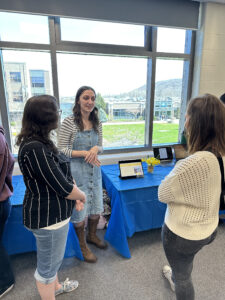
Led by Professor Tania Fera-VanGent, the course emphasizes verbal and written communication in horticulture-related contexts. Students develop research skills, craft field-related documents for customers, instructional materials, strategic writing styles, and proposals. The showcase provided a platform for students to apply their knowledge and skills to practical scenarios while honing their presentation skills in front of members of the NC community.
“Every year, I aim to give students in the Horticulture, Landscaping, and Greenhouse programs a real-world experience tied directly to their fields,” said Fera-VanGent. “This year, our collaboration with Honey Fields offered a genuine industry challenge that mirrored the real-world scenarios these students will face in their careers. This approach not only gives them hands-on experience but makes the study of Communications more compelling, which is reflected in the exemplary work they produced.”
“Our Communications courses at NC use authentic assessments to teach students important employability skills like how to communicate effectively, work well in a team, and problem solve,” said Jennifer Roberts, Associate Dean, Academic and Liberal Studies – Daniel J. Patterson Campus. “In Advanced Communications for Horticulture, the connection to industry provides real-world research and a community partnership experience that students can take with them as graduates to enhance their employment opportunities on a local or global scale.”

Students Jesse Mclinton and Katja Spoerri devised a unique “Hex Hive” landscape design for the Honey Fields facility.
Students were tasked with choosing between two cases: enhancing unoccupied space in front of the Honey Fields store to attract customers, employing a low maintenance and low budget model, or addressing the infestation of Varroa Mites while ensuring environmental sustainability. At the showcase, students presented their project proposals using visual pitch decks and poster boards to provide comprehensive recommendations and solutions around the functionality of the Honey Fields facility.
“It was a privilege to be invited to work with the students at Niagara College,” said Erin Rowaan, Owner, Honey Fields. “We love having opportunities to share our business and promote awareness of what is going on in the honey bee industry. These students were interested and engaged and their final projects were an indication of this. Their organization and creativity was impressive, and I will certainly be using some of the ideas students presented for our new landscaping project.”
Students Jesse Mclinton and Katja Spoerri who chose Case 1, devised a unique “Hex Hive” landscape design featuring a child-friendly play area, an educational teaching area, and an event space.
“This project provided a great opportunity to learn how to pitch and present to a real industry customer,” said Spoerri. “Working with actual challenges that Honey Fields faces made the project particularly exciting and relevant and it felt like a real test of our critical thinking and communication skills.”
Student Jashanpreet Kaur and her group focused on Case 2, presenting a comprehensive strategy to combat Varroa Mites. As a Horticulture Technician student, Kaur found the project eye-opening as it explored the world of insects, bees, and pesticides, topics not yet covered in her studies.
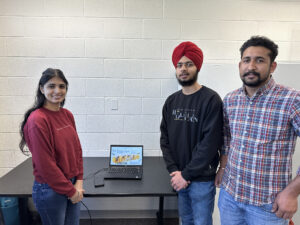
Student Jashanpreet Kaur and her group presented a comprehensive strategy to combat Varroa Mites in their proposal.
“This project not only enhanced my research and presentation skills but also widened my understanding of important issues like pesticide disruption in bee populations – insights that will be incredibly valuable in my ongoing horticulture studies,” she said.
For student Hannah VanderMeulen, the biggest takeaway from this project was understanding the importance of customer relations and the comprehensive process needed for successful project completion.
“This project was super interesting, and I really enjoyed working on it,” said VanderMeulen. “I think the biggest thing it taught me was how to take a project from beginning to end step-by-step, starting with understanding your customer’s needs through solid communication.”
