
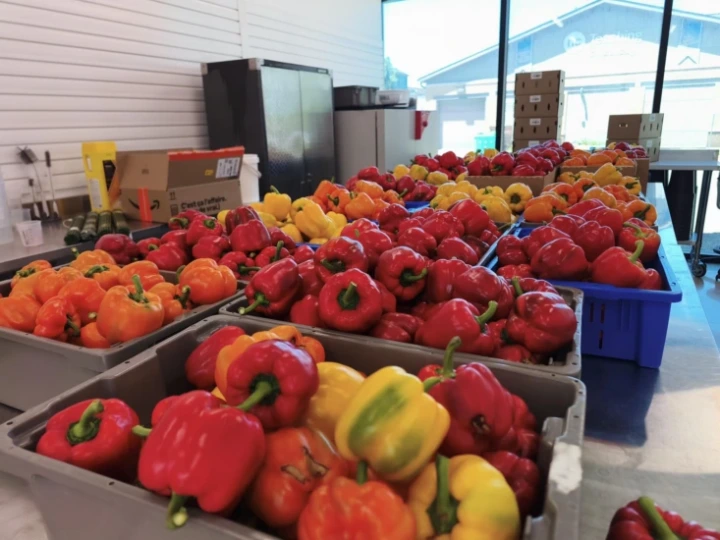
A Niagara College research project is delivering more than valuable data for the greenhouse industry. It’s also helping put fresh, nutritious food on tables across Niagara.
Through a project with a vegetable seed breeding company, NC’s Horticultural and Environmental Sciences Innovation Centre (HESIC) has donated approximately 4,035 lbs. of fresh bell peppers to community organizations, turning the results of its research into an unexpected opportunity to give back.
“The entire HESIC team has been happy to see the peppers from this trial being used to feed people who have a need for fresh, nutritious food at low or no cost,” said Ashley Paling, Research Lead at HESIC. “While our main objective is the research and data we are providing to our industry partner, these pepper donations have been an unexpected additional positive outcome of this project.”
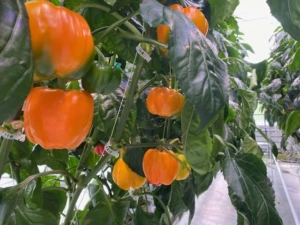
Peppers are grown using a high-wire system in HESIC’s research greenhouse.
The project was the first research initiative to take place in HESIC’s new research greenhouse, a $12-million facility featuring 1,260 square metres of dedicated applied research space that opened in 2025. Researchers are testing new bell pepper varieties developed by the industry partner, monitoring plant health and productivity to identify top-performing varieties for commercial greenhouse growers.
The peppers are grown using a high-wire system, a common commercial greenhouse method in which plants are trained to grow vertically along wires and regularly pruned to maximize production in a limited space.
“This system allows us to maximize the amount of produce we can grow in a small surface area,” said Paling. “Most tomatoes, cucumbers, bell peppers, and even eggplants are grown in this system in Canadian greenhouses which allows us to control the environment, extending the typical growing season we have here in Ontario.”
The controlled environment also allows researchers to manage temperature, light, humidity and carbon dioxide levels year-round, closely replicating the conditions of a commercial bell pepper operation.
Each Monday, the team harvests ripe peppers and records data, including total yield and the length and width of individual peppers. Once measurements are complete, the peppers are ready for distribution.
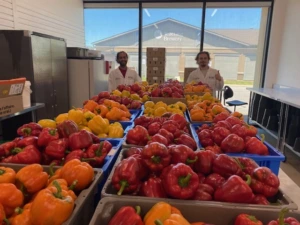
HESIC team members Rishi Dattani (left) and Damian Mocko (right) with one week’s worth of peppers harvested in crates during HESIC’s largest weekly harvest ever.
The donation initiative began in early 2025 through a connection between Paling and fellow NC Horticultural Technician (Co-op) graduate Luke Baulk, now Program Manager at United Way Niagara. Their conversation led to weekly pepper donations to United Way, which culminated in approximately 800 lbs. of peppers donated in the first year of the partnership.
“These produce donations help provide fresh, nutritious food to community agencies across Niagara, improving food access and reducing costs for programs such as food banks, meal programs and pay-what-you-can markets,” said Baulk. “What’s particularly exciting is the practical student learning and research at Niagara College having such a direct community impact. A big thank you to Ashley and the HESIC team for their ongoing generosity and commitment to supporting community initiatives.”
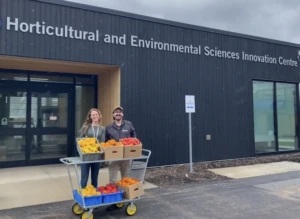
Ashley Paling and Luke Baulk standing outside of HESIC with the first United Way pepper donation of 2026.
The initiative expanded in early 2026 when Paling connected with Niagara Nutrition Partners (NNP) at a community event. Seeing an opportunity to help make more fresh produce available to those who need it, a second donation partnership was established with NNP to support its school food programs that provide nutritious food to students across Niagara.
“Thanks to Niagara College’s generous donation of fresh, locally grown peppers, thousands of students across Niagara have the opportunity to enjoy nutritious, high-quality produce as part of their school meals and snacks,” said Jordan Mammoliti, Giving and Community Engagement Manager for NNP. “This partnership not only helps us provide healthy food to students but also highlights the power of community collaboration in supporting student well-being. We are incredibly grateful to Niagara College for helping us nourish young minds and bodies while connecting students to the benefits of locally grown food.”
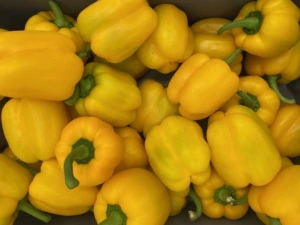
Peppers ready to be donated to United Way and NNP.
Pepper donations have increased significantly, with 3,235 lbs. distributed between the two organizations this year.
For Paling, one harvest day in particular stands out as a highlight of the research trial.
“On June 1, 2026, our team had its largest harvest of the project, bringing in 396 lbs. of peppers – 853 individual peppers. It was a memorable day for our team, seeing just how much produce we could harvest in a single day and how much we could donate to the community that week,” she said.
As the project enters its third year, with new plantings scheduled before the end of the year, the HESIC team is looking forward to continuing its research with the same industry partner. Seeing their research translate into tangible benefits for the community has been a rewarding part of their work and serves as a reminder that the impact of applied research can extend beyond the walls of the greenhouse.
