
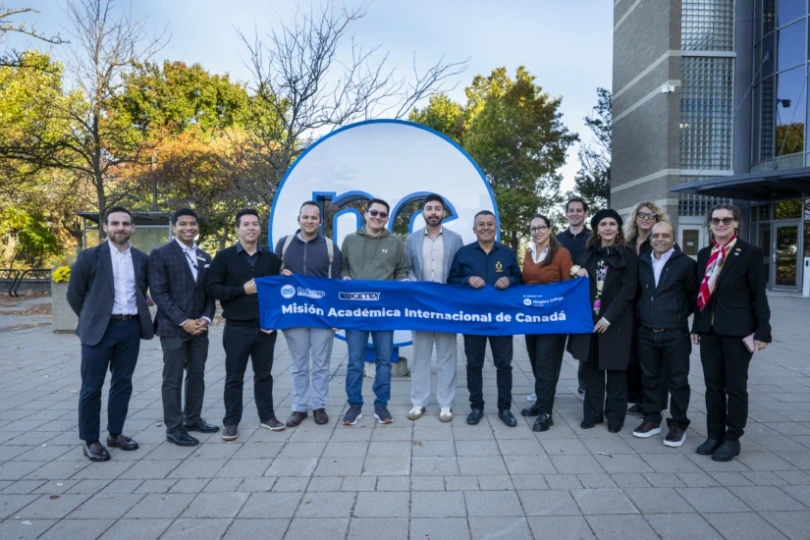
Niagara College welcomed representatives from seven higher education institutions in Colombia for a week-long professional development program focused on applied research, innovation and industry collaboration.
The Canada Academic Mission 2026 took place from October 18 to 24, with the Higher Education Development Fund (FODESEP) as NC’s lead partner and funding provided by the Colombian Institute of Educational Credit and Technical Studies Abroad (ICETEX). Developed by NC’s Global Customized Training and Consulting (GCTC) team, part of the Partnerships and Enterprises Division, the program brought together academic leaders, researchers and administrators from Colombia.
Through workshops, networking and site visits, participants in the ICETEX-FODESEP Canada Academic Mission explored Canadian approaches to applied research and opportunities to strengthen partnerships between Niagara College and Colombian postsecondary institutions.
The program focused on practical strategies for research leadership, developing and sustaining centres of excellence, and working with industry, government and community stakeholders. Participants also considered how these approaches could support research capacity and institutional innovation within their own organizations.
“Our institutions have campuses across Colombia, including rural areas and mid-sized cities where higher education has to respond directly to local needs,” said Pilar Gaitán Carrizosa, FODESEP’s representative in the delegation. “Niagara showed us a model that does exactly that: innovation centres built around the productive strengths of their region, students learning through real projects with industry, and partnerships where academia, industry, government and communities work together.”
“Our participants return home with their multiplication plans, a network among themselves and a relationship with Niagara College that we want to turn into joint projects,” added Carrizosa.
Workshops and site visits
Workshops covered research and innovation fundamentals, business development for research partnerships, creating centres of excellence and innovation, institutional innovation and applied learning practices, and network models for research and innovation. Visits to NC’s innovation facilities connected workshop discussions with examples of applied research in practice.
At the Daniel J. Patterson Campus in Niagara-on-the-Lake, participants visited the Horticultural and Environmental Sciences Innovation Centre, the Food and Beverage Innovation Centre and the Niagara College Craft Beverage Centre. At the Welland Campus, the delegation toured the Walker Advanced Manufacturing Innovation Centre and attended presentations from the Healthy Aging and Wellness Innovation Centre and the Business and Commercialization Innovation Centre.
These activities offered a closer look at how NC connects research expertise, applied learning and industry needs across a range of sectors.
“For us, visiting Niagara College has been an opportunity to rethink how we can make research more connected to real-world challenges,” said Jhoany Alejandro Valencia Arias, Professor at Institución Universitaria ITM. “This experience has allowed us to learn from innovative models, exchange perspectives with other higher education institutions, and reflect on the possibilities we have in Colombia to strengthen applied research, innovation, and collaboration with industry.”
“We return with new ideas, valuable lessons, and a stronger commitment to sharing what we have learned and transforming these experiences into opportunities for our institutions, students, and communities,” added Arias.
An executive networking event with NC President Sean Kennedy provided an additional opportunity for exchange. The week concluded with reflection sessions and discussions about next steps for collaboration.
“The participants came together without knowing each other. It was amazing to see how quickly the group built trust, and a shared vision for the transformation,” said Amy Proulx, Professor and Academic Program Coordinator for NC’s Culinary Innovation and Food Technology program, who facilitated multiple workshops. “For many years, Niagara College has taken a unique approach to research, and this visit allowed the team to explore our meaningful, unique practices that catalyzed their new idea generation.”
“This workshop represented the best of what Niagara College does in international partnerships. Capacity building and empowerment for our partners is one of our greatest strengths,” added Proulx.
