
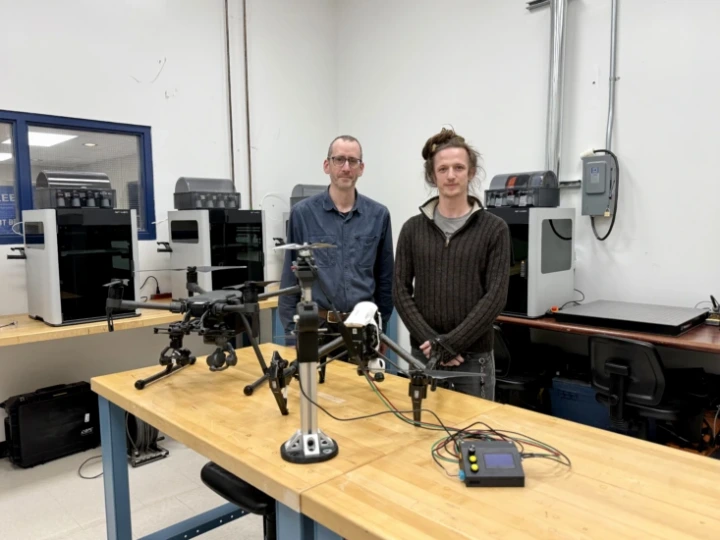
When Niagara College’s new Defence Systems Engineering Technology (DSET) program needed a way to give students hands-on experience testing drone propulsion systems, Program Coordinator Alexander McGlashan turned to the College’s Walker Advanced Manufacturing Innovation Centre (WAMIC) to explore an applied research solution.
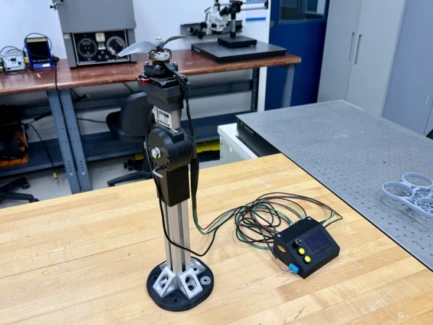
The program needed a thrust stand to help students learn about the physics, data analysis and aerospace engineering principles behind drone propulsion. A thrust stand measures and characterizes the thrust produced by different motor and propeller combinations, giving students a way to test how different components perform.
“We were looking for a solution,” said McGlashan. “In a program like this, the equipment is extremely expensive and because DSET is a new program, we have a number of new equipment requirements that we’re working to address. In this case, we saw an opportunity to work with WAMIC to develop something that would meet our needs and give our students the equipment they need for hands-on learning.”
To get the project started, McGlashan met with Electronics Engineering Research Assistant Kainaan Riordan to outline what the thrust stand needed to do, including the types of motors and propellers it would need to test. Riordan, who is in his last term of the Electronics Engineering Technology program, took those requirements and began developing a solution.
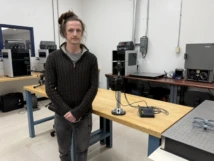
“At WAMIC, we look at how advanced manufacturing can be used to solve real-world problems,” said Riordan. “The DSET program presented an opportunity to collaborate on a real-world engineering challenge and develop a solution in-house, which has been an exciting project to be part of.”
Over the summer, Riordan designed and refined the thrust stand, using WAMIC’s advanced manufacturing capabilities to turn the concept into a working prototype. The system combines off-the-shelf aluminum components, 3D-printed plastic parts produced in-house and electronic components designed and assembled by Riordan.
One of the design’s key features is a rotating mounting plate that allows motors to be tested at different angles. The feature was designed to reflect the different orientations a motor and propeller may experience while a drone is in flight, allowing students to test performance under a range of conditions. Riordan also designed and programmed the thrust stand’s electronic components, bringing together the mechanical, electrical and software elements of the project.
The prototype was also created with students’ data-analysis needs in mind. McGlashan wanted students to be able to record test results, graph the data, conduct mathematical analysis and use the information for assignments or research projects.
To support this, Riordan incorporated a USB connection that allows students to transfer test data directly to a computer. He also developed software that can display the data and graphs in real time, giving students the option to monitor results while a live test is happening or save the information for analysis later.
With the prototype complete, Riordan will hand over the final designs to McGlashan and the DSET team. The prototype will serve as the foundation for a class set of thrust stands, which will be manufactured in the coming months with support from college staff and co-op students.
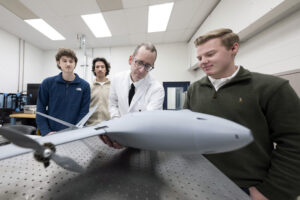
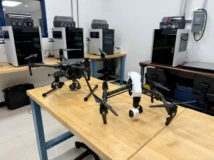
Students and Program Coordinator Alexander McGlashan inspect a fixed wing drone (UAV) manufactured at Niagara College.
For McGlashan, the project demonstrates how collaboration between academic programs and applied research can create new opportunities for student learning.
“It’s very powerful when you can combine academics with applied research. That’s one of the strengths of what we have here at the College,” he said. “When you give students the opportunity to work on projects that have real-world impact, it brings a different level of professionalism, understanding and awareness to their learning.”
The project also gives DSET students an opportunity to bring together the technical skills they develop in the classroom and apply them to practical engineering challenges, which will help prepare them for their future careers.
“We’re teaching our graduates to go out there and solve problems and meet challenges head on,” said McGlashan. “Working with WAMIC gives students that opportunity in a controlled environment and provides an extra level of applied learning they might not otherwise have.”
For Riordan, the project provided an opportunity to experience that process firsthand. From understanding the program’s requirements to designing, fabricating, programming and refining a working product, he led the entire process.
“It’s very uncommon for students to have access to this level of engagement before they enter industry,” said Riordan. “For someone like me, who has always dreamed of working in research and development, it can be a difficult field to get into. Being part of the WAMIC team and working on a real product from start to finish has been an incredible learning experience. I couldn’t ask for a better learning environment.”
