
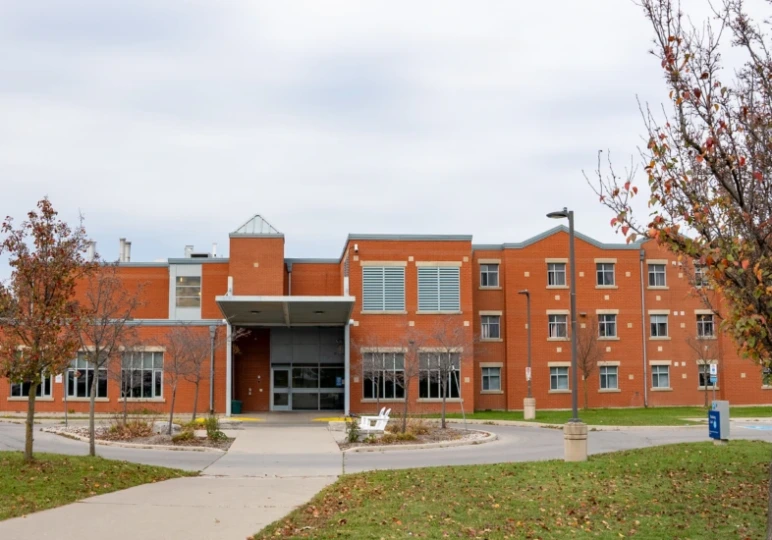
As Niagara College recognizes Disability Awareness Week from Oct. 5-9, recently completed accessibility upgrades in NC’s residences are helping create safer, more inclusive living spaces for students.
The improvements were identified through an accessibility audit and brought to life through a collaborative effort involving Student Engagement, Residence, Equity, Diversity and Inclusion (EDI), and Facilities Management Services (FMS).
Together, the teams worked to identify and address barriers within residence spaces at both the Welland and Daniel J. Patterson Campus in Niagara-on-the-Lake.
Recent accessibility improvements include:
- New visual fire alarms, providing visual emergency notifications in common areas and other residence spaces
- Vertical grab bars in roll-in showers in accessible suites
- Additional grab bars in washrooms
- Accessible washroom fixtures
- A fire extinguisher relocated to an accessible height (in identified common areas)
While these upgrades mark important progress, NC continues to identify barriers and opportunities for further accessibility improvements within its residence spaces.
Director of Student Community Development Ali Weir said the impact of accessibility improvements can be significant for a student’s day-to-day experience.
“For students with disabilities, these improvements can make everyday tasks easier and safer,” said Weir. “Things that may seem small to someone else can have a significant impact on a student’s ability to move through their day, participate in activities, and feel comfortable in their home.”
In planning the improvements, Weir said the team considered how changes could support students throughout their residence experience.
“We considered the diversity of needs within our residence community,” she said. “Accessibility can look different for every student, so it was important to think about flexibility, independence, safety, and comfort.”
Weir noted that accessible residence environments can benefit the broader student community as well, particularly as students may experience temporary, situational or changing accessibility needs throughout their time at NC.
“Ultimately, the goal was to create a residence environment where students feel supported and able to participate fully in residence life without having to navigate unnecessary barriers,” she said.
For Samah Sabra, Director of Equity, Diversity and Inclusion at NC, accessibility in residence also means considering a student’s ability to participate in the full residence experience and not just ensuring they can access their individual room.
“This is an important element of inclusion and ensuring that students with disabilities know that residence is for them, and that means all of residence, not just their own, individual accessible room and the path there,” said Sabra. “They should be able to join in all on-campus events and activities.”
Sabra highlighted the importance of collaboration across the College in creating accessible and inclusive environments, noting that accessibility involves all areas of campus life and cannot be addressed from one perspective alone.
“Accessibility requires anticipating potential barriers, identifying ways to address them, planning to create new, accessible, inclusive paths, and coordinating all of our efforts and skills to make sure it happens,” she said. “Making sure that we consider the entire student or employee journey and taking into account how visitors and guests experience campus requires collaboration because we each have one piece of the puzzle, but unless we bring them all together, we will fall short of reaching our shared goal.”
For Weir, the recent residence work has also reinforced the importance of considering accessibility proactively rather than waiting until someone encounters a barrier.
“This initiative has reinforced for me that accessibility needs to be part of the conversation from the beginning when we are thinking about student spaces and experiences,” she said. “It shouldn’t be something we consider after the fact or only when a student identifies a barrier.”
That consideration is particularly important in residence, where campus is not simply where students attend classes but where they live and build community.
“Residence is more than just a place to sleep, it is a student’s home and a major part of their student experience,” said Weir.
Sabra echoed the importance of creating spaces that anticipate and welcome people with disabilities as part of the campus community.
“Campus is home to NC students. This is even more true when we consider residence since it’s literally where students live,” she said. “It’s important for the spaces we live, study, or work in to be designed with all of us in mind.”
Sabra noted that part of addressing ableism (discrimination based on ability) is recognizing, anticipating and welcoming the presence of people with disabilities in NC communities and designing spaces and activities with them in mind.
“Students with disabilities need to know that they are not an after-thought at NC, that they are valued and appreciated for who they are and everything they bring to our communities on campus,” said Sabra. “Our communities are not complete without them.”
As NC marks Disability Awareness Week, Sabra hopes the initiative encourages members of the College community to continue looking for opportunities to identify and remove barriers.
“Our biggest hope is that the NC community continues to think about and find ways to increase accessibility,” she said. “If anyone notices a barrier, whether it’s a physical or attitudinal barrier, we want to learn about it so we can work to address it.”
