
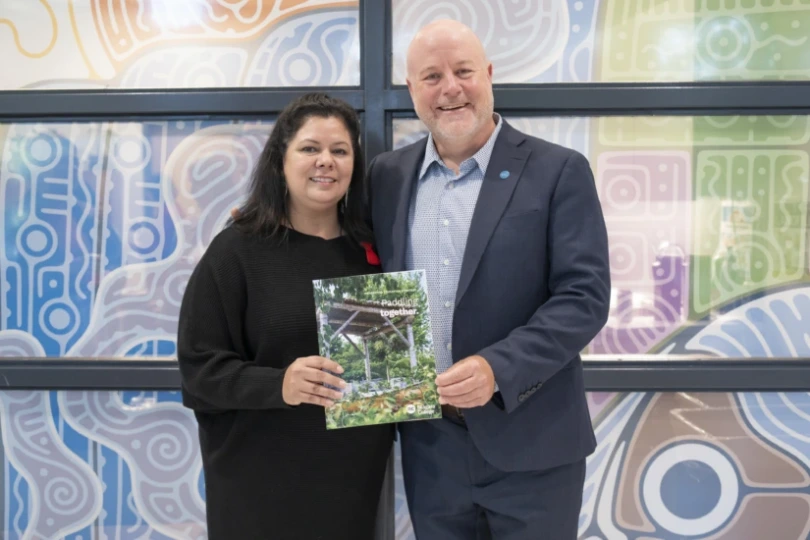
Niagara College has officially launched its new Indigenous Education Strategy, Paddling Together, outlining a shared vision, strategic priorities and roadmap for advancing Indigenous education, strengthening relationships and supporting the College’s ongoing commitment to the Truth and Reconciliation process.
The Strategy was developed over two years through consultations, surveys, conversations, and teachings and was led by the College’s Indigenous Education Strategy Advisory Group. The group brought together Indigenous staff, Indigenous Education Management Circle representatives, and non-Indigenous colleagues to help shape the Strategy’s vision, priorities and commitments.
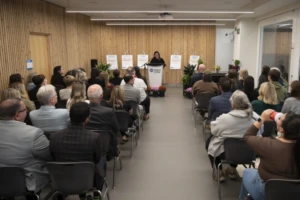
Leah Hogan, Director, Indigenous Education welcomes guests to the launch of NC’s Indigenous Education Strategy.
“Niagara College has been on an important journey to deepen our understanding of Indigenous perspectives and to centre those perspectives in our work,” said NC President, Sean Kennedy. “By drawing more fully on the diverse knowledge and experiences within our community, we can create a place where Indigenous learners continue to thrive, feel a stronger sense of belonging, connection, support and representation, and have meaningful opportunities to share their voices and shape the future of NC.”
In keeping with the principles of the Two Row Wampum and recognizing the waterways that have shaped the Niagara region, the Strategy’s five priority areas are represented as canoes: Community Relationships, Governance, Teaching and Learning, Indigenous Student Empowerment, and Organizational Culture and Systems.
The name Paddling Together reflects both the journey ahead and the importance of moving forward through listening, learning, relationships, and shared responsibility.
Paddling Together will act as a roadmap to advancing Indigenous education at the College.
“Paddling Together is an important step in the College’s work to increase access, inclusion, and support for First Nations, Inuit, and Métis Peoples across NC and to imagine what is possible for all learners when Indigenous ways of knowing, being and doing are considered”, said Leah Hogan, Director, Indigenous Education. “It has been an honour to work alongside our Indigenous partners and NC colleagues to bring this vision to life and to build a foundation for meaningful, lasting change across our College community.”
The Strategy launch also provided an opportunity to celebrate Indigenous Education’s new visual identity, created by Indigenous woodland-style artist Tsista Kennedy. The artwork was developed to complement Paddling Together, reflecting themes of Indigenous education, connection and community, and the College’s continued journey toward Reconciliation.
At the launch event, the artist shared the inspiration and meaning behind the artwork, which features his distinctive style of semi-bold black lines, intricate patterns and vibrant colours.
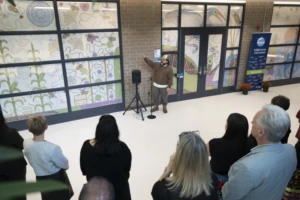
Artist Tsista Kennedy explains the meaning behind his artwork at the launch of NC’s Indigenous Education Strategy.
The artwork has been installed as a mural wrapping around the Indigenous Education Centre at the Daniel J. Patterson Campus in Niagara-on-the-Lake. Additional installations will be added in other areas of the College, extending the visual identity of Paddling Together at NC.
“As we launch Paddling Together, I invite our entire College community to carry this work forward with respect, openness, reciprocity and a commitment to Indigenous leadership as we all have a role to play in creating a more inclusive College community, strengthening relationships with Indigenous Peoples and communities, and contributing to meaningful and lasting change,” said President Kennedy.
