
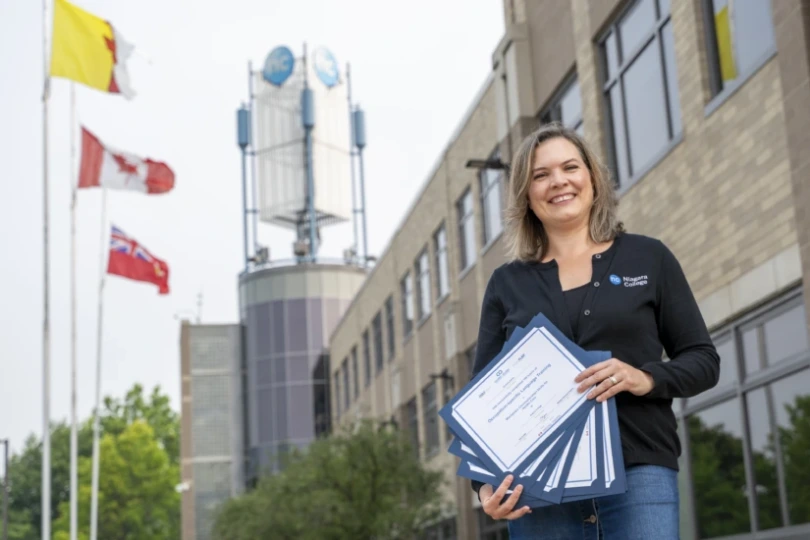
After over 15 years of helping hundreds of internationally-trained professionals seeking to rebuild their lives and careers in Canada, Niagara College’s OSLT program will leave behind a legacy of integration and empowerment.
Funded by Immigration, Refugees and Citizenship Canada (IRCC), NC has offered the Occupation Specific Language Training (OSLT) program since 2009, giving newcomers a place to hone their workplace communication skills through occupation-specific language training.
Kate Agar, Manager of Newcomer programs at NC, noted the program has assisted more than 835 newcomers over the years. OSLT has a strong language-learning component and is geared toward newcomers seeking employment in sectors such as Business, Health Sciences, and Technology. Geared to individuals who already have education, training, or experience in their field and want to strengthen their professional English skills, the program incorporates the language, communication styles, and workplace expectations unique to specific sectors, helping participants communicate effectively in their chosen profession.
With a shift in federal funding priorities, the historic program graduated its final cohort on July 18, marking the end of an era for NC – as well as colleges throughout the province who have offered the program.
Agar noted how much she has valued being a part of this program over the years, beginning with teaching the program before taking on her current position more recently.
“You really pour your heart and soul into supporting these individuals and the most rewarding part is seeing them succeed,” Agar said.
With curriculum designed by Colleges Ontario, OSLT doesn’t teach newcomers to speak English or basic grammar. It’s a specialized 180-hour program targeting the subtle, technical, linguistic and cultural nuances of Canadian workplaces across three key professional streams: Healthcare, Business and Technology.
In the Healthcare stream, tailored for medical specialists, dentists, nurses, and personal support workers, students are guided through high-stick sector specific scenarios. These include documenting patient data in electronic medical records, managing professional phone calls, interpreting body language, and navigating complex ethical discussions.
In the Business stream, which covers entrepreneurship, sales, and marketing, the curriculum focuses heavily on workplace safety, Canadian business etiquette, professional writing, accounting, and collaborative teamwork.
Meanwhile, the Technology stream is geared towards engineering and IT professionals learning to project manage, collaborate in diverse technical teams, and present technical data within Canadian industry standards.
Agar emphasized the unique challenges facing newcomers in the medical sector.
“In healthcare, the standards and systems are incredibly high and hard to navigate,” said Agar. “A nurse is a nurse anywhere, but their duties and responsibilities in the Canadian system are vastly different from back home. We don’t just teach vocabulary; we teach them how to navigate the system, how to gain confidence, and how to assert themselves in a medical environment.”
Nine internationally trained professionals are graduating from the Healthcare stream of NC’s final OSLT cohort graduating at the end of July, including dentists, nurses and other medical specialists from countries around the world including Colombia, Vietnam, Sudan, Iran and Turkey.
Bridging the professional gap
For over 14 years, Professor Olga Loshkin has taught OSLT programs for internationally trained managers, business specialists, tech experts and healthcare workers. While every cohort is different, she noted that while every cohort is distinct ,the goal remains unchanged: helping newcomers build professional confidence.
“Many participants arrive with years of education and experience but struggle to communicate confidently in a Canadian workplace. Being able to help them bridge that gap through workplace communication, language, and cultural understanding is incredibly meaningful,” she said. “Watching participants gain confidence, find employment, receive promotions, or simply feel that they belong in their new workplace is what makes this work so fulfilling.”
Loshkin has facilitated several innovative OSLT pilot projects at NC, including an Entrepreneurial Pilot Project that helped more than 100 newcomers connect with local business resources and launch enterprises.
“One of the most valuable aspects of this program was the opportunity to collaborate directly with employers. Through regular interaction, we were able to discuss workplace communication challenges, identify cultural differences that could affect collaboration, and develop practical strategies to bridge those gaps,” said Loshkin. “These conversations benefited not only the participants but also the organizations they worked for, helping create more inclusive and effective workplaces.”
Loshkin noted the experience was mutually beneficial: participants built leadership skills, employers learned how to better support internationally-trained staff, and she gained valuable insight into the evolving needs of Canadian workplaces.
“Seeing participants successfully transition into leadership positions and become trusted members of their organizations has been one of the most rewarding experiences of my career,” she said.
As an immigrant herself, Loshkin understands the personal challenge of adapting to a new culture and professional landscape.
“For me, OSLT is much more than a teaching job; it is a privilege. It gives me the opportunity to support others on a journey that I have experienced myself and to help them navigate the path with greater confidence,” said Loshkin. “I see it as my way of giving back to the community that welcomed me and of helping other newcomers realize their potential and build successful careers in Canada.”
The 17-year journey
Since its provincial rollout in 2009, OSLT at NC has evolved alongside the Niagara region’s changing workforce needs.
Launched by Colleges Ontario, the program was designed to address the underemployment of highly skilled immigrants. At NC, OSLT initially operated out of the Welland Campus, offering specialized training in business, health sciences and technology.
Between 2016 and 2022, the program underwent significant expansion and digital transformation. It became a flexible 180-hour curriculum delivered three times a year. By transitioning from in-person evening classes to a hybrid model, combining synchronous sessions and online modules, the College improved access for newcomers who were balancing classes with jobs.
The curriculum shifted deeper into socio-cultural training, teaching immigrants how to navigate Canadian office dynamics, client relationships and local interview protocols.
In its final years, OSLT integrated closely with NC’s Newcomer Employment and Experience Transition (NEXT) program, allowing graduates to step directly into professional work placements in their fields. During times of global crisis, the program temporarily expanded access to temporary residents to ensure immediate support for arriving humanitarian groups.
A lasting legacy
For many participants, the value of the OSLT goes beyond the curriculum. It has offered a safe space for those who left successful careers behind to connect with peers facing the same challenges in their new country, where their credentials may not be recognized, or where their job description may be much different.
“It acts as a community-building tool,” said Agar. “It brings people from the same professional backgrounds together so they can share stories of success, frustration and challenges, and support each other through the licensing process.”
Agar noted that the results speak for themselves. Program alumni frequently returned to NC to mentor new students, sharing their stories of transitioning from OSLT into vital roles in the community – from financial managers in the tourism sector, to practicing health care professionals.
Whether they decide to re-train and enrol in a program for a Canadian credential, or get licensed to practice in Canada, the program supports them on their journey.
Agar noted the biggest change she sees in the students has been internal.
“For so many immigrants, the spoken language is the biggest barrier to entry. Seeing them walk out of this program with the confidence to speak up, coordinate with colleagues and lead – that’s the true legacy of OSLT.”
Loshkin echoed that sentiment, emphasizing the broader impact.
“The transformation is often remarkable,” she said. “At the beginning of the program, many participants were hesitant. They may have strong technical expertise but lack confidence speaking in meetings, participating in discussions, networking, or interviewing for jobs. Many worried about making mistakes or being misunderstood.
“By the end of each OSLT program, I could see completely different people. They spoke with greater confidence, participated actively in discussions, understood Canadian workplace expectations, and communicated their ideas more effectively. They learn not only what to say but also how to build relationships, collaborate with colleagues, resolve workplace challenges, and present themselves professionally.”
One of the greatest rewards for Loshkin, has been seeing participants realize that their international experience is valuable in Canada.
“They leave with greater confidence, stronger communication skills, and a clearer sense of their professional future,” she said. “For many, OSLT becomes an important stepping stone toward rebuilding the careers they worked so hard to achieve.”
NC Newcomers office
While the OSLT will no longer be available, NC’s Newcomer Employment and Experience Transition Program (NEXT) will continue.
Specifically developed by Niagara College to support newcomers, NEXT focuses on helping newcomers transition into the Canadian workforce through workshops and training in areas such as career development, job search strategies, workplace communication, and workplace culture. It is designed to help newcomers understand Canadian workplace norms and expectations while preparing for successful workplace integration.
NEXT aligns with the Government of Canada’s Skills for Success framework, which emphasizes skills such as communication, creativity and innovation, problem-solving, collaboration, adaptability, and digital skills. In addition to group workshops, participants receive individualized support through one-on-one consultations. The program is offered in a variety of formats including in person and online delivery, as well as full time and part-time study options.
For information visit niagaracollege.ca/newcomers/
In their own words
“What I liked most about this course was the hands on experience and the opportunity to practice real life communication with clients. It has helped me build confidence in explaining clinical findings, giving oral hygiene instructions, and documenting professionally. I also appreciated the environment – it made it easier to learn and grow step by step.” – OSLT Healthcare 2025 cohort
“What I liked most about this course was the practical focus on real life scenarios related to my profession, such as role plays, interviews, and communication exercises. These activities helped me build confidence and better understand Canadian workplace expectations. I also appreciated the supportive environment and the opportunity to learn from others in similar fields.” – OSLT Healthcare 2025 cohort
“One of my best experiences at Niagara College was working in diverse teams. Collaborating with classmates from different backgrounds helped me improve my communication skills and gain new perspectives.” – OSLT Business Fall 2025 cohort
“Learning Canadian communication style, especially the nonverbal communication which speaks even louder than words. For example, silence in my home country means ‘respect,’ whereas it means ‘lack of interest’ in the Canadian context. Assertive communication was also big news for me, as this is very different from how we handle conflicts in my home country. In my home country we say ‘the boss is always right’ which is not the case in Canadian context. We are made to fear the boss and accept micromanagement as the norm.” – OSLT Business Winter 2026 cohort
“Leaving voice messages is not done with the same principles back in my home country as it is done in the Canadian context … making a request before paying a visit to a friend or even family member in the Canadian context is the norm, whereas in my home country this would be considered disrespectful. We don’t need an invitation in my home country to visit a friend or neighbor, worst still a family member.” – OSLT Business Winter 2026 cohort
“Olga has provided amazing motivation and useful information that I can apply in real life. As a student, I found her guidance very helpful and easy to understand. She shares practical ideas that help me feel more confident and better prepared for my future.” – OSLT Business Winter 2026 cohort
“Moving to a new country requires more than just technical skills; It requires cultural and linguistic adaptation. Thanks to the OSLT course, my professional communication skills have improved, and I’ve learned about the specific world culture of my industry. Understanding the norms, values, and expectations helps me adapt to Canadian work practices. I feel more confident presenting myself professionally in a Canadian work environment. I suggest every newcomer to take this training or any similar programs that focus on developing required Canadian workplace communication skills.” – OSLT Business Winter 2026 cohort
“I would say the program is interconnected with culture, soft skills, professional communication and interaction skills, personal experiences, etc. The most meaningful part of the program is that it always interconnects with each part and fills the gap between what we already know and what we haven’t known yet. For instance, we all had past work experience back home. This program helps us refresh our previous knowledge of the workplace and culture, which makes it easier for us to understand what we need to know and how to improve our skills.” – OSLT Health Care Spring 2026 cohort
[KA1]July 18 is the last day for our current cohort.
