
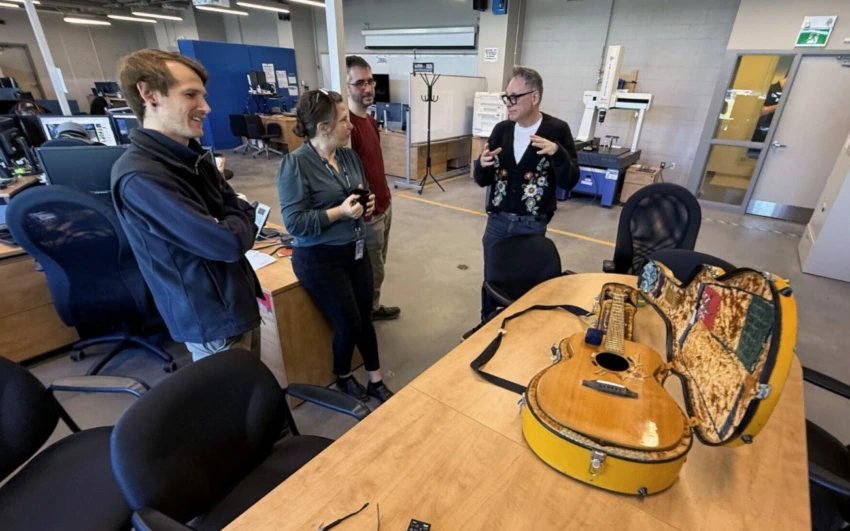
As Canadians celebrate Canada Day this July, Niagara College’s Walker Advanced Manufacturing Innovation Centre (WAMIC) is marking the occasion by helping preserve one of the country’s most unique cultural artifacts for future generations.
The iconic Voyageur guitar, the centrepiece of the Six String Nation project, has been digitally scanned and recreated by WAMIC to support the launch of an interactive online museum experience in honour of the guitar’s 20th anniversary. Created in 2006 by Canadian broadcaster and author Jowi Taylor, Voyageur incorporates 64 symbolic pieces representing the people, places, cultures, and defining moments of every Canadian province and territory.
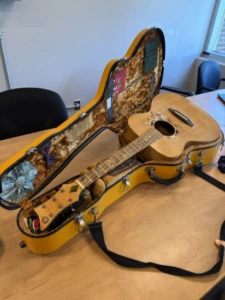
The Voyageur guitar before it was digitally scanned by the WAMIC team.
Neil Wilkinson, Associate Director of WAMIC, first learned about this potential project through NC’s Manager of Digital Media, Luke Gillett, who also serves as Chair of the Board of Six String Nation. During their discussions, Gillett shared the Board’s vision of creating a digital twin of the guitar, enabling people across Canada to engage with the instrument through immersive and interactive experiences. The project was a natural fit for WAMIC’s skills and expertise, and the partnership quickly took shape.
“Voyageur was built to connect us — not just to the diverse materials from every corner of this country, but to each other,” said Taylor. “By working with Niagara College to bring the guitar into the digital realm, we aren’t just creating a museum piece; we are opening up a new, accessible space where all Canadians, from students in a social studies classroom to citizens exploring our national history to newcomers seeking to better understand their new home from multiple perspectives, can discover these stories and engage in a vital dialogue about who we are, how we relate to each other, and what we can build together.”
Leading the technical work was Ty Lozon, a Mechanical Research Assistant and senior co-op student in NC’s Mechanical Engineering Technology program, under the supervision of Brock Husak, WAMIC’s Advanced Manufacturing Engineering Specialist. Together, they invested more than 80 hours of work to create highly accurate digital models of 132 individual components that make up the guitar.
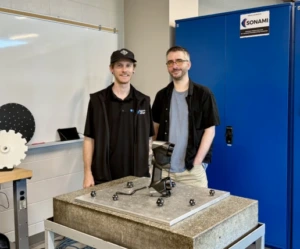
Brock Husak (L) and Ty Lozon invested more than 80 hours on the Voyageur project.
One of the project’s greatest challenges was not simply recreating the guitar as a single object but accurately modelling every individual piece that contributes to its story. Each component was digitally captured and recreated to within 1.5 millimetres of accuracy, allowing the virtual model to be disassembled and explored piece by piece.
“It was a fun project to work on,” said Lozon. “As we built the model, I found myself learning more about the guitar’s history and the significance of the materials it contains. It was rewarding to help bring that story into a digital format.”
To complete the work, the team used WAMIC’s Creaform HandySCAN BLACK laser scanner, advanced technology commonly used in manufacturing and product development. The scanner captures millions of precise data points from a physical object, allowing engineers to create detailed digital models through a process known as reverse engineering.
“We’re taking a physical object and reverse engineering it to create digital drawings and models,” explained Wilkinson. “Rather than designing something and then building it, we’re working backwards from the finished object. The technology allows us to capture complex shapes quickly and accurately, creating a highly detailed digital representation.”
While scanning the guitar itself was relatively straightforward, isolating and modelling each historical artifact embedded within the instrument required considerable effort.
“If we only modelled the guitar as a single object, it wouldn’t achieve the project’s goals,” said Wilkinson. “The value is in being able to separate the individual pieces and tell the story behind each one. Every fragment of wood, bone, stone, or metal has its own significance. Digitally capturing all of those components and then reassembling them into the complete guitar was a substantial undertaking by Ty and Brock.”
-
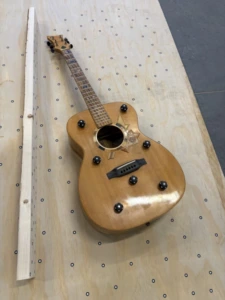
- The Voyageur guitar with scanning targets.
-
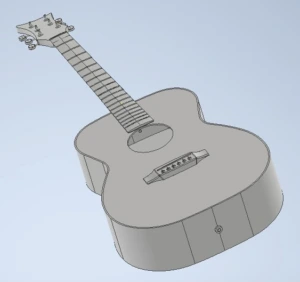
- A digital image of Voyageur created by the WAMIC team.
“Currently, experiencing the Voyageur is limited by the physical necessity of the guitar being present in a specific location,” said Gillett. “My goal is to break that barrier. We want to create an experience where people can explore the guitar in ways that aren’t possible in the physical world. By digitizing the instrument, we are unlocking access to individual pieces of Canadian history that are otherwise hidden in plain sight–whether it’s material from Haida Gwaii’s ‘Golden Spruce,’ Paul Henderson’s hockey stick from the ’72 Summit Series, or a canoe paddle belonging to Pierre Elliott Trudeau. We are creating a digital cornerstone to preserve and share this remarkable national story.'”
WAMIC’s digital scans represent the first phase of Six String Nation’s three-pillar initiative: an interactive WebGL experience, followed by the development of a physical interactive installation, and a specialized educational framework designed to integrate these resources into Canadian social studies and history curricula at the elementary, secondary, and post-secondary levels.
The project represents a unique intersection of advanced manufacturing technology, innovation, and Canadian history. It also marks a return visit for Voyageur to NC after first visiting the Welland campus in 2011 when creator Jowi Taylor presented it during Niagara Day celebrations.
About Six String Nation
The Six String Nation project is a registered non-profit dedicated to connecting Canadians through the stories embedded in Voyageur. As the project expands its digital reach, public support is vital. To learn more about the guitar’s history, explore the upcoming digital initiatives, or make a donation to support this national project, please visit www.sixstringnation.com/
