
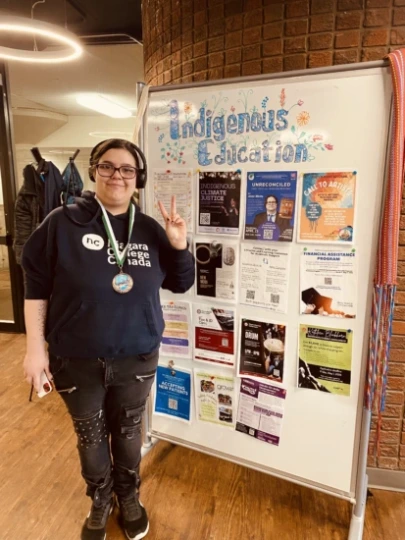
As Kayanna Saylor prepares to cross the convocation stage on June 11, she reflects on her NC journey that transformed both her sense of identity and her confidence. When she first arrived at NC, the Game Development student from St. Catharines was excited about stepping into a new chapter in her life but felt as though her inner fire was small, and her place within the college community was uncertain.
A Game Development grad in the School of Media from St. Catharines, Saylor knew she was Indigenous, but much of her identity had been hidden from her growing up. Rather than holding her back, that uncertainty became the foundation of a transformative journey, one shaped by discovery, support, and community nurtured through NC’s Indigenous Education (IE) department.
Saylor’s first connection to IE came before classes even began, through Paddle Forward, a land-based, experiential program designed to introduce incoming Indigenous students to culture, community, and campus life. The experience helped her step outside her comfort zone, build early relationships, and begin forming a meaningful connection to both the land and her identity.
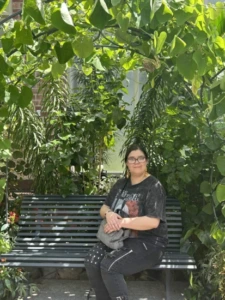
Kayanna Saylor travelled to New Zealand with NC’s IE team to participate in the World’s Indigenous Peoples Conference.
In her first year at NC, Saylor immersed herself in research with the help of the IE team, determined to understand her roots. That process eventually led her to a powerful discovery: her great-grandfather’s birth certificate, linking her family to Ohsweken, a rural community located within the Six Nations of the Grand River. But the journey wasn’t just about documents, it was about belonging.
“One of my biggest fears was taking up space that wasn’t meant for me,” Saylor explained. “But they (IE) made it clear that my story isn’t uncommon, and that our people were often disconnected from our communities. They took the time to meet with me, answer my questions, and help me learn about our people and our traditions in a respectful way which helped me feel more connected to my heritage.”
As she transitioned to NC life, that connection only deepened. The IE lounge quickly became a central part of her daily routine, not just a place to study, but as a consistent, welcoming environment where she felt safe, supported, and understood.
Through IE, Saylor accessed a wide range of services that supported her success holistically. Academic guidance, cultural teachings, and one-on-one mentorship helped her navigate coursework while also exploring her identity in a respectful and supported way.
As she continued her journey, the impact of those supports became even more significant. In her second year, Saylor was diagnosed with autism, giving her new insight into her learning and communication style. The IE team played a key role in helping her access resources, navigate her diagnosis, and implement academic accommodations tailored to her needs.
“The IE lounge became my safe space on campus,” said Saylor. “The staff work incredibly hard to support students transitioning into college and make sure everyone feels welcome. The support I received from the IE team had such a positive impact on me and they truly invested in me, not just as a student, but as a person.”
With that strong foundation, Saylor’s confidence and engagement grew, opening doors to new opportunities. In 2025, she received recognition for her resilience and commitment to education through a bursary award at the Indigenous Student Awards Banquet and later that year she was selected to attend the World’s Indigenous Peoples Conference in New Zealand through the Embark Student Foundation as part of the Indigenous Student Success Pathways Project. These experiences expanded her perspectives and reinforced the importance of Indigenous voices and connections on a global scale.
Back on campus, Saylor became a leading advocate for accessibility in design, drawing on her lived experience to help create more inclusive gameplay systems in her third-year game project. Her team earned third place for Achievement in Accessibility at the Level Up Showcase in Toronto, an annual event featuring more than 160 post-secondary teams from across Ontario.
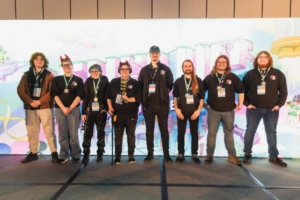
Kayanna Saylor (fourth from left) with her team at Level Up.
Even before her graduation date, Saylor has already been building her career in the gaming industry. She is working with Little Buffalo Studios on an Indigenous-led game project, continuing her focus on representation and accessibility. Her goal is to help shape a future where Indigenous stories are visible in games and where all players can see themselves reflected.
“As a department, we’ve all had the privilege of watching Kayanna grow since the day we first met her,” said Jessica Winger, Indigenous Student Success Leader. “We are incredibly proud of her journey at NC. The perseverance she has shown while navigating challenges throughout her program has been truly admirable. Despite those challenges, she remained focused on reaching the finish line and on using her voice to address gaps she saw in the gaming industry. I have no doubt she will build an incredible career for herself. Her perspective is needed, and we are all honoured to have been part of her story. I can’t wait to see her walk across the convocation stage.”
“Game development is challenging and when you truly devote yourself to it, it takes everything,” said Saylor. “But it’s worth it when you can give people a sense of hope or happiness or make them feel something meaningful. Games create experiences that stay with people and can even change how they see the world.”
As she approaches convocation, Saylor reflects on her time at NC by describing her growth through two powerful images: fire and water.
“When I started at NC, my fire was small and my stream felt empty,” she said. “Over time, the IE staff helped me tend that fire and bring life back to my stream. Now, my fire is strong, and my stream has become a flowing river and that’s because of the support I received from the Centre. They’ve helped me grow into a better person. I’m more confident using my voice, and I truly don’t think I’d be where I am today without their immense support.”
Saylor’s story is one of transformation, not just as a student, but as a person reclaiming identity, building confidence, and creating space for others to do the same. Her journey is a powerful example of what’s possible when students are supported, seen, and encouraged to find their voice and as she steps into the next chapter, one thing is clear: her fire is only getting started.
