
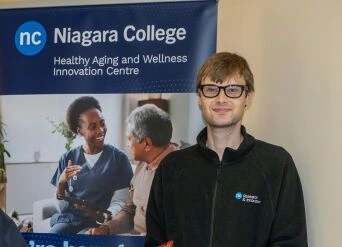
Matthew Bosnich didn’t have to go far to find his dream career. Long before he officially graduated from Recreation Therapy on June 9, this Welland resident began putting his skills to work on campus as part of NC’s Healthy Aging and Wellness Innovation Centre (HAWIC).
Since completing the program last year, the new NC grad has been working as a HAWIC – the latest innovation centre from the College’s trailblazing Research and Innovation division – as a Research Associate. Alongside Research Lead Christine Wilkinson and the HAWIC Team, he’s been working to help shift perspectives on senior care, transforming evidence-based theory into real-world solutions that improve the quality of life for older adults. From leveraging robotic animals to help seniors living with dementia, to investigating fairer driving assessment tools for those in the “Gray Zone,” Bosnich is proving that when it comes to supporting our aging population, the possibilities are limitless.
InsideNC caught up with Bosnich and asked about some of his work at HAWIC. Here is what he had to say:
How were you first involved with the Fins, Feathers and Fur initiative?
I started as a Research Assistant for Christine Wilkinson on a Photovoice project exploring what “academic success” meant to students. That led to me supporting her on the Fins and Feathers project. At first, I was helping format and build the project’s toolkit boxes and helping with the logo design.
I took part in the first pilot training at Linhaven Long-Term Care home in the spring of 2025, assisting with set-up, facilitation, and take-down. From there, I helped transcribe post-session interviews and prepared a data analysis presentation. In the fall, I assembled toolkit sets–including robotic birds and seals–for our partner LTC homes, and developed a pricing list to help us scale production.
How did you feel about being involved in this initiative as a student?
It was an excellent opportunity to bridge classroom learning with the real world. We learned about evidence-based practice in the Recreation Therapy program, and this really enforced how important research is in ensuring that our interventions are effective. There should always be a purpose behind what we do for our clients!
What are you now doing for the project in your full-time role?
Since starting full-time in January, I’ve been developing new resources for our toolkits, creating promotional materials, and planning the rollout of a study comparing robotic cat and dog models. We are currently working on training for the “Fur” addition to the project. I also had the opportunity to attend the 2026 International Society for Gerontechnology Conference in Vancouver with Christine to promote the work we are doing at HAWIC. That was a really cool experience.
What inspired you to take on this staff position with HAWIC?
I had never considered a research career before, but after a year as a Research Assistant, the opportunity to contribute more to what is being built with HAWIC was too good to pass up. It’s a great feeling to see a project develop from its early stages to a point where it is making a meaningful impact in the community. I felt I had the right skill set to contribute meaningfully.
How do you feel about the robotic animals research?
It is inspiring and incredibly important. We hear a lot about the detrimental effects of loneliness in long-term care. These robots aren’t often utilized to their full potential, but our toolkits help recreation professionals deliver meaningful interactions. They become more than just a comfortable distraction; they stir deep conversations, such as reminiscing about a childhood pet, which helps fulfill social and emotional needs.
What do you find rewarding about this work?
Knowing that our work makes a real, positive impact on the lives of older adults. It is also rewarding to help fellow recreation therapy students and professionals develop the skills they need to best serve their residents.
Do you have a favourite robotic animal or experience?
The PARO seal is a favourite. We see such wonderful reactions from residents–the smiles and physical responses we captured during our training videos at Linhaven were really heartwarming. I can’t wait to see what we discover with the robotic cat and dog research!
Tell me about the driving simulator study you presented at the Niagara Health Knowledge Institute (NHKI) Research Day in May.
The project, “From Cognitive Assessments to Road Readiness,” is a collaboration between Niagara College, the Alzheimer Society of Niagara Region, the Centre for Research on Safe Driving at Lakehead University, and several other health partners. We are exploring if a driving simulator can act as a fairer assessment tool for older adults in the “Gray Zone”–those diagnosed with a cognitive impairment who hold a valid license but face uncertain driving safety. We are testing the simulator at Niagara College to see if participants find it a valuable and acceptable part of the assessment process.
How do you feel about being involved with the driving simulator project?
It’s been a great opportunity to refine my research coordination skills. It’s a very meaningful project; our findings will hopefully lead to a more accessible, fairer assessment option for those who are still safe drivers.
Tell us about your experience presenting the research poster at this industry event?
I had never done a poster presentation before, so it was a great accomplishment to prepare for the event and present our learnings. It gave me the chance to connect with group members and discuss potential for further collaboration.
Matthew Bosnich’s convocation ceremony was on the afternoon of June 9.
